
Metallurgical Engineering
GATE MT format:mcq PYQs
Build your understanding with focused practice from past exam papers.
Questions 341–350 of 379. Imported answers require independent review unless marked reviewed.
Question 37
Open questionMTMCQ2 marksNeeds review
Consider a dilute substitutional solid solution of X in a metal A. The powder diffraction pattern of this alloy reveals that all the peaks have shifted to the left when compared to those for pure A (with no split of peaks). If such a solute interacts and segregates to an edge dislocation, which of the following positions around the dislocation will it preferentially occupy?
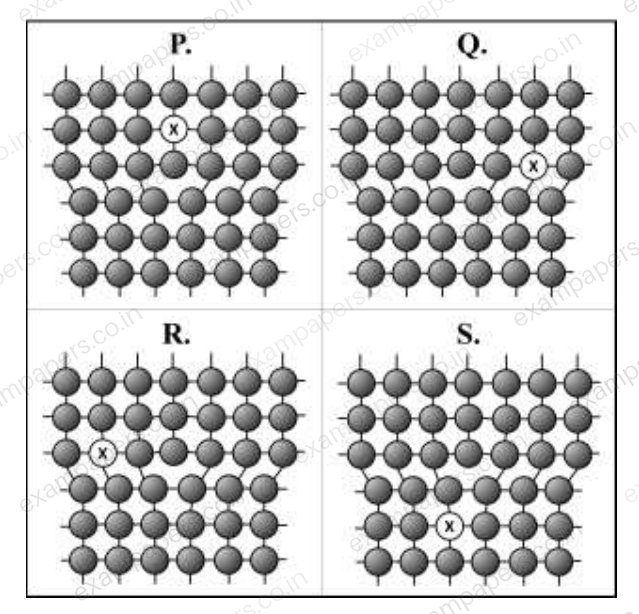
Your answerChoose one option.
Log in to check the answer
You can attempt this question now. Sign in to view the answer key, explanations and discussion.Log in to check answerQuestion 38
Open questionMTMCQ2 marksNeeds review
A classroom of 20 students can be categorized on the basis of blood-types: 5 students each with “A”, “B”, “AB”, and “O” blood-types. If four students are selected at random from this class, what is the probability that each student has a different blood-type?
Your answerChoose one option.
Log in to check the answer
You can attempt this question now. Sign in to view the answer key, explanations and discussion.Log in to check answerQuestion 39
Open questionMTMCQ2 marksNeeds review
If the solid-liquid interface energy increases by 10%, the energy barrier for homogeneous nucleation of a spherical solid from the liquid, will change by:
Your answerChoose one option.
Log in to check the answer
You can attempt this question now. Sign in to view the answer key, explanations and discussion.Log in to check answerQuestion 40
Open questionMTMCQ2 marksNeeds review
Consider the following stress state imposed on a material:
. If the material responds elastically with a volumetric strain
, what is its bulk modulus?Your answerChoose one option.
Log in to check the answer
You can attempt this question now. Sign in to view the answer key, explanations and discussion.Log in to check answerQuestion 1
Open questionMTMCQ1 markNeeds review
For the matrix,
,
isYour answerChoose one option.
Log in to check the answer
You can attempt this question now. Sign in to view the answer key, explanations and discussion.Log in to check answerQuestion 2
Open questionMTMCQ1 markNeeds review
The mean of a numerical data-set is
and the standard deviation is
. If a number
is added to each term in the data-set then the mean and standard deviation become:Your answerChoose one option.
Log in to check the answer
You can attempt this question now. Sign in to view the answer key, explanations and discussion.Log in to check answerQuestion 3
Open questionMTMCQ1 markNeeds review
If
then at
, the function
isYour answerChoose one option.
Log in to check the answer
You can attempt this question now. Sign in to view the answer key, explanations and discussion.Log in to check answerQuestion 4
Open questionMTMCQ1 markNeeds review
The pressure (P) versus volume (V) diagram given below represents reversible isothermal curves at temperatures, T1, T2 and T3.
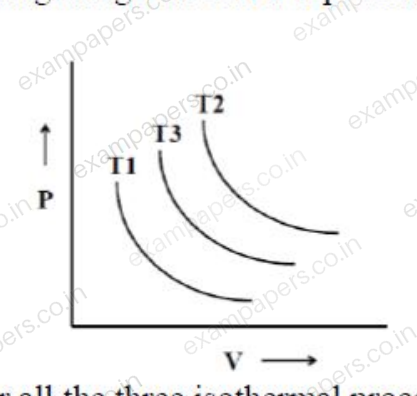
Considering one mole of ideal gas for all the three isothermal processes, which one of the following is TRUE?
Your answerChoose one option.
Log in to check the answer
You can attempt this question now. Sign in to view the answer key, explanations and discussion.Log in to check answerQuestion 5
Open questionMTMCQ1 markNeeds review
For the electrochemical reaction, Cu²⁺ + Zn = Zn²⁺ + Cu, the standard cell potential at 25°C and 1 atm pressure is:
(Given: E° (Cu²⁺/Cu) = 0.337 V and E° (Zn²⁺/Zn) = −0.763 V)
Your answerChoose one option.
Log in to check the answer
You can attempt this question now. Sign in to view the answer key, explanations and discussion.Log in to check answerQuestion 6
Open questionMTMCQ1 markNeeds review
The rate of dissolution of Al particles in liquid steel is proportional to concentration difference (ΔC). ΔC is defined by:
(Given: (i) C_b = bulk concentration of dissolved Al in liquid steel, (ii) C* = saturation concentration of Al in liquid steel at the given temperature, (iii) C_m = Density of Al/Atomic weight of Al.)
Your answerChoose one option.
Log in to check the answer
You can attempt this question now. Sign in to view the answer key, explanations and discussion.Log in to check answer