
Metallurgical Engineering
GATE MT format:nat PYQs
Build your understanding with focused practice from past exam papers.
Questions 181–190 of 232. Imported answers require independent review unless marked reviewed.
Question 53
Open questionMTNAT2 marksNeeds review
If the solid-solid interfacial energy (
) is 0.87
and solid-liquid interfacial energy (
) is 0.5
, the dihedral angle (
, in degree, rounded off to one decimal place) during sintering is ________.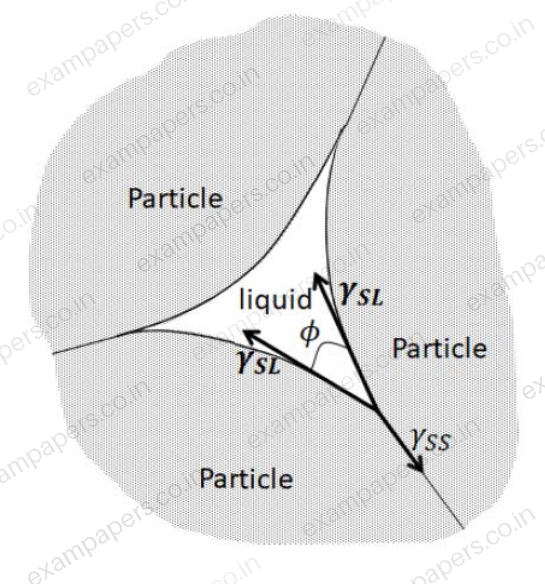
Log in to check the answer
You can attempt this question now. Sign in to view the answer key, explanations and discussion.Log in to check answerQuestion 54
Open questionMTNAT2 marksNeeds review
The maximum possible reduction (in mm, rounded off to one decimal place) of a 100 mm thick slab during rolling is ________.
Given: The coefficient of friction between roll and the slab is 0.2, and the roll diameter is 200 mm.
Log in to check the answer
You can attempt this question now. Sign in to view the answer key, explanations and discussion.Log in to check answerQuestion 55
Open questionMTNAT2 marksNeeds review
An arc welding is performed at 400 Amperes, 20 V at a traverse speed of 5
. If the heat transfer efficiency is 0.6, the energy input per unit length (in
, rounded off to the nearest integer) during the process is ________.Log in to check the answer
You can attempt this question now. Sign in to view the answer key, explanations and discussion.Log in to check answerQuestion 22
Open questionMTNAT1 markNeeds review
In the A-rich end of the A-B binary eutectic phase diagram (shown below), the solid and liquidus are straight lines.
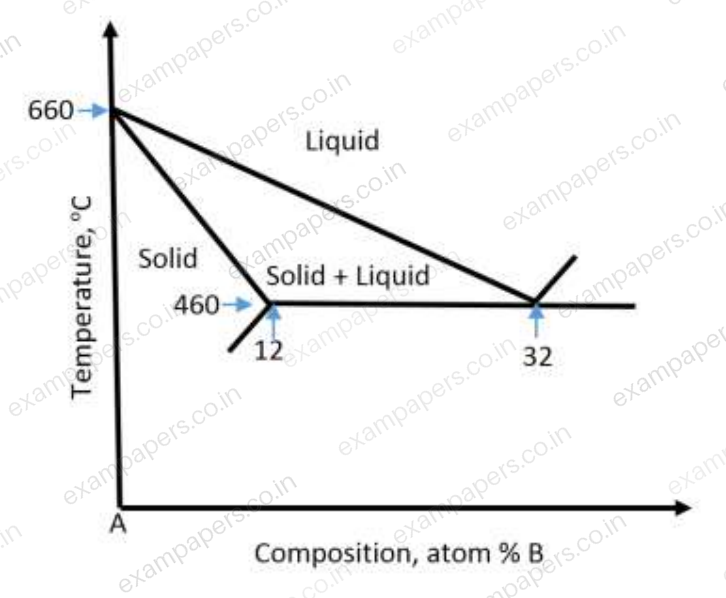
The freezing range of the alloy with 16% B is ________ (in °C to one decimal place)
Log in to check the answer
You can attempt this question now. Sign in to view the answer key, explanations and discussion.Log in to check answerQuestion 23
Open questionMTNAT1 markNeeds review
A vector field is given as follows:
The divergence of this field evaluated at
is ______________ .Log in to check the answer
You can attempt this question now. Sign in to view the answer key, explanations and discussion.Log in to check answerQuestion 24
Open questionMTNAT1 markNeeds review
A plate of thickness h = 120 mm is cold rolled in a mill with a roll diameter of 200 mm. If the coefficient of friction
is 0.1, the maximum possible reduction
in a single pass is ______ (in mm to one decimal place)Log in to check the answer
You can attempt this question now. Sign in to view the answer key, explanations and discussion.Log in to check answerQuestion 25
Open questionMTNAT1 markNeeds review
A copper-aluminium diffusion couple develops a certain concentration profile after an isothermal treatment at 600°C for 10 hours. The time required to achieve the same concentration profile at 500°C is ________ (in hours to 1 decimal place)
Given: The interdiffusion coefficient for copper in aluminium at 500°C and 600°C are
and
.Log in to check the answer
You can attempt this question now. Sign in to view the answer key, explanations and discussion.Log in to check answerQuestion 41
Open questionMTNAT2 marksNeeds review
A continuous and aligned carbon-fiber composite consists of 25 vol. % of fibers in an epoxy matrix. The Young’s modulus of fiber and matrix, respectively are
and
. If the composite is subjected to longitudinal loading (iso-strain condition and assuming elastic response), the fraction of load borne by the reinforcement is ______ (to two decimal places)Log in to check the answer
You can attempt this question now. Sign in to view the answer key, explanations and discussion.Log in to check answerQuestion 42
Open questionMTNAT2 marksNeeds review
Pure iron transforms from body centered cubic (BCC) to face centered cubic (FCC) crystal structure at 912 °C. If the lattice parameter of the BCC phase is 0.293 nm and that of the FCC phase is 0.363 nm, the associated volume change is ______ (in % to one decimal place)
Log in to check the answer
You can attempt this question now. Sign in to view the answer key, explanations and discussion.Log in to check answerQuestion 43
Open questionMTNAT2 marksNeeds review
As shown in schematic below, an alloy is cast as a rectangular slab between two thick mould walls that differ in their thermal conductivities. Shrinkage defects are found at a distance L1 from Mould-1 with thermal conductivity
and distance L2 from Mould-2 with thermal conductivity
. If the ratio L1:L2 = 3:2, and assuming 1-D heat transfer, the ratio
is ______ (to two decimal places) 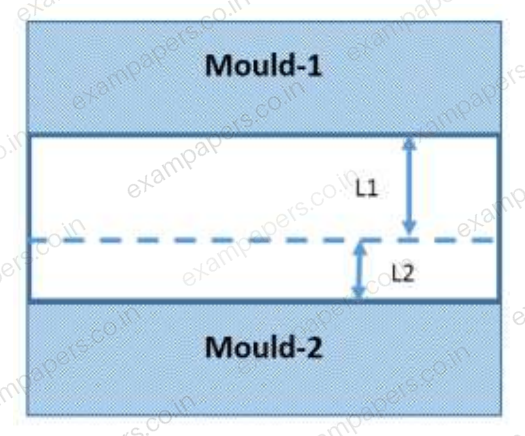
Log in to check the answer
You can attempt this question now. Sign in to view the answer key, explanations and discussion.Log in to check answer