
Metallurgical Engineering
GATE MT Hot, warm and cold working of metals PYQs
Build your understanding with focused practice from past exam papers.
Questions 21–30 of 31. Imported answers require independent review unless marked reviewed.
Question 22
Open questionMTMCQ1 markNeeds review
Alligatoring is a defect commonly observed in ____________.
Your answerChoose one option.
Log in to check the answer
You can attempt this question now. Sign in to view the answer key, explanations and discussion.Log in to check answerQuestion 25
Open questionMTNAT1 markNeeds review
A plate of width 100 cm and thickness 5 cm is rolled to a thickness of 3 cm. If the entry velocity is 10 cm s⁻¹, the exit velocity of the plate (in cm s⁻¹, rounded off to one decimal place) is ____________.
Assume no change in the width of the plate.
Log in to check the answer
You can attempt this question now. Sign in to view the answer key, explanations and discussion.Log in to check answerQuestion 34
Open questionMTMCQ2 marksNeeds review
Match the automobile components in Column I with the corresponding manufacturing process in Column II.
Column I: Automobile components
(P) Engine block
(Q) Brake pad
(R) Connecting rod
(S) Door panel
Column II: Manufacturing process
Forging
Sheet metal forming
Casting
Powder metallurgy
Your answerChoose one option.
Log in to check the answer
You can attempt this question now. Sign in to view the answer key, explanations and discussion.Log in to check answerQuestion 54
Open questionMTNAT2 marksNeeds review
The maximum possible reduction (in mm, rounded off to one decimal place) of a 100 mm thick slab during rolling is ________.
Given: The coefficient of friction between roll and the slab is 0.2, and the roll diameter is 200 mm.
Log in to check the answer
You can attempt this question now. Sign in to view the answer key, explanations and discussion.Log in to check answerQuestion 7
Open questionMTMCQ1 markNeeds review
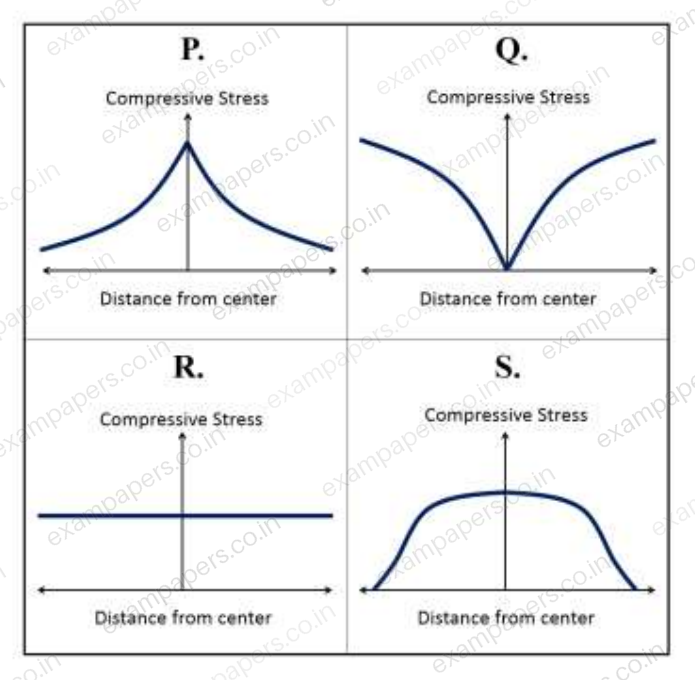
During upset forging, and considering friction, which of the following profiles represents the axial compressive stress?
Note: In these profiles, the absolute value of the axial compressive stress is plotted on the y-axis.
Your answerChoose one option.
Log in to check the answer
You can attempt this question now. Sign in to view the answer key, explanations and discussion.Log in to check answerQuestion 24
Open questionMTNAT1 markNeeds review
A plate of thickness h = 120 mm is cold rolled in a mill with a roll diameter of 200 mm. If the coefficient of friction
is 0.1, the maximum possible reduction
in a single pass is ______ (in mm to one decimal place)Log in to check the answer
You can attempt this question now. Sign in to view the answer key, explanations and discussion.Log in to check answerQuestion 36
Open questionMTMCQ2 marksNeeds review
Match the manufacturing processes in Group 1, with the types of cracks in Group 2:
Group 1
P. Arc welding
Q. Extrusion
R. Draw
S. Rolling
Group 2
Edge crack
Chevron crack
Surface crack
Liquation crack
Your answerChoose one option.
Log in to check the answer
You can attempt this question now. Sign in to view the answer key, explanations and discussion.Log in to check answerQuestion 55
Open questionMTNAT2 marksNeeds review
The ideal plastic work involved in extruding a cylindrical billet of length 100 mm, from an initial diameter of 20 mm to a final diameter of 16 mm is ______ (in J to one decimal place). The flow stress in compression is 40 MPa, and remains constant throughout the process.
Log in to check the answer
You can attempt this question now. Sign in to view the answer key, explanations and discussion.Log in to check answerQuestion 22
Open questionMTNAT1 markNeeds review
A material, which shows power law behavior, σ̄ = 50ε̄^0.3, is being wire drawn. The maximum strain per pass in annealed condition (assume ideal work and efficiency η = 1) is __________ (answer up to two decimal places)
Log in to check the answer
You can attempt this question now. Sign in to view the answer key, explanations and discussion.Log in to check answerQuestion 23
Open questionMTMCQ1 markNeeds review
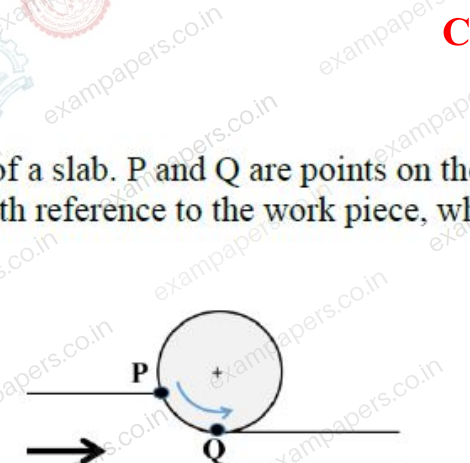
Schematic diagram shows rolling of a slab. P and Q are points on the surface of the workpiece near entrance and exit, respectively. With reference to the work piece, which one of the following statements is TRUE?
Your answerChoose one option.
Log in to check the answer
You can attempt this question now. Sign in to view the answer key, explanations and discussion.Log in to check answer