
Metallurgical Engineering
GATE MT Laws of thermodynamics PYQs
Build your understanding with focused practice from past exam papers.
Questions 61–69 of 69. Imported answers require independent review unless marked reviewed.
Question 53
Open questionMTNAT2 marksNeeds review
A 1 mol piece of copper at 400 K is brought in contact with another 1 mol piece of copper at 300 K, and allowed to reach thermal equilibrium. The entropy change for this process is ______ (in J K
to three decimal places) Given: Specific heat capacity of copper (between 250 K and 500 K) is 22.6 J K
mol
. Assume that the system containing the two pieces of copper remains isolated during this process.Log in to check the answer
You can attempt this question now. Sign in to view the answer key, explanations and discussion.Log in to check answerQuestion 4
Open questionMTMCQ1 markNeeds review
The pressure (P) versus volume (V) diagram given below represents reversible isothermal curves at temperatures, T1, T2 and T3.
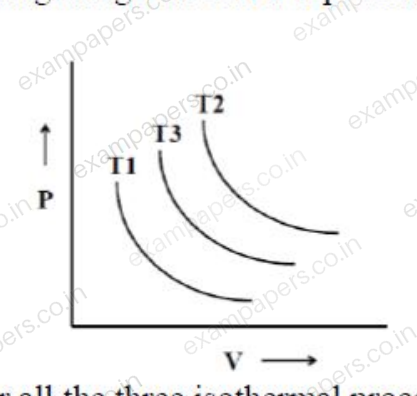
Considering one mole of ideal gas for all the three isothermal processes, which one of the following is TRUE?
Your answerChoose one option.
Log in to check the answer
You can attempt this question now. Sign in to view the answer key, explanations and discussion.Log in to check answerQuestion 7
Open questionMTNAT1 markNeeds review
Hydrogen dissolves in Pd by the reaction H₂ = 2 [H]. At 300°C and P_H₂ = 1 atm, the solubility of hydrogen in Pd is 1.64 × 10⁴ mm³ (STP) per kg of Pd. At 300°C and P_H₂ = 0.09 atm, the solubility of hydrogen in Pd in mm³ (STP) per kg of Pd is __________ (answer up to one decimal place)
Log in to check the answer
You can attempt this question now. Sign in to view the answer key, explanations and discussion.Log in to check answerQuestion 31
Open questionMTMCQ2 marksNeeds review
and
are the melting points of pure metal A and pure stoichiometric oxide
, respectively, and
. The stoichiometric metal oxidation reaction
is in equilibrium at 1 atm pressure at temperature less than
. If the temperature increases, which schematic represents the correct standard free energy change versus temperature plot?Your answerChoose one option.
Log in to check the answer
You can attempt this question now. Sign in to view the answer key, explanations and discussion.Log in to check answerQuestion 35
Open questionMTNAT2 marksNeeds review
CaCO
(s) dissociates in a closed system according to the reaction:
CaCO
(s) = CaO(s) + CO
(g)
Assuming the reaction is in thermodynamic equilibrium, the degree(s) of freedom, F = __________Log in to check the answer
You can attempt this question now. Sign in to view the answer key, explanations and discussion.Log in to check answerQuestion 37
Open questionMTNAT2 marksNeeds review
In primary steelmaking, dissolved oxygen (O) reacts with carbon (C) to produce CO (g), at 1 atm pressure according to the reaction: C + O = CO (g). The equilibrium constant for this reaction is
, where T is in Kelvin. Assuming Henrian activity coefficient of both O and C to be unity, the dissolved oxygen content (in wt.%) of plain carbon steel melt with 0.7 wt.% C at 1600°C is __________ (answer up to four decimal places)Log in to check the answer
You can attempt this question now. Sign in to view the answer key, explanations and discussion.Log in to check answerQuestion 41
Open questionMTMCQ2 marksNeeds review
Pure metals A and B form two real binary solid solutions α and β at temperature T and pressure P. The free energy versus composition plots for both the solutions are shown below.
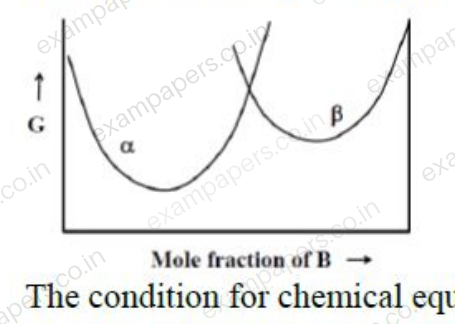
The condition for chemical equilibrium is:
Your answerChoose one option.
Log in to check the answer
You can attempt this question now. Sign in to view the answer key, explanations and discussion.Log in to check answerQuestion 42
Open questionMTNAT2 marksNeeds review
Pure orthorhombic sulfur transforms to stable monoclinic sulfur above 368.5 K. Applying Third law of thermodynamics, the value of entropy (in J K
) of transformation at 368.5 K is __________ (answer up to two decimal places)Given:
i. Entropy change associated with heating orthorhombic sulfur from 0 K to 368.5 K is 36.86 J K
.
ii. Entropy change associated with cooling monoclinic sulfur from 368.5 K to 0 K is −37.8 J K
.Log in to check the answer
You can attempt this question now. Sign in to view the answer key, explanations and discussion.Log in to check answerQuestion 44
Open questionMTNAT2 marksNeeds review
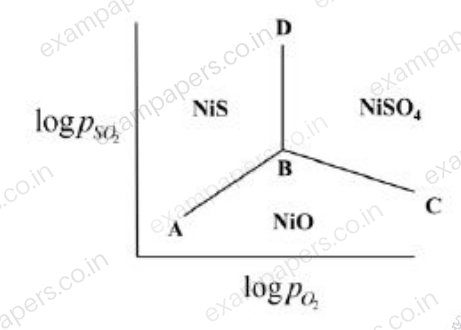
Assuming the solid phases to be pure, the slope of line BC in the predominance area diagram schematically shown below is ________ (answer up to two decimal places)
Log in to check the answer
You can attempt this question now. Sign in to view the answer key, explanations and discussion.Log in to check answer