
Metallurgical Engineering
GATE MT Principles of heat treatment of steels, TTT and CT diagrams; Surface hardening treatments; Recovery, recrystallization and grain growth; Heat treatment of cast iron and aluminium alloys. PYQs
Build your understanding with focused practice from past exam papers.
How to practice Principles of heat treatment of steels, TTT and CT diagrams; Surface hardening treatments; Recovery, recrystallization and grain growth; Heat treatment of cast iron and aluminium alloys.
Attempt a question, record the concept and assumptions, then check the available answer. Rework mistakes after revising the relevant concepts. Topic tags can overlap; review the question context.
Questions 1–10 of 10. Imported answers require independent review unless marked reviewed.
Question 42
Open questionMTMCQ2 marksNeeds review
The microstructures of a quenched steel tempered at three temperatures
for a fixed time are schematically illustrated. The solid circles represent cementite particles in ferrite matrix;
,
and
are average radii of cementite particles, and
,
and
are volume fractions of cementite at temperatures
,
and
, respectively. If the cementite in steel is more noble than ferrite, then which one of the three microstructures will have the highest corrosion rate when exposed to an aqueous solution of 3.5 wt. % NaCl? 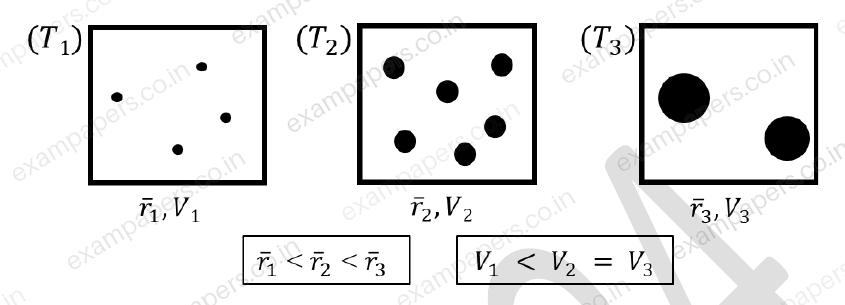
Your answerChoose one option.
Log in to check the answer
You can attempt this question now. Sign in to view the answer key, explanations and discussion.Log in to check answerQuestion 50
Open questionMTMSQ2 marksNeeds review
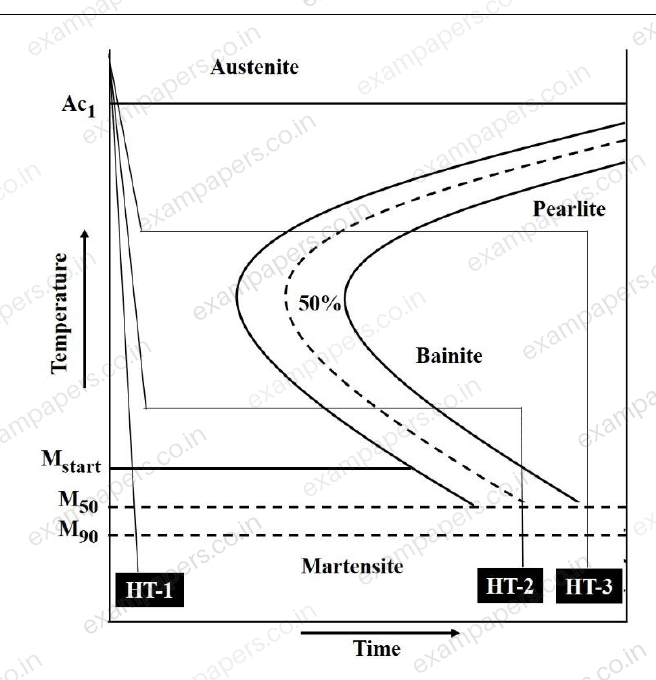
For the given schematic TTT diagram of an eutectoid steel, the following statement(s) is/are true for the heat treatment schedules HT-1, HT-2, and HT-3.
Your answerSelect all correct options. You can choose more than one.
Log in to check the answer
You can attempt this question now. Sign in to view the answer key, explanations and discussion.Log in to check answerQuestion 22
Open questionMTMCQ1 markNeeds review
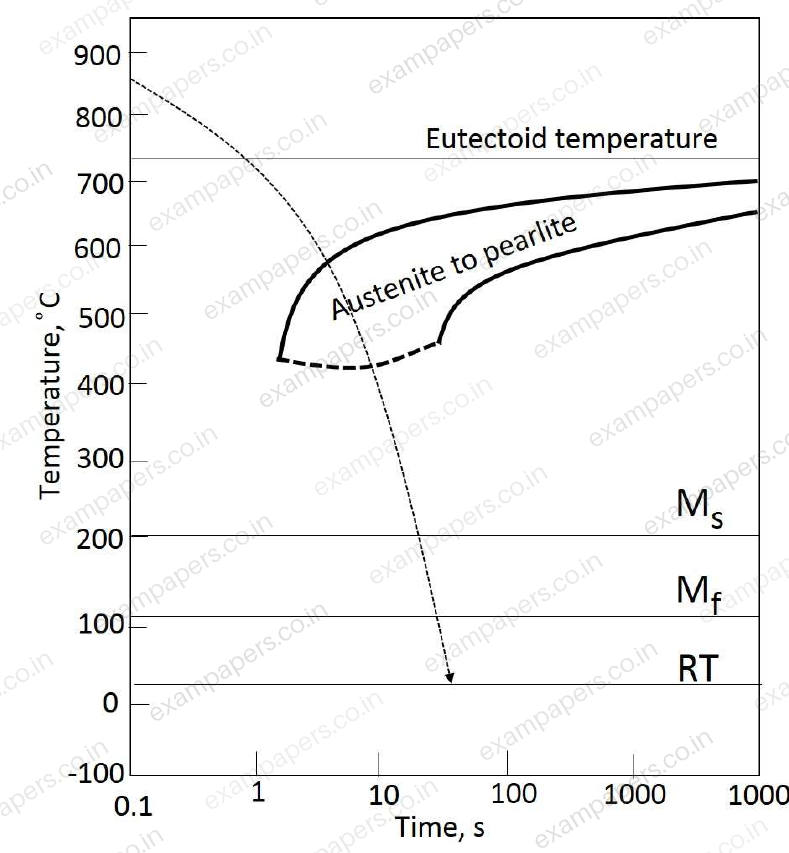
The CCT diagram of a eutectoid steel with a superposed cooling curve is shown in the figure. The microstructure at room temperature (RT) after this heat treatment is ____________
Your answerChoose one option.
Log in to check the answer
You can attempt this question now. Sign in to view the answer key, explanations and discussion.Log in to check answerQuestion 31
Open questionMTMSQ1 markNeeds review
Identify the correct statement(s) with respect to the role of nickel as an alloying element in steels.
Your answerSelect all correct options. You can choose more than one.
Log in to check the answer
You can attempt this question now. Sign in to view the answer key, explanations and discussion.Log in to check answerQuestion 9
Open questionMTMCQ1 markNeeds review
Which one of the following elements alloyed with iron is a ferrite stabilizer?
Your answerChoose one option.
Log in to check the answer
You can attempt this question now. Sign in to view the answer key, explanations and discussion.Log in to check answerQuestion 10
Open questionMTMCQ1 markNeeds review
Which one of the following is the correct decreasing sequence of Quenching Power for quenchants used in heat treatment of steels?
Your answerChoose one option.
Log in to check the answer
You can attempt this question now. Sign in to view the answer key, explanations and discussion.Log in to check answerQuestion 20
Open questionMTMCQ1 markNeeds review
A heavily cold-worked metal will
Your answerChoose one option.
Log in to check the answer
You can attempt this question now. Sign in to view the answer key, explanations and discussion.Log in to check answerQuestion 18
Open questionMTMCQ1 markNeeds review
In a Jominy end-quench test of the eutectoid plain-carbon steel, which of the following represents the sequence of microstructures observed from the quenched end of the specimen?
Your answerChoose one option.
Log in to check the answer
You can attempt this question now. Sign in to view the answer key, explanations and discussion.Log in to check answerQuestion 20
Open questionMTMCQ1 markNeeds review
A steel is plastically worked in the temperature range below the nose of the TTT curve and above M
, followed by quenching to produce fine martensite. What is this process called?Your answerChoose one option.
Log in to check the answer
You can attempt this question now. Sign in to view the answer key, explanations and discussion.Log in to check answerQuestion 49
Open questionMTNAT2 marksNeeds review
During heat treatment of a cold worked metal, recrystallization is 20% complete after 100 s. The transformation (in %) in 400 s is ________ (answer up to two decimal places)
(Assume Avrami exponent, n = 2)
Log in to check the answer
You can attempt this question now. Sign in to view the answer key, explanations and discussion.Log in to check answer