
Metallurgical Engineering
GATE MT Spatial Aptitude PYQs
Build your understanding with focused practice from past exam papers.
How to practice Spatial Aptitude
Attempt a question, record the concept and assumptions, then check the available answer. Rework mistakes after revising the relevant concepts. Topic tags can overlap; review the question context.
Questions 1–10 of 14. Imported answers require independent review unless marked reviewed.
Question 3
Open questionGAMCQ1 markNeeds review
The next figure (indicated by ‘?’) in the sequence is
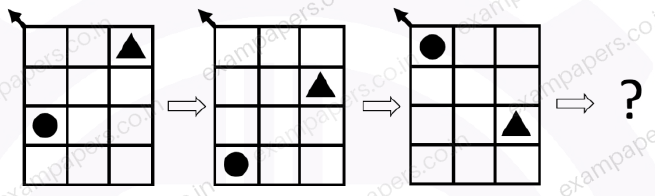
Your answerChoose one option.
Log in to check the answer
You can attempt this question now. Sign in to view the answer key, explanations and discussion.Log in to check answerQuestion 10
Open questionGAMCQ2 marksNeeds review
Which one of the patterns labelled P, Q, R, and S is used to generate the following figure?
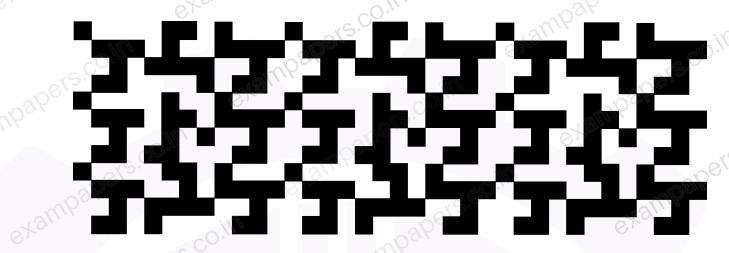
Your answerChoose one option.
Log in to check the answer
You can attempt this question now. Sign in to view the answer key, explanations and discussion.Log in to check answerQuestion 4
Open questionGAMCQ1 markNeeds review
The paper as shown in the figure is folded to make a cube where each square corresponds to a particular face of the cube. Which one of the following options correctly represents the cube?
Note: The figures shown are representative.
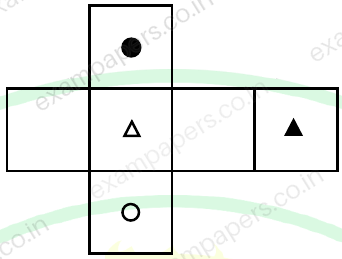
Your answerChoose one option.
Log in to check the answer
You can attempt this question now. Sign in to view the answer key, explanations and discussion.Log in to check answerQuestion 10
Open questionGAMCQ2 marksNeeds review
The least number of squares to be added in the figure to make AB a line of symmetry is
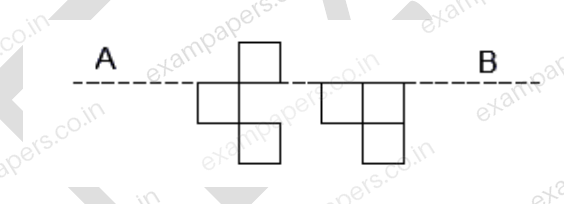
Your answerChoose one option.
Log in to check the answer
You can attempt this question now. Sign in to view the answer key, explanations and discussion.Log in to check answerQuestion 3
Open questionGAMCQ1 markNeeds review
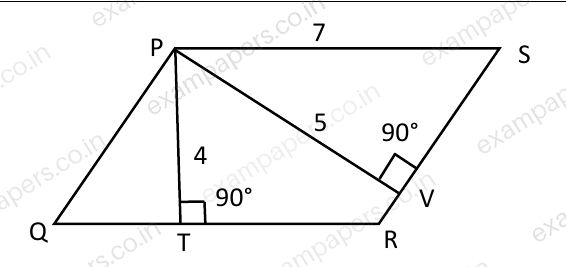
In the given figure, PQRS is a parallelogram with PS = 7 cm, PT = 4 cm and PV = 5 cm. What is the length of RS in cm? (The diagram is representative.)
Your answerChoose one option.
Log in to check the answer
You can attempt this question now. Sign in to view the answer key, explanations and discussion.Log in to check answerQuestion 5
Open questionGAMCQ1 markNeeds review
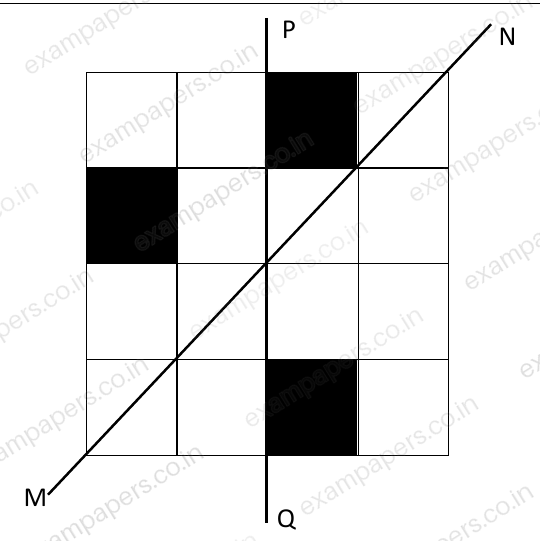
A line of symmetry is defined as a line that divides a figure into two parts in a way such that each part is a mirror image of the other part about that line.
The given figure consists of 16 unit squares arranged as shown. In addition to the three black squares, what is the minimum number of squares that must be colored black, such that both PQ and MN form lines of symmetry? (The figure is representative)
Your answerChoose one option.
Log in to check the answer
You can attempt this question now. Sign in to view the answer key, explanations and discussion.Log in to check answerQuestion 10
Open questionGAMCQ2 marksNeeds review
Which one of the following shapes can be used to tile (completely cover by repeating) a flat plane, extending to infinity in all directions, without leaving any empty spaces in between them? The copies of the shape used to tile are identical and are not allowed to overlap.
Your answerChoose one option.
Log in to check the answer
You can attempt this question now. Sign in to view the answer key, explanations and discussion.Log in to check answerQuestion 4
Open questionGAMCQ1 markNeeds review
The figure shows a grid formed by a collection of unit squares. The unshaded unit square in the grid represents a hole.
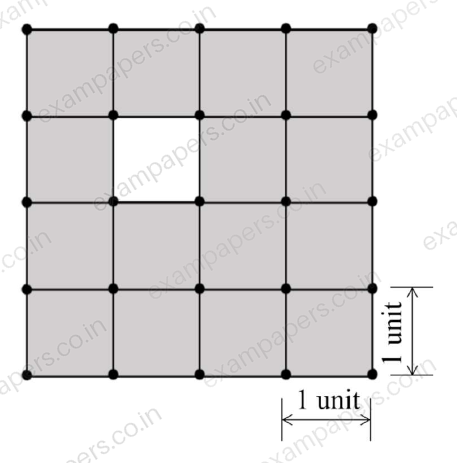
What is the maximum number of squares without a “hole in the interior” that can be formed within the 4 × 4 grid using the unit squares as building blocks?
Your answerChoose one option.
Log in to check the answer
You can attempt this question now. Sign in to view the answer key, explanations and discussion.Log in to check answerQuestion 5
Open questionGAMCQ1 markNeeds review
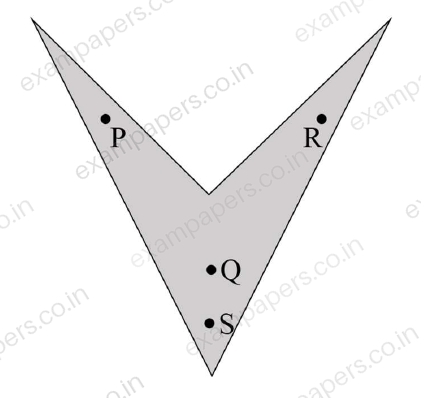
An art gallery engages a security guard to ensure that the items displayed are protected. The diagram below represents the plan of the gallery where the boundary walls are opaque. The location the security guard posted is identified such that all the inner space (shaded region in the plan) of the gallery is within the line of sight of the security guard. If the security guard does not move around the posted location and has a 360° view, which one of the following correctly represents the set of ALL possible locations among the locations P, Q, R and S, where the security guard can be posted to watch over the entire inner space of the gallery?
Your answerChoose one option.
Log in to check the answer
You can attempt this question now. Sign in to view the answer key, explanations and discussion.Log in to check answerQuestion 10
Open questionGAMCQ2 marksNeeds review
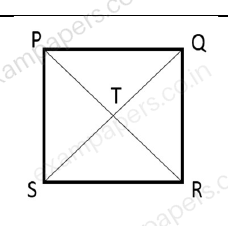
Consider the following square with the four corners and the center marked as P, Q, R, S and T respectively. Let X, Y and Z represent the following operations:
X: rotation of the square by 180 degree with respect to the S-Q axis.
Y: rotation of the square by 180 degree with respect to the P-R axis.
Z: rotation of the square by 90 degree clockwise with respect to the axis perpendicular, going into the screen and passing through the point T.
Consider the following three distinct sequences of operation (which are applied in the left to right order).
(1) XYZ
(2) XY
(3) ZZZ
Which one of the following statements is correct as per the information provided above?
Your answerChoose one option.
Log in to check the answer
You can attempt this question now. Sign in to view the answer key, explanations and discussion.Log in to check answer