
Metallurgical Engineering
GATE MT topic:crystal-imperfections PYQs
Build your understanding with focused practice from past exam papers.
How to practice topic:crystal-imperfections
Attempt a question, record the concept and assumptions, then check the available answer. Rework mistakes after revising the relevant concepts. Topic tags can overlap; review the question context.
Questions 1–9 of 9. Imported answers require independent review unless marked reviewed.
Question 13
Open questionMTMCQ1 markNeeds review
Match each crystal defect in Column I with the corresponding type in Column II.
Column I
P. Edge dislocation
Q. Stack fault
R. Frenkel defect
S. Porosity
Column II
Zero-dimensional defect
One-dimensional defect
Two-dimensional defect
Three-dimensional defect
Your answerChoose one option.
Log in to check the answer
You can attempt this question now. Sign in to view the answer key, explanations and discussion.Log in to check answerQuestion 40
Open questionMTMCQ2 marksNeeds review
In a cubic lattice, what is the ratio of interplanar spacings of the (100), (110) and (111) planes? (Round off to two decimal places)
Your answerChoose one option.
Log in to check the answer
You can attempt this question now. Sign in to view the answer key, explanations and discussion.Log in to check answerQuestion 44
Open questionMTMCQ2 marksNeeds review
Match the entries in Column I with the stacking sequences of the close-packed planes listed in Column II.
Column I
P. Face centered cubic (FCC) structure
Q. Intrinsic stacking fault in FCC
R. Across an annealing twin boundary in FCC
S. Hexagonal close-packed structure
Column II
ABCABC
ABABAB
ABCACBC
ABCABCABCBA
Your answerChoose one option.
Log in to check the answer
You can attempt this question now. Sign in to view the answer key, explanations and discussion.Log in to check answerQuestion 53
Open questionMTNAT2 marksNeeds review
If for element A, the formation enthalpy and formation entropy per vacancy created are 0.5 eV and
, respectively, then the equilibrium vacancy concentration (in mole fraction) at 500 K is ________
.
(Round off to two decimal places)Given: Boltzmann constant,
Log in to check the answer
You can attempt this question now. Sign in to view the answer key, explanations and discussion.Log in to check answerQuestion 50
Open questionMTNAT2 marksNeeds review
Consider a tilt boundary of misorientation of
in an aluminium grain. The lattice parameter of aluminium is 0.4 nm. The spacing between the dislocations that form the tilt boundary is ______ nm (round off to 2 decimal places).Log in to check the answer
You can attempt this question now. Sign in to view the answer key, explanations and discussion.Log in to check answerQuestion 31
Open questionMTMCQ2 marksNeeds review
In the absence of any external stress, which one of the following statements related to the interaction of point defect and a dislocation is FALSE:
Your answerChoose one option.
Log in to check the answer
You can attempt this question now. Sign in to view the answer key, explanations and discussion.Log in to check answerQuestion 53
Open questionMTNAT2 marksNeeds review
The radius of an interstitial atom which just fits (without distorting the structure) inside an octahedral void of a bcc-iron crystal (in nm) is: ________ (round off to 3 decimal places).
Assume the radius of Fe atom to be 0.124 nm.
Log in to check the answer
You can attempt this question now. Sign in to view the answer key, explanations and discussion.Log in to check answerQuestion 10
Open questionMTMCQ1 markNeeds review
The c/a ratio of Zn (hcp) is 1.856. Slip at room temperature occurs most easily on which of the following slip systems in Zn:
Note: In hcp metals, the ideal c/a ratio is 1.633.
Your answerChoose one option.
Log in to check the answer
You can attempt this question now. Sign in to view the answer key, explanations and discussion.Log in to check answerQuestion 21
Open questionMTMCQ1 markNeeds review
What is the requirement for equilibrium at a triple junction as shown in the schematic, with
,
and
as grain boundary tensions and
,
and
as dihedral angles? 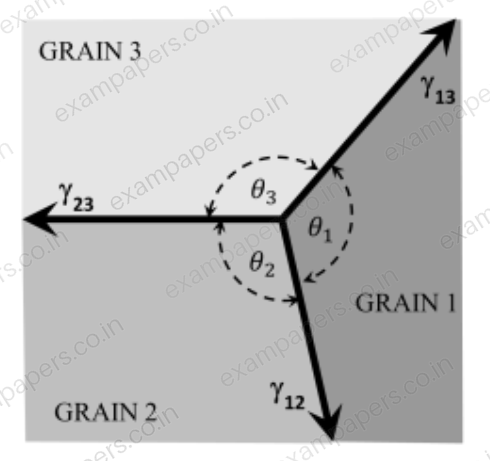
Your answerChoose one option.
Log in to check the answer
You can attempt this question now. Sign in to view the answer key, explanations and discussion.Log in to check answer