
Metallurgical Engineering
GATE MT topic:dislocation-theory PYQs
Build your understanding with focused practice from past exam papers.
Questions 11–18 of 18. Imported answers require independent review unless marked reviewed.
Question 40
Open questionMTMCQ2 marksNeeds review
Find the correct match between dislocation reactions (Column A) to the descriptions (Column B)
Column A
(P)
(Q)
(R)
Column B
(1) Leading partials merging to form a Lomer-Cottrell lock in an FCC metal
(2) Energetically unfavorable dislocation reaction in an FCC metal
(3) Typical dislocation reaction in a BCC metal
Your answerChoose one option.
Log in to check the answer
You can attempt this question now. Sign in to view the answer key, explanations and discussion.Log in to check answerQuestion 46
Open questionMTNAT2 marksNeeds review
Two dislocation lines parallel to z-axis lying in the x-z plane are shown in the figure. The glide force (in Newton) exerted by the edge dislocation on the screw dislocation is: __________ (round off to nearest integer).
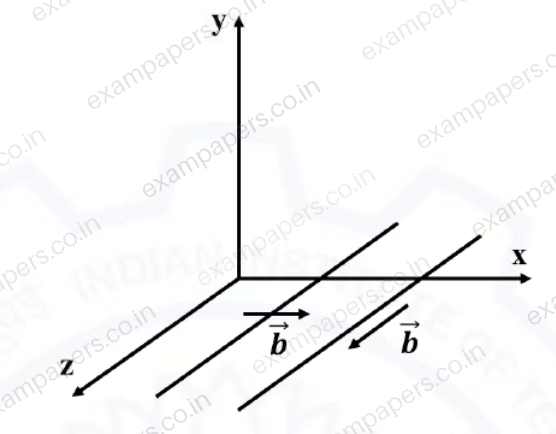
For the edge, the shear stress component is given by:
Given: Shear modulus, G = 28 GPa
Poisson’s ratio, ν = 0.3
Burgers vector, b = 0.29 nm
Distance between the two dislocations = 0.5 nmLog in to check the answer
You can attempt this question now. Sign in to view the answer key, explanations and discussion.Log in to check answerQuestion 26
Open questionMTMCQ2 marksNeeds review
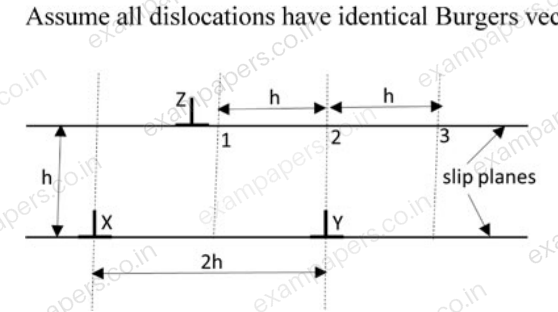
In the edge dislocation configuration given in the figure, dislocations X and Y are fixed and separated by a distance
on the same slip plane. Dislocation Z is free to glide on a parallel slip plane. The two slip planes are separated by a distance
. Which one of the following statements is TRUE regarding the stability of dislocation Z at positions 1, 2 and 3?Assume all dislocations have identical Burgers vector.
Your answerChoose one option.
Log in to check the answer
You can attempt this question now. Sign in to view the answer key, explanations and discussion.Log in to check answerQuestion 27
Open questionMTMCQ2 marksNeeds review
Which one of the following dislocation reactions is NOT feasible in a FCC crystal?
Your answerChoose one option.
Log in to check the answer
You can attempt this question now. Sign in to view the answer key, explanations and discussion.Log in to check answerQuestion 47
Open questionMTNAT2 marksNeeds review
Cold working of iron leads to increase in dislocation density from
to
. The associated stored energy (in
, rounded off to one decimal place) is ________.Given: Shear modulus of iron = 82 GPa, Burger’s vector,
,
nm.Log in to check the answer
You can attempt this question now. Sign in to view the answer key, explanations and discussion.Log in to check answerQuestion 37
Open questionMTMCQ2 marksNeeds review
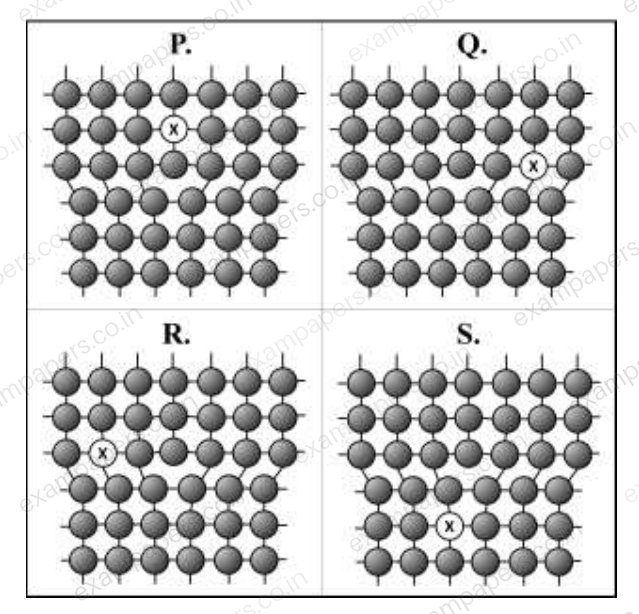
Consider a dilute substitutional solid solution of X in a metal A. The powder diffraction pattern of this alloy reveals that all the peaks have shifted to the left when compared to those for pure A (with no split of peaks). If such a solute interacts and segregates to an edge dislocation, which of the following positions around the dislocation will it preferentially occupy?
Your answerChoose one option.
Log in to check the answer
You can attempt this question now. Sign in to view the answer key, explanations and discussion.Log in to check answerQuestion 18
Open questionMTMCQ1 markNeeds review
Stress required to operate a Frank-Read source of length L is approximately given by:
Your answerChoose one option.
Log in to check the answer
You can attempt this question now. Sign in to view the answer key, explanations and discussion.Log in to check answerQuestion 50
Open questionMTMCQ2 marksNeeds review
At low temperature, two parallel edge dislocations lying on parallel slip planes are shown in different configurations below.
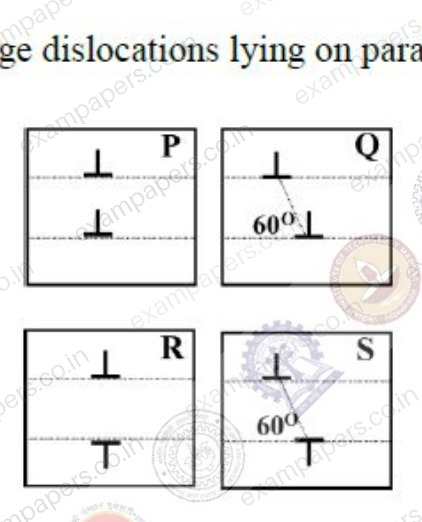
Match the following:
Configuration [P]
Configuration [Q]
Configuration [R]
Configuration [S]
[1] Dislocations repel
[2] Dislocations attract
[3] Dislocations are in stable equilibrium
[4] Dislocations are in unstable equilibrium
Your answerChoose one option.
Log in to check the answer
You can attempt this question now. Sign in to view the answer key, explanations and discussion.Log in to check answer