
Metallurgical Engineering
GATE MT topic:laws-thermodynamics PYQs
Build your understanding with focused practice from past exam papers.
How to practice topic:laws-thermodynamics
Attempt a question, record the concept and assumptions, then check the available answer. Rework mistakes after revising the relevant concepts. Topic tags can overlap; review the question context.
Questions 1–10 of 69. Imported answers require independent review unless marked reviewed.
Question 20
Open questionMTMCQ1 markNeeds review
Which one of the following is NOT a state function?
Your answerChoose one option.
Log in to check the answer
You can attempt this question now. Sign in to view the answer key, explanations and discussion.Log in to check answerQuestion 21
Open questionMTMCQ1 markNeeds review
For a regular solution, which one of the following statements is correct?
(ΔHₘᵢₓ is the enthalpy of mixing and ΔSₘᵢₓ is the entropy of mixing)
Your answerChoose one option.
Log in to check the answer
You can attempt this question now. Sign in to view the answer key, explanations and discussion.Log in to check answerQuestion 30
Open questionMTMSQ1 markNeeds review
Choose the correct option(s).
Here ‘A’ is the Helmholtz free energy and ‘G’ is the Gibbs free energy.
Your answerSelect all correct options. You can choose more than one.
Log in to check the answer
You can attempt this question now. Sign in to view the answer key, explanations and discussion.Log in to check answerQuestion 34
Open questionMTNAT1 markNeeds review
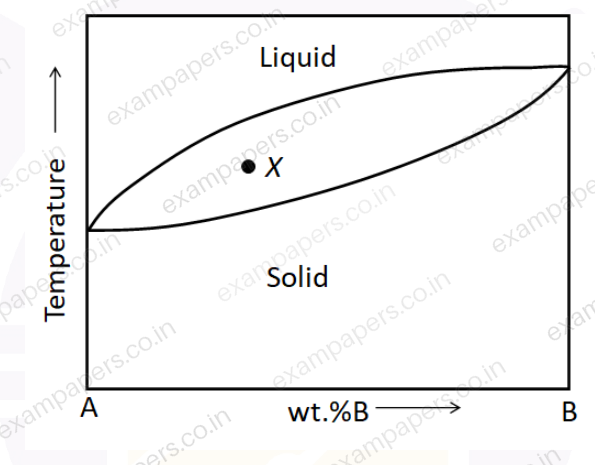
For an equilibrium phase diagram of a binary A-B alloy at a constant pressure as shown in the figure, the degree of freedom at ‘X’ is (answer in integer) ____________.
Log in to check the answer
You can attempt this question now. Sign in to view the answer key, explanations and discussion.Log in to check answerQuestion 53
Open questionMTNAT2 marksNeeds review
20 g of gold (Au) and 20 g of silver (Ag) are mixed to form a single-phase solid solution (assume ideal mixing). The atomic weight of Au is 197 g/mol and the atomic weight of Ag is 108 g/mol. The value of universal gas constant R is 8.314 J/mol-K. The total entropy of mixing (rounded off to two decimal places) is __________ J/K.
Log in to check the answer
You can attempt this question now. Sign in to view the answer key, explanations and discussion.Log in to check answerQuestion 54
Open questionMTNAT2 marksNeeds review
2 moles of an ideal gas is reversibly expanded from 10 liter to 20 liter at isothermal condition. The value of universal gas constant R is 8.314 J/mol-K. If the temperature of the gas is 27 °C, the magnitude of work done in the process (rounded off to two decimal places) is ____________ Joules.
Log in to check the answer
You can attempt this question now. Sign in to view the answer key, explanations and discussion.Log in to check answerQuestion 55
Open questionMTNAT2 marksNeeds review
Specific heat capacity at constant pressure (C
) of a solid metal is given by the following equation:C
(in J/mol-K) = 20 + (5 × 10⁻³)·T (for T = 298 K to 1000 K)At constant pressure, if the temperature (T in K) of 2 moles of metal is increased from 300 K to 600 K, the change in enthalpy of the metal (answer in integer) is __________ Joules.
Log in to check the answer
You can attempt this question now. Sign in to view the answer key, explanations and discussion.Log in to check answerQuestion 56
Open questionMTNAT2 marksNeeds review
With reference to the Ellingham diagram, the standard Gibbs free energy change for the oxidation of solid metal M (s) and liquid metal M (l) is given below:
Reaction I:
M (s) + O₂ (g) → MO₂ (s)
ΔG° = (− 338900 − 15.2T lnT + 247T) Joules;
from T = 300 K to melting point.
Reaction II:
M (l) + O₂ (g) → MO₂ (s)
ΔG° = (− 390800 − 15.2T lnT + 285.3T) Joules;
from melting point to T = 1800 K
The melting point of the metal M (rounded off to one decimal place) is _____________ Kelvin.
Log in to check the answer
You can attempt this question now. Sign in to view the answer key, explanations and discussion.Log in to check answerQuestion 61
Open questionMTNAT2 marksNeeds review
For the following reaction between methane and stoichiometric air having composition 20 vol.% O₂ and 80 vol.% N₂, the estimated adiabatic flame temperature (rounded off to one decimal place) is _________________ Kelvin.
CH₄ (g) + 2 O₂ (g) → CO₂ (g) + 2 H₂O (g)
Given: ΔH = − 850 kJ/mol at 298 K
Assume specific heat at constant pressure (Cₚ) for each reactant and product is 50 J/mol-K and is independent of temperature.
Log in to check the answer
You can attempt this question now. Sign in to view the answer key, explanations and discussion.Log in to check answerQuestion 12
Open questionMTMCQ1 markNeeds review
For an isobaric process, the heat transferred is equal to the change in __________ of the system.
Your answerChoose one option.
Log in to check the answer
You can attempt this question now. Sign in to view the answer key, explanations and discussion.Log in to check answer