
Metallurgical Engineering
GATE MT topic:laws-thermodynamics PYQs
Build your understanding with focused practice from past exam papers.
Questions 11–20 of 69. Imported answers require independent review unless marked reviewed.
Question 15
Open questionMTMCQ1 markNeeds review
Which one of the following is an intensive property?
Your answerChoose one option.
Log in to check the answer
You can attempt this question now. Sign in to view the answer key, explanations and discussion.Log in to check answerQuestion 19
Open questionMTMCQ1 markNeeds review
Consider the following gas-phase reaction:
If the enthalpy of reaction is negative, which one of the following conditions promotes a higher equilibrium concentration of SO3?
Your answerChoose one option.
Log in to check the answer
You can attempt this question now. Sign in to view the answer key, explanations and discussion.Log in to check answerQuestion 30
Open questionMTMSQ1 markNeeds review
Standard Gibbs free energies of formation of some solid oxides per mole of O₂ at 100 K are given below.
SiO₂: −728 kJ, TiO₂: −737 kJ, VO: −712 kJ, MnO: −624 kJ
Regarding thermodynamic feasibility of oxide reduction, which of the following statements is/are CORRECT under standard conditions at 1000 K?
Your answerSelect all correct options. You can choose more than one.
Log in to check the answer
You can attempt this question now. Sign in to view the answer key, explanations and discussion.Log in to check answerQuestion 34
Open questionMTNAT1 markNeeds review
Consider the gas phase reaction:
At equilibrium for a particular temperature, the partial pressures of CO, O
, and CO
are found to be
atm,
atm, and 16 atm, respectively. The equilibrium constant for the reaction is _____
(rounded off to one decimal place).Log in to check the answer
You can attempt this question now. Sign in to view the answer key, explanations and discussion.Log in to check answerQuestion 37
Open questionMTMCQ2 marksNeeds review
Consider the phase diagram of a one component system given below.
,
, and
are the molar volumes of
,
, and liquid phases, respectively. Which one of the following statements is TRUE? Given: The change in molar enthalpies,
and
, are positive. 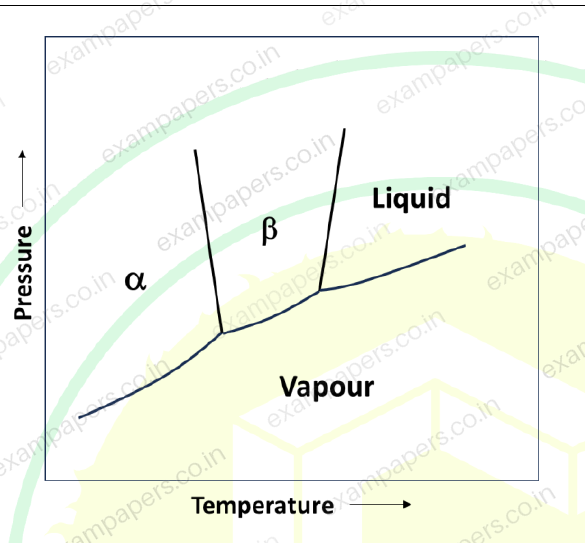
Your answerChoose one option.
Log in to check the answer
You can attempt this question now. Sign in to view the answer key, explanations and discussion.Log in to check answerQuestion 50
Open questionMTNAT2 marksNeeds review
The excess molar Gibbs free energy of a solution of element A and B at 1000 K is given by
, where
and
are mole fractions of A and B, respectively.The activity of B in a solution of A and B containing 40 mol% of B at 1000 K is _____ (rounded off to two decimal places).
Given: Ideal gas constant R = 8.314 J mol
K
Log in to check the answer
You can attempt this question now. Sign in to view the answer key, explanations and discussion.Log in to check answerQuestion 51
Open questionMTNAT2 marksNeeds review
Molten steel at 1900 K having dissolved hydrogen needs to be vacuum degassed.
The equilibrium partial pressure of hydrogen to be maintained to achieve 1 ppm (mass basis) of dissolved hydrogen is _____ Torr (rounded off to two decimal places).
Given: For the hydrogen dissolution reaction in molten steel (½ H
(g) = [H]), the equilibrium constant (expressed in terms of ppm of dissolved H) is:
1 atm = 760 Torr
Log in to check the answer
You can attempt this question now. Sign in to view the answer key, explanations and discussion.Log in to check answerQuestion 53
Open questionMTNAT2 marksNeeds review
Consider the following reactions and their standard Gibbs free energies (in J):
Fe(s) +
O
(g) ⇌ FeO(s)
2 H
(g) + O
(g) ⇌ 2 H
O(g)
Assuming Fe and FeO to be pure and no solubility of gases in the solids, the value of
required to reduce solid FeO to solid Fe at 1000 K is _____ (rounded off to two decimal places).Given: Ideal gas constant R = 8.314 J mol
K
Log in to check the answer
You can attempt this question now. Sign in to view the answer key, explanations and discussion.Log in to check answerQuestion 14
Open questionMTMCQ1 markNeeds review
If in an A-B solid solution, the activity and mole fraction of A are given by
and
, respectively, then the activity coefficient of A is given byYour answerChoose one option.
Log in to check the answer
You can attempt this question now. Sign in to view the answer key, explanations and discussion.Log in to check answerQuestion 29
Open questionMTMSQ1 markNeeds review
Which of the following is/are criterion/criteria for equilibrium of an isolated system held at constant temperature and constant pressure?
Your answerSelect all correct options. You can choose more than one.
Log in to check the answer
You can attempt this question now. Sign in to view the answer key, explanations and discussion.Log in to check answer