
Metallurgical Engineering
GATE MT topic:laws-thermodynamics PYQs
Build your understanding with focused practice from past exam papers.
Questions 41–50 of 69. Imported answers require independent review unless marked reviewed.
Question 43
Open questionMTNAT2 marksNeeds review
For the equilibrium reaction
, the value of
at 973 K is: ________ (round off to 2 decimal places).
Given:
ΔG° at 973 K = −100 kJ
ΔG° at 973 K = 292 kJ
R = 8.314 J mol⁻¹ K⁻¹
Assume: Cu and Cu₂S are pure solids.Log in to check the answer
You can attempt this question now. Sign in to view the answer key, explanations and discussion.Log in to check answerQuestion 44
Open questionMTNAT2 marksNeeds review
One mole of an ideal gas at 10 atm. and 300 K undergoes reversible adiabatic expansion to a pressure of one atm. The work done (in Joule) by the gas is: __________ (round off to nearest integer).
Given: R = 8.314 J mol⁻¹ K⁻¹; 1 atm. = 101325 Pa; Cₚ = 2.5R
Log in to check the answer
You can attempt this question now. Sign in to view the answer key, explanations and discussion.Log in to check answerQuestion 45
Open questionMTNAT2 marksNeeds review
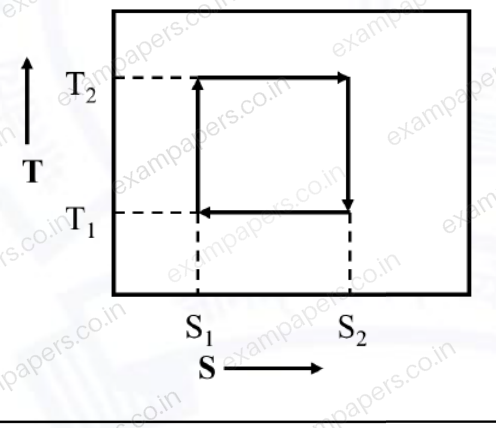
The figure shows the entropy versus temperature (S-T) plot of a reversible cycle of an engine. If T₁ = 200 K and T₂ = 600 K, the efficiency of the engine (in percent) is: __________ (round off to 2 decimal places).
Log in to check the answer
You can attempt this question now. Sign in to view the answer key, explanations and discussion.Log in to check answerQuestion 10
Open questionMTMCQ1 markNeeds review
When 1 mole of C
H
at 300 K is burnt with stoichiometric amount of oxygen at 300 K to form CO
and H
O, the adiabatic flame temperature is 5975 K. If C
H
is burnt under the same conditions but with excess oxygen, the adiabatic flame temperature will beYour answerChoose one option.
Log in to check the answer
You can attempt this question now. Sign in to view the answer key, explanations and discussion.Log in to check answerQuestion 48
Open questionMTNAT2 marksNeeds review
If liquid copper is cooled to 1353 K, magnitude of the driving force for liquid to transform to solid is ______ J·mol
(round off to one decimal place).Given, melting temperature and enthalpy of melting of copper are 1356 K and 13 kJ·mol
respectively.Log in to check the answer
You can attempt this question now. Sign in to view the answer key, explanations and discussion.Log in to check answerQuestion 49
Open questionMTNAT2 marksNeeds review
1000 kg of liquid steel containing 0.03 wt.% S needs to be desulphurized using a slag to bring the sulphur content down to 0.015 wt.%. The quantity of slag needed is ______ kg (round off to the nearest integer).
Assume:
Thermodynamic equilibrium
No sulphur in the slag prior to desulphurization treatment
Given the equilibrium sulphur partition ratio between slag and steel,
.Log in to check the answer
You can attempt this question now. Sign in to view the answer key, explanations and discussion.Log in to check answerQuestion 54
Open questionMTNAT2 marksNeeds review
A Basic Oxygen Furnace operator, at the end of oxygen blow, measures the dissolved oxygen content in the steel as 0.03 wt.% and the steel temperature as 1800 K. The carbon content [C] in the steel is ______ wt.% (round off to two decimal places).
Assume:
Equilibrium between dissolved carbon [C], dissolved oxygen [O], and CO (gas) at 1 atmosphere.
Henry’s law is valid for both [C] and [O]
Given:
[ C ]
+ [ O ]
→ (CO)
R = 8.314 J·mol
·K
Log in to check the answer
You can attempt this question now. Sign in to view the answer key, explanations and discussion.Log in to check answerQuestion 5
Open questionMTMCQ1 markNeeds review
Liquid steel is kept in a graphite crucible for sufficiently long time such that equilibrium is established. Activity of carbon (with respect to graphite as the standard state) in the liquid is
Your answerChoose one option.
Log in to check the answer
You can attempt this question now. Sign in to view the answer key, explanations and discussion.Log in to check answerQuestion 6
Open questionMTMCQ1 markNeeds review
The variation of standard free energies for two oxides AO and BO with temperature are shown below.
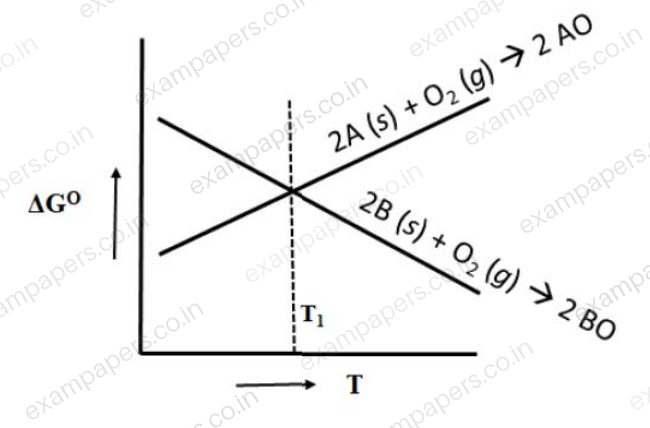
The correct statement with reference to the above figure is
Your answerChoose one option.
Log in to check the answer
You can attempt this question now. Sign in to view the answer key, explanations and discussion.Log in to check answerQuestion 35
Open questionMTMCQ2 marksNeeds review
The equilibrium constant for the following reaction at 300 K is _____________.
C (graphite) + 2H₂ (g) → CH₄ (g)
Given: At 300 K, ΔH° = −74,900 J.mol⁻¹; ΔS° = −80 J.mol⁻¹.K⁻¹; R = 8.314 J.mol⁻¹.K⁻¹.
Your answerChoose one option.
Log in to check the answer
You can attempt this question now. Sign in to view the answer key, explanations and discussion.Log in to check answer