
Metallurgical Engineering
GATE MT topic:materials-science PYQs
Build your understanding with focused practice from past exam papers.
Questions 171–180 of 650. Imported answers require independent review unless marked reviewed.
Question 41
Open questionMTMCQ2 marksNeeds review
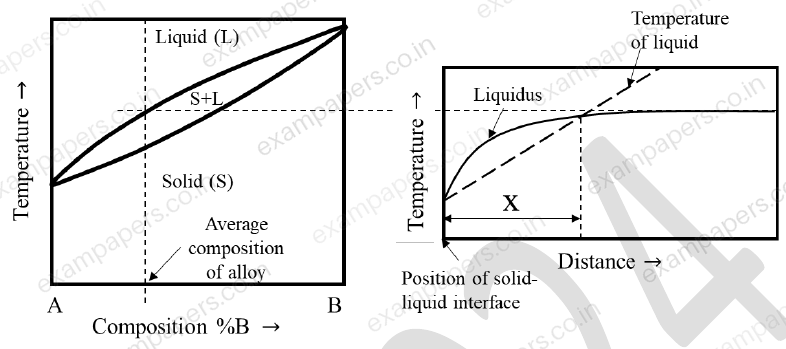
The constitutional undercooling condition for a hypothetical binary alloy of A with solute B during solidification is shown in the figure along with its binary phase diagram. Based on these two schematics, one can conclude that the solute concentration in region X will be __________ the average composition of the initial liquid phase.
Your answerChoose one option.
Log in to check the answer
You can attempt this question now. Sign in to view the answer key, explanations and discussion.Log in to check answerQuestion 42
Open questionMTMCQ2 marksNeeds review
The microstructures of a quenched steel tempered at three temperatures
for a fixed time are schematically illustrated. The solid circles represent cementite particles in ferrite matrix;
,
and
are average radii of cementite particles, and
,
and
are volume fractions of cementite at temperatures
,
and
, respectively. If the cementite in steel is more noble than ferrite, then which one of the three microstructures will have the highest corrosion rate when exposed to an aqueous solution of 3.5 wt. % NaCl? 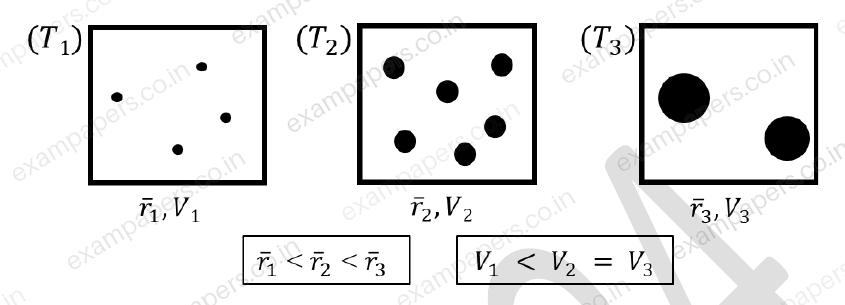
Your answerChoose one option.
Log in to check the answer
You can attempt this question now. Sign in to view the answer key, explanations and discussion.Log in to check answerQuestion 43
Open questionMTMCQ2 marksNeeds review
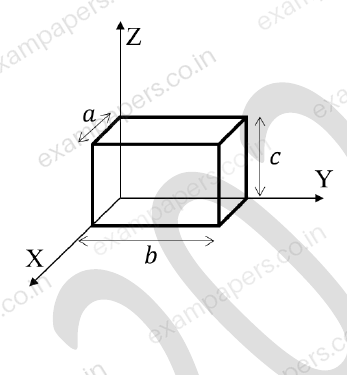
An isotropic metallic cuboid block shown in the figure has a coefficient of linear thermal expansion
, Young’s modulus
and Poisson’s ratio
. The dimensions of the cuboid are
,
and
in the X, Y and Z directions, respectively. It is rigidly constrained against expansion in the X direction. However, it is free to expand in the Y and Z directions. It is initially stress-free. Subsequently, it is heated so that its temperature increases by
. What would be the CHANGE in the dimension of the cuboid in the Y direction?Assume linear elasticity, and that thermal as well as mechanical strains are infinitesimally small.
Your answerChoose one option.
Log in to check the answer
You can attempt this question now. Sign in to view the answer key, explanations and discussion.Log in to check answerQuestion 44
Open questionMTMCQ2 marksNeeds review
Match the entries in Column I with the stacking sequences of the close-packed planes listed in Column II.
Column I
P. Face centered cubic (FCC) structure
Q. Intrinsic stacking fault in FCC
R. Across an annealing twin boundary in FCC
S. Hexagonal close-packed structure
Column II
ABCABC
ABABAB
ABCACBC
ABCABCABCBA
Your answerChoose one option.
Log in to check the answer
You can attempt this question now. Sign in to view the answer key, explanations and discussion.Log in to check answerQuestion 45
Open questionMTMCQ2 marksNeeds review
Which one of the following graphs represents Griffith’s criterion for the growth of a crack in a brittle isotropic infinite large plate with a center crack?
In the graph,
is the magnitude of the total strain energy released (shown by solid curve) and
is the total surface energy (shown by dashed line) and
is the critical crack length (shown by downward arrow) at which the crack starts growing. The tangent to the
curve parallel to the
line is shown by the dotted line.Your answerChoose one option.
Log in to check the answer
You can attempt this question now. Sign in to view the answer key, explanations and discussion.Log in to check answerQuestion 46
Open questionMTMCQ2 marksNeeds review
For rolling of slabs, determine the correctness or otherwise of the following Assertion [a] and Reason [r].
Assertion [a]: Grooves are made on the surface of the rolls parallel to their roll axes to achieve large thickness reduction in a short time.
Reason [r]: Given
is the coefficient of friction between the rolls and the slab, and
is the angle of bite between the entrance plane and the centerline of the rolls, unaided entry of slab in the rolls can take place only if
.Your answerChoose one option.
Log in to check the answer
You can attempt this question now. Sign in to view the answer key, explanations and discussion.Log in to check answerQuestion 47
Open questionMTMSQ2 marksNeeds review
Which of the following statements is/are correct?
Your answerSelect all correct options. You can choose more than one.
Log in to check the answer
You can attempt this question now. Sign in to view the answer key, explanations and discussion.Log in to check answerQuestion 48
Open questionMTMSQ2 marksNeeds review
A creep test of a pure polycrystalline metal is performed in tension and the creep strain rate is observed to decrease during the primary stage. The creep mechanism is later determined to be dislocation-climb-controlled. The observed decrease in creep strain rate is/are due to
Your answerSelect all correct options. You can choose more than one.
Log in to check the answer
You can attempt this question now. Sign in to view the answer key, explanations and discussion.Log in to check answerQuestion 49
Open questionMTMSQ2 marksNeeds review
Which of the following statements is/are correct for joining processes?
(A) In case of soldering and brazing, the filler material has a melting point lower than that of the metals joined.
(B) In tungsten inert gas welding, tungsten is the filler material.
(C) Friction welding is a solid-state joining process.
(D) The following reaction is associated with thermit welding:
Note:
stands for gas.Your answerSelect all correct options. You can choose more than one.
Log in to check the answer
You can attempt this question now. Sign in to view the answer key, explanations and discussion.Log in to check answerQuestion 50
Open questionMTMSQ2 marksNeeds review
Which of the following statements is/are correct for non-destructive testing?
Your answerSelect all correct options. You can choose more than one.
Log in to check the answer
You can attempt this question now. Sign in to view the answer key, explanations and discussion.Log in to check answer