
Metallurgical Engineering
GATE MT topic:materials-science PYQs
Build your understanding with focused practice from past exam papers.
Questions 491–500 of 650. Imported answers require independent review unless marked reviewed.
Question 26
Open questionMTMCQ2 marksNeeds review
Match the reactors / refining sites in Column I with the corresponding refining process in Column II.
Column I: Reactors / refining sites
(P) Blast furnace runner
(Q) AOD
(R) Torpedo car
(S) BOF
Column II: Refining processes
De-carburization
External De-sulfurization
De-phosphorization
External De-siliconization
Your answerChoose one option.
Log in to check the answer
You can attempt this question now. Sign in to view the answer key, explanations and discussion.Log in to check answerQuestion 27
Open questionMTMCQ2 marksNeeds review
Match the injection metallurgy techniques in Column I with the corresponding objectives in Column II.
Column I: Injection metallurgy techniques
(P) Aluminium wire feeding
(Q) Calcium treatment
(R) Argon rinsing
(S) Lime powder injection
Column II: Objectives
Inclusion modification
Mixing of liquid steel
De-sulphurization
Deoxidation
Your answerChoose one option.
Log in to check the answer
You can attempt this question now. Sign in to view the answer key, explanations and discussion.Log in to check answerQuestion 28
Open questionMTMCQ2 marksNeeds review
The table (see options below) providing correct information about crystal structure, co-ordination number and packing fraction is ____________.
[Note: FCC: Face centered cubic; BCC: Body centered cubic; DC: Diamond cubic. CN: Coordination number; PF: Packing fraction]
Your answerChoose one option.
Log in to check the answer
You can attempt this question now. Sign in to view the answer key, explanations and discussion.Log in to check answerQuestion 29
Open questionMTMCQ2 marksNeeds review
Match the phase transformation in Column I with the corresponding reaction in Column II.
[Note: α, β, γ are solid phases; L, L₁, L₂ are liquid phases.]
Column I: Phase transformation
(P) Peritectic
(Q) Monotectic
(R) Eutectoid
(S) Syntetic
Column II: Reaction
γ → α + β
L₁ + L₂ → α
L₁ → L₂ + α
L + α → β
Your answerChoose one option.
Log in to check the answer
You can attempt this question now. Sign in to view the answer key, explanations and discussion.Log in to check answerQuestion 30
Open questionMTMCQ2 marksNeeds review
In a typical scanning electron microscope (SEM) image, information about topography and atomic contrast are obtained from _____________.
Your answerChoose one option.
Log in to check the answer
You can attempt this question now. Sign in to view the answer key, explanations and discussion.Log in to check answerQuestion 31
Open questionMTMCQ2 marksNeeds review
Match the ceramics in Column I with corresponding application in Column II.
Column I: Ceramics
(P) Mullite
(Q) Spinel ferrites
(R) Tungsten carbide
(S) Barium titanate
Column II: Application
Cutting tools
Refractories
Piezoelectric
Soft magnet
Your answerChoose one option.
Log in to check the answer
You can attempt this question now. Sign in to view the answer key, explanations and discussion.Log in to check answerQuestion 32
Open questionMTMCQ2 marksNeeds review
An aluminum single crystal is loaded in tension along [1̄ 1 0] axis. Among the following slip systems, the one that will be activated first is
Your answerChoose one option.
Log in to check the answer
You can attempt this question now. Sign in to view the answer key, explanations and discussion.Log in to check answerQuestion 33
Open questionMTMCQ2 marksNeeds review
The correct Mohr’s circle construction for the stress state given below is _____________.
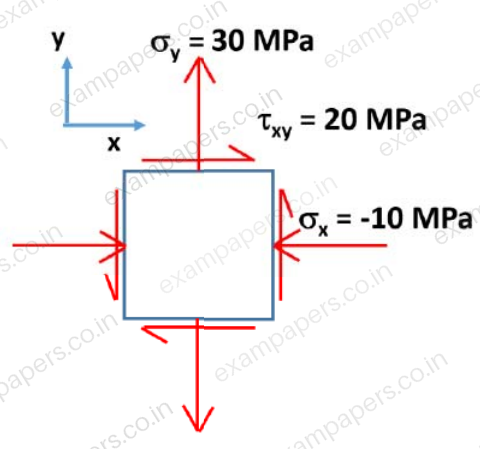
Stress state:
,
,
.The shared axes are
to the right and
upward.Your answerChoose one option.
Log in to check the answer
You can attempt this question now. Sign in to view the answer key, explanations and discussion.Log in to check answerQuestion 34
Open questionMTMCQ2 marksNeeds review
Match the automobile components in Column I with the corresponding manufacturing process in Column II.
Column I: Automobile components
(P) Engine block
(Q) Brake pad
(R) Connecting rod
(S) Door panel
Column II: Manufacturing process
Forging
Sheet metal forming
Casting
Powder metallurgy
Your answerChoose one option.
Log in to check the answer
You can attempt this question now. Sign in to view the answer key, explanations and discussion.Log in to check answerQuestion 35
Open questionMTMCQ2 marksNeeds review
The equilibrium constant for the following reaction at 300 K is _____________.
C (graphite) + 2H₂ (g) → CH₄ (g)
Given: At 300 K, ΔH° = −74,900 J.mol⁻¹; ΔS° = −80 J.mol⁻¹.K⁻¹; R = 8.314 J.mol⁻¹.K⁻¹.
Your answerChoose one option.
Log in to check the answer
You can attempt this question now. Sign in to view the answer key, explanations and discussion.Log in to check answer