
Metallurgical Engineering
GATE MT topic:materials-science PYQs
Build your understanding with focused practice from past exam papers.
Questions 581–590 of 650. Imported answers require independent review unless marked reviewed.
Question 51
Open questionMTNAT2 marksNeeds review
For the reaction: 4Ag(s, pure) + O
(g) → 2Ag
O(s, pure), the standard enthalpy change,
, and the standard entropy change,
, in the temperature range from 298 K to 500 K. The temperature above which Ag
O decomposes in an atmosphere containing oxygen at a partial pressure
is ______ (in K to one decimal place). Given: Gas constant R = 8.314 J K
mol
Log in to check the answer
You can attempt this question now. Sign in to view the answer key, explanations and discussion.Log in to check answerQuestion 52
Open questionMTNAT2 marksNeeds review
In a powder diffraction experiment on BCC iron, the first peak occurs at
. The wavelength of X-rays is ______ (in nm to three decimal places). Given: The lattice parameter of iron = 0.287 nmLog in to check the answer
You can attempt this question now. Sign in to view the answer key, explanations and discussion.Log in to check answerQuestion 53
Open questionMTNAT2 marksNeeds review
A 1 mol piece of copper at 400 K is brought in contact with another 1 mol piece of copper at 300 K, and allowed to reach thermal equilibrium. The entropy change for this process is ______ (in J K
to three decimal places) Given: Specific heat capacity of copper (between 250 K and 500 K) is 22.6 J K
mol
. Assume that the system containing the two pieces of copper remains isolated during this process.Log in to check the answer
You can attempt this question now. Sign in to view the answer key, explanations and discussion.Log in to check answerQuestion 54
Open questionMTNAT2 marksNeeds review
Using the trapezoidal rule with two equal intervals (n = 2, Δx = 1), the definite integral
______________ (to two decimal places).Log in to check the answer
You can attempt this question now. Sign in to view the answer key, explanations and discussion.Log in to check answerQuestion 55
Open questionMTNAT2 marksNeeds review
The ideal plastic work involved in extruding a cylindrical billet of length 100 mm, from an initial diameter of 20 mm to a final diameter of 16 mm is ______ (in J to one decimal place). The flow stress in compression is 40 MPa, and remains constant throughout the process.
Log in to check the answer
You can attempt this question now. Sign in to view the answer key, explanations and discussion.Log in to check answerQuestion 1
Open questionMTMCQ1 markNeeds review
For the matrix,
,
isYour answerChoose one option.
Log in to check the answer
You can attempt this question now. Sign in to view the answer key, explanations and discussion.Log in to check answerQuestion 2
Open questionMTMCQ1 markNeeds review
The mean of a numerical data-set is
and the standard deviation is
. If a number
is added to each term in the data-set then the mean and standard deviation become:Your answerChoose one option.
Log in to check the answer
You can attempt this question now. Sign in to view the answer key, explanations and discussion.Log in to check answerQuestion 3
Open questionMTMCQ1 markNeeds review
If
then at
, the function
isYour answerChoose one option.
Log in to check the answer
You can attempt this question now. Sign in to view the answer key, explanations and discussion.Log in to check answerQuestion 4
Open questionMTMCQ1 markNeeds review
The pressure (P) versus volume (V) diagram given below represents reversible isothermal curves at temperatures, T1, T2 and T3.
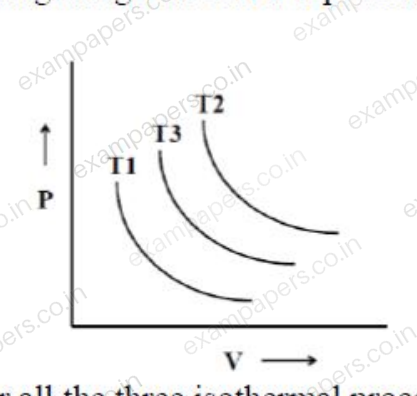
Considering one mole of ideal gas for all the three isothermal processes, which one of the following is TRUE?
Your answerChoose one option.
Log in to check the answer
You can attempt this question now. Sign in to view the answer key, explanations and discussion.Log in to check answerQuestion 5
Open questionMTMCQ1 markNeeds review
For the electrochemical reaction, Cu²⁺ + Zn = Zn²⁺ + Cu, the standard cell potential at 25°C and 1 atm pressure is:
(Given: E° (Cu²⁺/Cu) = 0.337 V and E° (Zn²⁺/Zn) = −0.763 V)
Your answerChoose one option.
Log in to check the answer
You can attempt this question now. Sign in to view the answer key, explanations and discussion.Log in to check answer