
Metallurgical Engineering
GATE MT topic:phase-transformation PYQs
Build your understanding with focused practice from past exam papers.
How to practice topic:phase-transformation
Attempt a question, record the concept and assumptions, then check the available answer. Rework mistakes after revising the relevant concepts. Topic tags can overlap; review the question context.
Questions 1–10 of 21. Imported answers require independent review unless marked reviewed.
Question 57
Open questionMTNAT2 marksNeeds review
A given volume of liquid is undercooled just below the melting temperature to form a spherical solid nucleus (consider homogeneous nucleation). The Gibbs free energy of solidification (ΔGᵥ) is (− 0.5 × 10⁸) J/m³. The solid-liquid interfacial energy (γ) is isotropic and its value is 0.1 J/m².
The critical nucleus size for a stable nucleus is __________ nm (answer in integer).
Log in to check the answer
You can attempt this question now. Sign in to view the answer key, explanations and discussion.Log in to check answerQuestion 23
Open questionMTMCQ1 markNeeds review
In the Fe-C system, the invariant reaction Liquid + δ ⇌ γ takes place at 1493 °C. This type of reaction is called _____.
Your answerChoose one option.
Log in to check the answer
You can attempt this question now. Sign in to view the answer key, explanations and discussion.Log in to check answerQuestion 22
Open questionMTMCQ1 markNeeds review
Which one of the following schemes represents the variation of the rate of nucleation of solid from a pure liquid metal as a function of undercooling (
, where
and
are the freezing temperature and the liquid temperature, respectively)?Your answerChoose one option.
Log in to check the answer
You can attempt this question now. Sign in to view the answer key, explanations and discussion.Log in to check answerQuestion 33
Open questionMTNAT1 markNeeds review
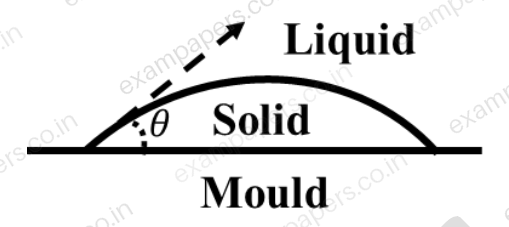
For a solid embryo in contact with a perfectly flat mould wall as shown in the schematic, the wetting angle
is ______ degrees. (Round off to one decimal place.) Given: Surface tension between liquid and mould wall =
; Surface tension between solid and mould wall =
; Surface tension between liquid and solid =
. 
Log in to check the answer
You can attempt this question now. Sign in to view the answer key, explanations and discussion.Log in to check answerQuestion 41
Open questionMTMCQ2 marksNeeds review
The constitutional undercooling condition for a hypothetical binary alloy of A with solute B during solidification is shown in the figure along with its binary phase diagram. Based on these two schematics, one can conclude that the solute concentration in region X will be __________ the average composition of the initial liquid phase.
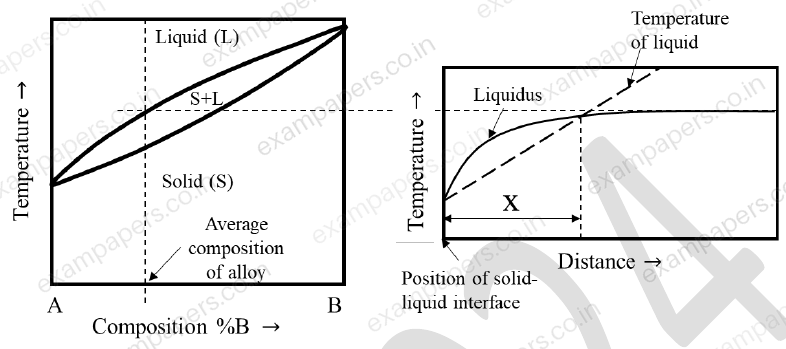
Your answerChoose one option.
Log in to check the answer
You can attempt this question now. Sign in to view the answer key, explanations and discussion.Log in to check answerQuestion 61
Open questionMTNAT2 marksNeeds review
80
of A-B alloy containing 20 wt.% B is held at temperature
. The weight of B dissolved in
at that temperature is ________
.
(Round off to the nearest integer).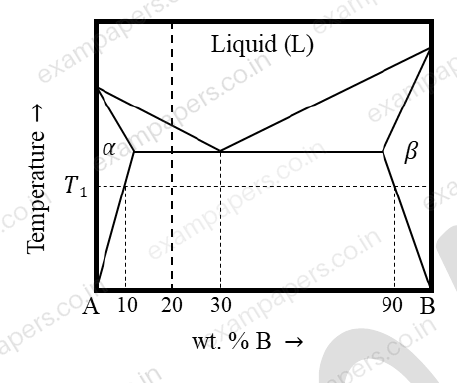
Log in to check the answer
You can attempt this question now. Sign in to view the answer key, explanations and discussion.Log in to check answerQuestion 29
Open questionMTMSQ1 markNeeds review
The condition(s) for high degree of mutual substitutional solid solubility for two metals is/are
Your answerSelect all correct options. You can choose more than one.
Log in to check the answer
You can attempt this question now. Sign in to view the answer key, explanations and discussion.Log in to check answerQuestion 61
Open questionMTNAT2 marksNeeds review
The alloy A (given in the phase diagram) is cooled slowly from the liquid state to just below the eutectic temperature.
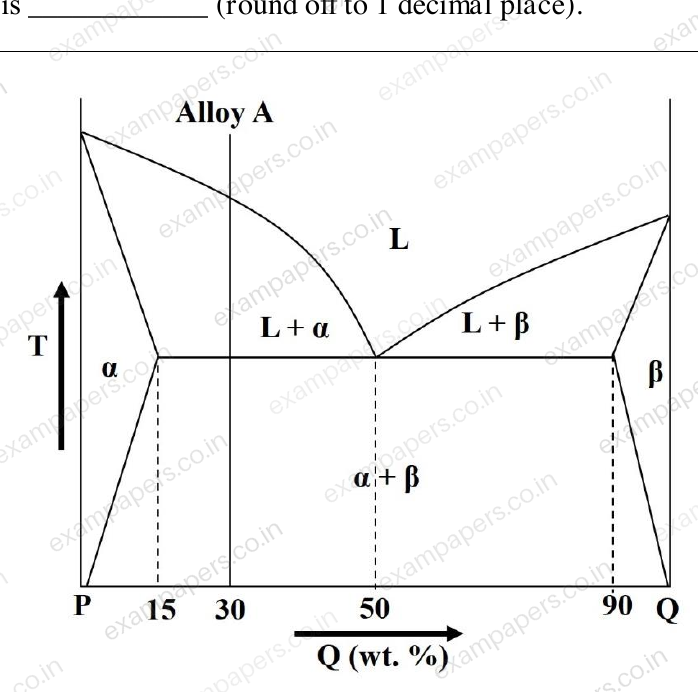
The ratio of weight fractions of pro-eutectic
to eutectic
is __________ (round off to 1 decimal place).Log in to check the answer
You can attempt this question now. Sign in to view the answer key, explanations and discussion.Log in to check answerQuestion 55
Open questionMTNAT2 marksNeeds review
During solidification of a pure metal, the radius of critical nucleus at an undercooling of 10 K is __________ ×
m (answer rounded off to 1 decimal place).Given: solid/liquid interface energy = 0.177 J·m⁻²,
melting point of the metal = 1356 K and
latent heat of fusion = 1.88 ×
J·m⁻³Log in to check the answer
You can attempt this question now. Sign in to view the answer key, explanations and discussion.Log in to check answerQuestion 19
Open questionMTNAT1 markNeeds review
Consider homogeneous nucleation of a spherical solid in liquid. For a given undercooling, if surface energy of a nucleus increases by 20 %, the corresponding increase (in percent) in the critical radius of the nucleus is: __________ (round off to nearest integer).
Log in to check the answer
You can attempt this question now. Sign in to view the answer key, explanations and discussion.Log in to check answer