
Metallurgical Engineering
GATE MT X-ray Diffraction – Bragg’s law, optical metallography, principles of SEM imaging. PYQs
Build your understanding with focused practice from past exam papers.
How to practice X-ray Diffraction – Bragg’s law, optical metallography, principles of SEM imaging.
Attempt a question, record the concept and assumptions, then check the available answer. Rework mistakes after revising the relevant concepts. Topic tags can overlap; review the question context.
Questions 1–10 of 10. Imported answers require independent review unless marked reviewed.
Question 30
Open questionMTMSQ1 markNeeds review
Which of the following
reflections is/are allowed in X-ray diffraction pattern of a crystal with face centered cubic lattice?Your answerSelect all correct options. You can choose more than one.
Log in to check the answer
You can attempt this question now. Sign in to view the answer key, explanations and discussion.Log in to check answerQuestion 60
Open questionMTNAT2 marksNeeds review
Diffraction pattern of a polycrystalline BC metal is obtained using monochromatic X-rays of wavelength 0.25 nm. If the first peak occurs at Brag angle (
) of 30°, then the radius of the metal atom in nm is __________ (round off to 2 decimal places).Log in to check the answer
You can attempt this question now. Sign in to view the answer key, explanations and discussion.Log in to check answerQuestion 15
Open questionMTMCQ1 markNeeds review
The sequence of peaks corresponding to the planes (in the order of increasing
) observed in the X-ray diffractogram of a pure copper powder sample is __________Your answerChoose one option.
Log in to check the answer
You can attempt this question now. Sign in to view the answer key, explanations and discussion.Log in to check answerQuestion 21
Open questionMTNAT1 markNeeds review
In the X-ray diffraction pattern of a FCC crystal, the first reflection occurs at a Bragg angle (θ) of 30°. The Bragg angle (in degree) for the second reflection will be: __________ (round off to 1 decimal place).
Log in to check the answer
You can attempt this question now. Sign in to view the answer key, explanations and discussion.Log in to check answerQuestion 34
Open questionMTMCQ2 marksNeeds review
X-ray diffraction pattern from an element metal with a FCC crystal structure shows the first peak at a Bragg angle
. The lattice parameter of this metal is ______ nm.Given, wavelength of the X-ray used is 0.1543 nm.
Your answerChoose one option.
Log in to check the answer
You can attempt this question now. Sign in to view the answer key, explanations and discussion.Log in to check answerQuestion 24
Open questionMTNAT1 markNeeds review
A FCC crystal with a lattice parameter of 0.3615 nm is used to measure the wavelength of monochromatic X-rays. The Brag angle (θ) for the reflection from (111) planes is 21.68°. The wavelength of X-rays (in nm, rounded off to three decimal places) is ____________.
Log in to check the answer
You can attempt this question now. Sign in to view the answer key, explanations and discussion.Log in to check answerQuestion 30
Open questionMTMCQ2 marksNeeds review
In a typical scanning electron microscope (SEM) image, information about topography and atomic contrast are obtained from _____________.
Your answerChoose one option.
Log in to check the answer
You can attempt this question now. Sign in to view the answer key, explanations and discussion.Log in to check answerQuestion 37
Open questionMTMCQ2 marksNeeds review
Consider a dilute substitutional solid solution of X in a metal A. The powder diffraction pattern of this alloy reveals that all the peaks have shifted to the left when compared to those for pure A (with no split of peaks). If such a solute interacts and segregates to an edge dislocation, which of the following positions around the dislocation will it preferentially occupy?
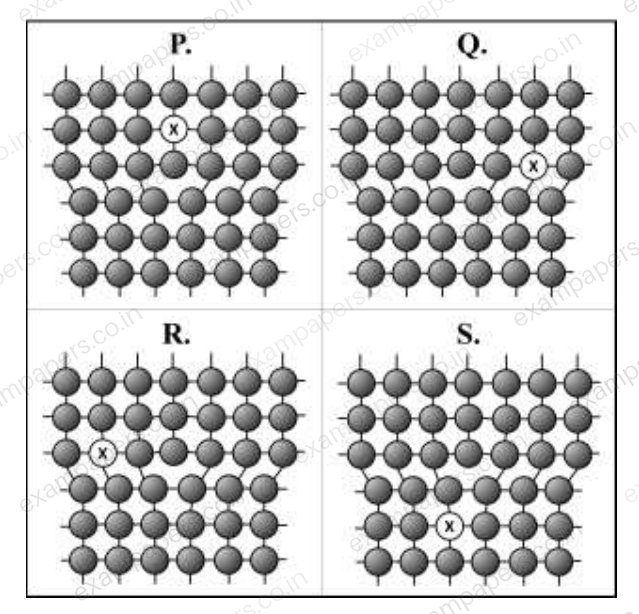
Your answerChoose one option.
Log in to check the answer
You can attempt this question now. Sign in to view the answer key, explanations and discussion.Log in to check answerQuestion 52
Open questionMTNAT2 marksNeeds review
In a powder diffraction experiment on BCC iron, the first peak occurs at
. The wavelength of X-rays is ______ (in nm to three decimal places). Given: The lattice parameter of iron = 0.287 nmLog in to check the answer
You can attempt this question now. Sign in to view the answer key, explanations and discussion.Log in to check answerQuestion 19
Open questionMTNAT1 markNeeds review
The second peak in the powder X-ray diffraction pattern of a FCC metal occurs at a Bragg angle θ (in degrees) = __________ (answer up to two decimal places)
(Given: λ_CuKα = 0.154 nm; lattice parameter of the metal = 0.36 nm)
Log in to check the answer
You can attempt this question now. Sign in to view the answer key, explanations and discussion.Log in to check answer