
Physics
GATE PH concept:hamiltonian PYQs
Build your understanding with focused practice from past exam papers.
How to practice concept:hamiltonian
Attempt a question, record the concept and assumptions, then check the available answer. Rework mistakes after revising the relevant concepts. Topic tags can overlap; review the question context.
Questions 1–10 of 14. Imported answers require independent review unless marked reviewed.
Question 51
Open questionPHMSQ2 marksNeeds review
The Lagrangian of a particle of mass
and charge
moving in a uniform magnetic field of magnitude
that points in the
direction, is given by
where
are the components of its velocity
. If
denote the conjugate momenta in the
directions and
is the Hamiltonian, which of the following option(s) is/are correct?Your answerSelect all correct options. You can choose more than one.
Log in to check the answer
You can attempt this question now. Sign in to view the answer key, explanations and discussion.Log in to check answerQuestion 52
Open questionPHMSQ2 marksNeeds review
A bead is constrained to move along a long, massless, frictionless horizontal rod parallel to the
axis. The rod itself is moving vertically upward along the
direction against gravity with a constant speed, starting from
at
, and remains horizontal. The conjugate momenta are denoted by
,
,
and the Hamiltonian by
. Which of the following option(s) is/are correct?Your answerSelect all correct options. You can choose more than one.
Log in to check the answer
You can attempt this question now. Sign in to view the answer key, explanations and discussion.Log in to check answerQuestion 53
Open questionPHMSQ2 marksNeeds review
In a one-dimensional Hamiltonian system with position
and momentum
, consider the canonical transformation
, where
and
are the new position and momentum, respectively. Which of the following option(s) regarding the generating function
is/are correct?Your answerSelect all correct options. You can choose more than one.
Log in to check the answer
You can attempt this question now. Sign in to view the answer key, explanations and discussion.Log in to check answerQuestion 54
Open questionPHMSQ2 marksNeeds review
The energy of a free, relativistic particle of rest mass
moving along the
axis in one dimension, is denoted by
. When moving in a given potential
, its Hamiltonian is
. In the presence of this potential, its speed is
, conjugate momentum
, and the Lagrangian
. Then, which of the following option(s) is/are correct?Your answerSelect all correct options. You can choose more than one.
Log in to check the answer
You can attempt this question now. Sign in to view the answer key, explanations and discussion.Log in to check answerQuestion 62
Open questionPHNAT2 marksNeeds review
The Hamiltonian for a one dimensional system with mass
, position
and momentum
is
, where
is a real function of
. If
, then
. The value of
(in integer) is _____.Log in to check the answer
You can attempt this question now. Sign in to view the answer key, explanations and discussion.Log in to check answerQuestion 23
Open questionPHMCQ1 markNeeds review
Let
be the phase space density of an ensemble of a system. The Hamiltonian of the system is
. If
denotes the Poisson bracket of
and
, then
implies
Your answerChoose one option.
Log in to check the answer
You can attempt this question now. Sign in to view the answer key, explanations and discussion.Log in to check answerQuestion 54
Open questionPHMSQ2 marksNeeds review
A system with time independent Hamiltonian
has two constants of motion
and
. Then which of the following Poisson brackets are always zero?Your answerSelect all correct options. You can choose more than one.
Log in to check the answer
You can attempt this question now. Sign in to view the answer key, explanations and discussion.Log in to check answerQuestion 55
Open questionPHMSQ2 marksNeeds review
In the action-angle variables
, consider the Hamiltonian
and
. Let
. Which of the following are possible plots of the trajectories with different initial conditions in
-
plane?Your answerSelect all correct options. You can choose more than one.
Log in to check the answer
You can attempt this question now. Sign in to view the answer key, explanations and discussion.Log in to check answerQuestion 30
Open questionPHMCQ2 marksNeeds review
Consider a point charge
of mass
suspended by a mass, inextensible string of length
in free space (permittivity
) as shown in the figure. It is placed at a height
(
) over an infinitely large, grounded conducting plane. The gravitational potential energy is assumed to be zero at the position of the conducting plane and is positive above the plane. If
represents the angular position and
its corresponding canonical momentum, then the correct Hamiltonian of the system is 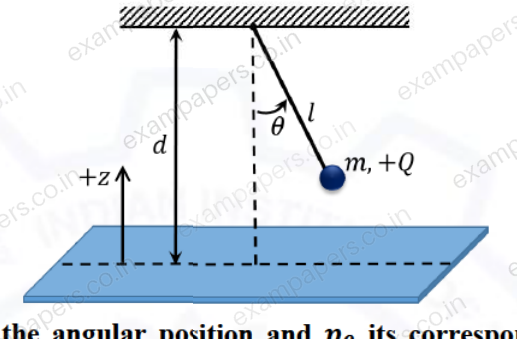
Your answerChoose one option.
Log in to check the answer
You can attempt this question now. Sign in to view the answer key, explanations and discussion.Log in to check answerQuestion 46
Open questionPHMSQ2 marksNeeds review
The time derivative of a differentiable function
is added to a Lagrangian
such that
where
are the generalized coordinates, generalized velocities and time, respectively. Let
be the generalized momentum and
the Hamiltonian associated with
. If
and
are those associated with
, then the correct option(s) is(are)Your answerSelect all correct options. You can choose more than one.
Log in to check the answer
You can attempt this question now. Sign in to view the answer key, explanations and discussion.Log in to check answer