
Physics
GATE PH exam:gate PYQs
Build your understanding with focused practice from past exam papers.
Questions 11–20 of 650. Imported answers require independent review unless marked reviewed.
Question 11
Open questionPHMCQ1 markNeeds review
In free space, an electromagnetic wave is traveling whose wavevector is
. The electric field component of this electromagnetic wave is given by
. The speed of light in free space is
. The corresponding magnetic field
isYour answerChoose one option.
Log in to check the answer
You can attempt this question now. Sign in to view the answer key, explanations and discussion.Log in to check answerQuestion 12
Open questionPHMCQ1 markNeeds review
An infinitely large non-conducting thin sheet in the
plane (
) carries a uniform surface charge density
. The electric field in the region
is
. Then, the electric field
in the region
will be(
)Your answerChoose one option.
Log in to check the answer
You can attempt this question now. Sign in to view the answer key, explanations and discussion.Log in to check answerQuestion 13
Open questionPHMCQ1 markNeeds review
Consider an operator
which is not Hermitian. Find the possible values of
and
such that the operator
is Hermitian.Your answerChoose one option.
Log in to check the answer
You can attempt this question now. Sign in to view the answer key, explanations and discussion.Log in to check answerQuestion 14
Open questionPHMCQ1 markNeeds review
For a scalar field
and a vector field
,
is equivalent to the expressionYour answerChoose one option.
Log in to check the answer
You can attempt this question now. Sign in to view the answer key, explanations and discussion.Log in to check answerQuestion 15
Open questionPHMCQ1 markNeeds review
Which of the following options is correct for transformation of electric field
and magnetic field
under time reversal, i.e.,
?Your answerChoose one option.
Log in to check the answer
You can attempt this question now. Sign in to view the answer key, explanations and discussion.Log in to check answerQuestion 16
Open questionPHMCQ1 markNeeds review
On a horizontal plane, a projectile of mass
is launched from the ground with speed
at an angle
with the horizontal. In addition to the gravitational force (
), it also experiences a drag force
, where
is its velocity and
is a constant. It hits the ground at a distance
from the point of launch with its velocity making an angle
with the horizontal, as shown schematically in the figure. Then which of the following options is correct? 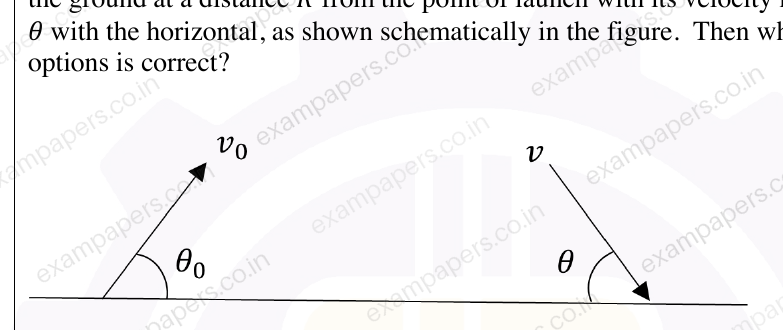
Your answerChoose one option.
Log in to check the answer
You can attempt this question now. Sign in to view the answer key, explanations and discussion.Log in to check answerQuestion 17
Open questionPHMCQ1 markNeeds review
Consider the Otto cycle for an ideal gas engine consisting of two quasistatic adiabatic and two quasistatic isochoric processes. The correct temperature-entropy (T-S) phase diagram for the cycle is
Your answerChoose one option.
Log in to check the answer
You can attempt this question now. Sign in to view the answer key, explanations and discussion.Log in to check answerQuestion 18
Open questionPHMCQ1 markNeeds review
The formula for energy
of a photon gas at temperature
in a two-dimensional box at equilibrium with
denoting the density of states of photons is given below where symbols
,
and
have their standard meaning. The specific heat (
) of this photon gas obeys
Your answerChoose one option.
Log in to check the answer
You can attempt this question now. Sign in to view the answer key, explanations and discussion.Log in to check answerQuestion 19
Open questionPHMCQ1 markNeeds review
For the electric field of an electromagnetic wave given below, which of the following statements is correct?
Your answerChoose one option.
Log in to check the answer
You can attempt this question now. Sign in to view the answer key, explanations and discussion.Log in to check answerQuestion 20
Open questionPHMCQ1 markNeeds review
A gas of non-interacting
atoms (of mass
) is in a three-dimensional trap whose energy levels can be approximated by those of a harmonic oscillator potential
. The chemical potential of the gas at
K isYour answerChoose one option.
Log in to check the answer
You can attempt this question now. Sign in to view the answer key, explanations and discussion.Log in to check answer