
Physics
GATE PH format:msq PYQs
Build your understanding with focused practice from past exam papers.
How to practice format:msq
Attempt a question, record the concept and assumptions, then check the available answer. Rework mistakes after revising the relevant concepts. Topic tags can overlap; review the question context.
Questions 1–10 of 88. Imported answers require independent review unless marked reviewed.
Question 24
Open questionPHMSQ1 markNeeds review
Given
is the electromagnetic charge and
is the strangeness quantum number, identify the particle(s) for which
is satisfied.Your answerSelect all correct options. You can choose more than one.
Log in to check the answer
You can attempt this question now. Sign in to view the answer key, explanations and discussion.Log in to check answerQuestion 25
Open questionPHMSQ1 markNeeds review
Schematic variation of the specific heat
of an ideal gas of diatomic molecules with temperature
is shown in the figure below. For rotational energy
and vibrational energy
of the molecule, which of the following options is/are correct? Here
is the Boltzmann constant. 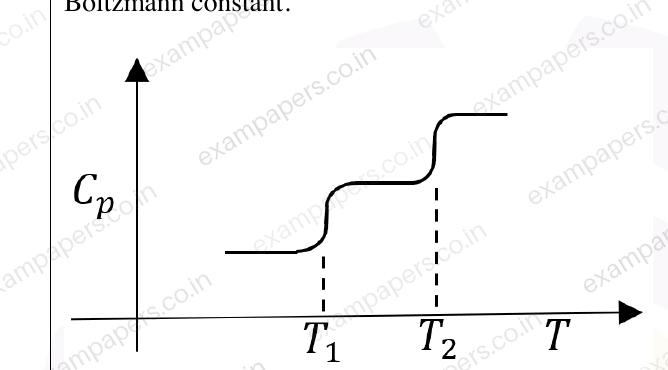
Your answerSelect all correct options. You can choose more than one.
Log in to check the answer
You can attempt this question now. Sign in to view the answer key, explanations and discussion.Log in to check answerQuestion 26
Open questionPHMSQ1 markNeeds review
If the perturbation
is added to the Hamiltonian of a one-dimensional harmonic oscillator, the matrix element
is/are non-zero for which of the following states? Here, the eigenstates of the harmonic oscillator are denoted by
.Your answerSelect all correct options. You can choose more than one.
Log in to check the answer
You can attempt this question now. Sign in to view the answer key, explanations and discussion.Log in to check answerQuestion 27
Open questionPHMSQ1 markNeeds review
For which of the following functions does the Laplacian vanish?
Your answerSelect all correct options. You can choose more than one.
Log in to check the answer
You can attempt this question now. Sign in to view the answer key, explanations and discussion.Log in to check answerQuestion 50
Open questionPHMSQ2 marksNeeds review
Which of the following operators is/are self-adjoint?
Your answerSelect all correct options. You can choose more than one.
Log in to check the answer
You can attempt this question now. Sign in to view the answer key, explanations and discussion.Log in to check answerQuestion 51
Open questionPHMSQ2 marksNeeds review
Consider two operators
and
which are related as
. If
is a non-zero real number, which of the following statements is/are true?Your answerSelect all correct options. You can choose more than one.
Log in to check the answer
You can attempt this question now. Sign in to view the answer key, explanations and discussion.Log in to check answerQuestion 52
Open questionPHMSQ2 marksNeeds review
Consider operators
,
, and
for three observables of a quantum system satisfying
,
, and
, with uncertainties
,
,
, respectively. From the options given below, which is/are implied by the commutation relations among
,
, and
?Your answerSelect all correct options. You can choose more than one.
Log in to check the answer
You can attempt this question now. Sign in to view the answer key, explanations and discussion.Log in to check answerQuestion 53
Open questionPHMSQ2 marksNeeds review
Consider the distribution of outcomes generated by
(
) independent throws of (i) a coin or (ii) a six-sided dice. A coin (dice) is unbiased if (all) its sides have equal probability to show up in a throw; it is biased otherwise. For the cases (i) and (ii) above, which of the following statements is/are true?Your answerSelect all correct options. You can choose more than one.
Log in to check the answer
You can attempt this question now. Sign in to view the answer key, explanations and discussion.Log in to check answerQuestion 54
Open questionPHMSQ2 marksNeeds review
The dispersion (
) of the conduction band (CB) and valence band (VB) for a semiconductor are shown schematically in the figure. Considering the possibility of an electron making a transition from the bottom of the CB to the top of the VB, which of the following options is/are correct? 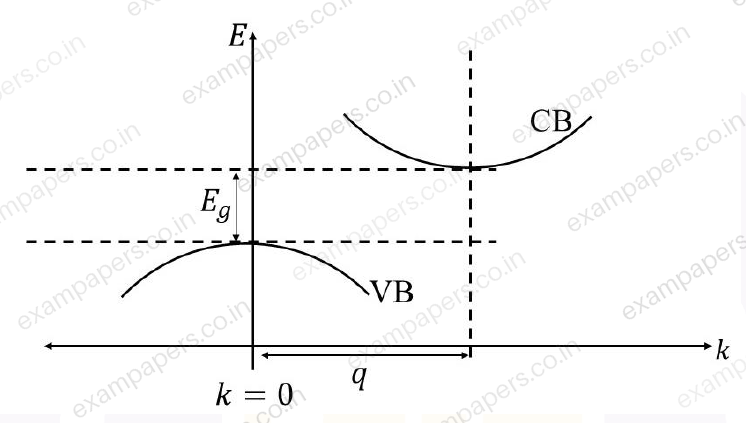
Your answerSelect all correct options. You can choose more than one.
Log in to check the answer
You can attempt this question now. Sign in to view the answer key, explanations and discussion.Log in to check answerQuestion 55
Open questionPHMSQ2 marksNeeds review
A symmetric rigid body has moment of inertia
about its principal axes 1, 2, and 3, respectively, with
and
. It is rotating in space with no torque on it so that its angular momentum
is constant. Let
be the components of its angular velocity along the principal axes 1, 2, and 3, respectively. Which of the following quantities is/are constant during the motion of this rigid body?Your answerSelect all correct options. You can choose more than one.
Log in to check the answer
You can attempt this question now. Sign in to view the answer key, explanations and discussion.Log in to check answer