
Physics
GATE PH Nuclear and Particle Physics PYQs
Build your understanding with focused practice from past exam papers.
Questions 41–50 of 61. Imported answers require independent review unless marked reviewed.
Question 21
Open questionPHNAT1 markNeeds review
A particle
undergoes strong decay
. The isospin of
is _____.Log in to check the answer
You can attempt this question now. Sign in to view the answer key, explanations and discussion.Log in to check answerQuestion 36
Open questionPHMCQ2 marksNeeds review
According to the Fermi gas model of the nucleus, the nucleons move in a spherical volume of radius
, where
is the mass number and
is an empirical constant with the dimensions of length. The Fermi energy of the nucleus
is proportional toYour answerChoose one option.
Log in to check the answer
You can attempt this question now. Sign in to view the answer key, explanations and discussion.Log in to check answerQuestion 52
Open questionPHNAT2 marksNeeds review
In the center of mass frame, two protons each having energy 7000 GeV, collide to produce protons and anti-protons. The maximum number of anti-protons produced is _____.
(Assume the proton mass to be 1 GeV/
)Log in to check the answer
You can attempt this question now. Sign in to view the answer key, explanations and discussion.Log in to check answerQuestion 2
Open questionPHMCQ1 markNeeds review
Considering baryon number and lepton number conservation laws, which of the following processes are allowed?
(i)
(ii)
Your answerChoose one option.
Log in to check the answer
You can attempt this question now. Sign in to view the answer key, explanations and discussion.Log in to check answerQuestion 13
Open questionPHMCQ1 markNeeds review
A massive particle X in free space decays spontaneously into two photons. Which of the following statements is true for X?
Your answerChoose one option.
Log in to check the answer
You can attempt this question now. Sign in to view the answer key, explanations and discussion.Log in to check answerQuestion 15
Open questionPHMCQ1 markNeeds review
The nuclear spin and parity of
in its ground state isYour answerChoose one option.
Log in to check the answer
You can attempt this question now. Sign in to view the answer key, explanations and discussion.Log in to check answerQuestion 41
Open questionPHMCQ2 marksNeeds review
Low energy collision (
-wave scattering) of pion (
) with deuteron (d) results in the production of two protons (
). The relative orbital angular momentum (in units of
) of the resulting two-proton system for this reaction isYour answerChoose one option.
Log in to check the answer
You can attempt this question now. Sign in to view the answer key, explanations and discussion.Log in to check answerQuestion 48
Open questionPHNAT2 marksNeeds review
A radioactive element X has a half-life of 30 hours. It decays via alpha, beta and gamma emissions with the branching ratio for beta decay being 0.75. The partial half-life for beta decay in unit of hours is
Log in to check the answer
You can attempt this question now. Sign in to view the answer key, explanations and discussion.Log in to check answerQuestion 14
Open questionPHMCQ1 markNeeds review
The elementary particle
is placed in the baryon decuplet, shown below, at 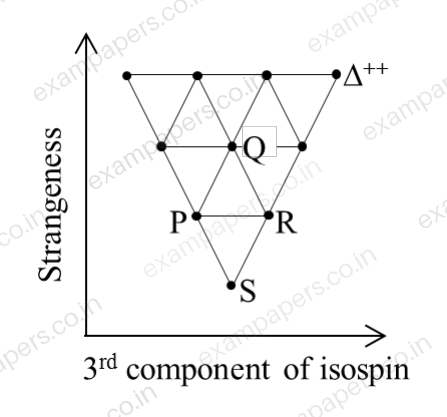
Your answerChoose one option.
Log in to check the answer
You can attempt this question now. Sign in to view the answer key, explanations and discussion.Log in to check answerQuestion 18
Open questionPHMCQ1 markNeeds review
In the decay,
, what is
?Your answerChoose one option.
Log in to check the answer
You can attempt this question now. Sign in to view the answer key, explanations and discussion.Log in to check answer