
Physics
GATE PH purpose:exam-prep PYQs
Build your understanding with focused practice from past exam papers.
Questions 41–50 of 650. Imported answers require independent review unless marked reviewed.
Question 41
Open questionPHMCQ2 marksNeeds review
The energy
and degeneracy
of the second excited state of a three-dimensional, isotropic quantum harmonic oscillator with angular frequency
areYour answerChoose one option.
Log in to check the answer
You can attempt this question now. Sign in to view the answer key, explanations and discussion.Log in to check answerQuestion 42
Open questionPHMCQ2 marksNeeds review
Two identical particles with a fixed total energy
are in thermal equilibrium in a one-dimensional harmonic oscillator potential
. Let the entropy of the particles be denoted by
if they are fermions with spin
and
if they are bosons with spin 0. Then, which of the following options is correct?
(
is the Boltzmann constant)Your answerChoose one option.
Log in to check the answer
You can attempt this question now. Sign in to view the answer key, explanations and discussion.Log in to check answerQuestion 43
Open questionPHMCQ2 marksNeeds review
In the circuit shown,
Volts, where
is in seconds, which of the following options is correct?
(take the op amp to be ideal)
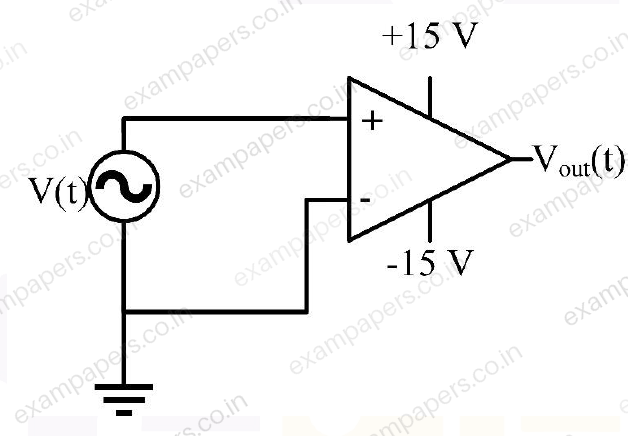
Your answerChoose one option.
Log in to check the answer
You can attempt this question now. Sign in to view the answer key, explanations and discussion.Log in to check answerQuestion 44
Open questionPHMCQ2 marksNeeds review
Considering the circuit and the associated signals measured at different pins (numbered as 1, 2, 3, 4, 5) shown in the figure, the correct option is
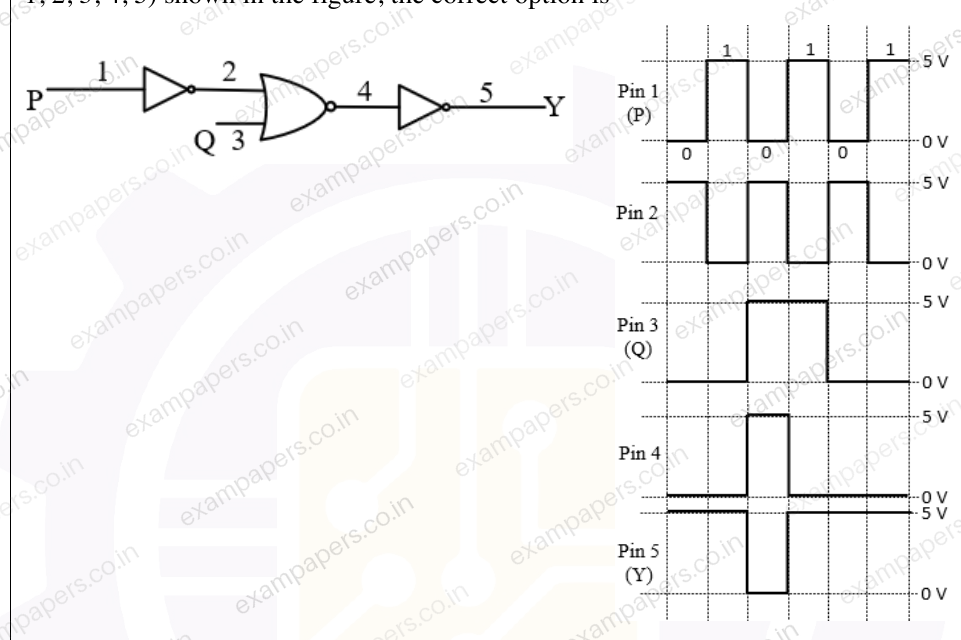
Your answerChoose one option.
Log in to check the answer
You can attempt this question now. Sign in to view the answer key, explanations and discussion.Log in to check answerQuestion 45
Open questionPHMCQ2 marksNeeds review
A gas of
classical particles that can occupy energy levels
and
is in equilibrium with a reservoir at temperature
. From the schematics shown below, choose the correct dependence of the internal energy
on
.Your answerChoose one option.
Log in to check the answer
You can attempt this question now. Sign in to view the answer key, explanations and discussion.Log in to check answerQuestion 46
Open questionPHMCQ2 marksNeeds review
The Lagrangian
with the generalized coordinate
is transformed to
. Consider the following statements:
(i) Expression for the canonical momentum does not change.
(ii) The equation of the motion does not change.
Which of the following options is correct for the above statements?Your answerChoose one option.
Log in to check the answer
You can attempt this question now. Sign in to view the answer key, explanations and discussion.Log in to check answerQuestion 47
Open questionPHMCQ2 marksNeeds review
An infinitely large thin sheet in the
-plane carries uniform positive charge density and is moving with constant velocity
in the
direction (see figure below). The direction of the corresponding Poynting vector is
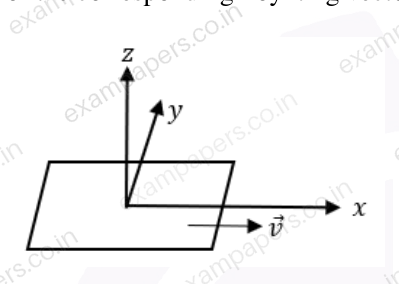
Your answerChoose one option.
Log in to check the answer
You can attempt this question now. Sign in to view the answer key, explanations and discussion.Log in to check answerQuestion 48
Open questionPHMCQ2 marksNeeds review
A positive point charge is fixed at the origin. At some distance from it on the
axis, a point dipole is kept pointing in the
direction. The force on the dipole isYour answerChoose one option.
Log in to check the answer
You can attempt this question now. Sign in to view the answer key, explanations and discussion.Log in to check answerQuestion 49
Open questionPHMCQ2 marksNeeds review
Two frames
(solid lines) and
(dashed lines) with common origin are shown in the figure below. Frame
is inertial while
is rotating about the common
-axis. There is a point mass fixed at
on the
-axis of the
frame. The magnitude of the centrifugal force and the Coriolis force experienced by the mass in the
frame is
and
, respectively. Which of the following options is correct for these forces? 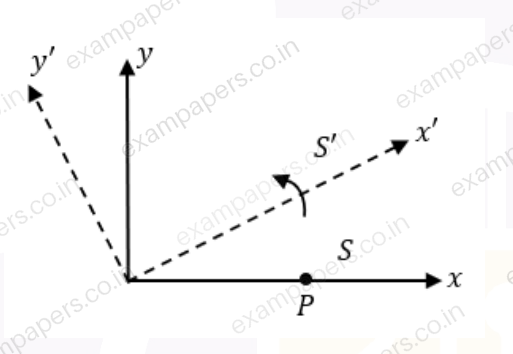
Your answerChoose one option.
Log in to check the answer
You can attempt this question now. Sign in to view the answer key, explanations and discussion.Log in to check answerQuestion 50
Open questionPHMSQ2 marksNeeds review
Which of the following operators is/are self-adjoint?
Your answerSelect all correct options. You can choose more than one.
Log in to check the answer
You can attempt this question now. Sign in to view the answer key, explanations and discussion.Log in to check answer