
Physics
GATE PH Solid State Physics PYQs
Build your understanding with focused practice from past exam papers.
Questions 51–60 of 65. Imported answers require independent review unless marked reviewed.
Question 25
Open questionPHNAT1 markNeeds review
A conventional type-I superconductor has a critical temperature of 4.7 K at zero magnetic field and a critical magnetic field of 0.3 Tesla at 0 K. The critical field in Tesla at 2 K (rounded off to three decimal places) is
Log in to check the answer
You can attempt this question now. Sign in to view the answer key, explanations and discussion.Log in to check answerQuestion 33
Open questionPHMCQ2 marksNeeds review
A particle of mass
moves in a lattice along the
-axis in a periodic potential
with periodicity
. The corresponding Brillouin zone extends from
to
with the two
-points being equivalent. If a weak force
in the
-direction is applied to the particle, it starts a periodic motion with time period
. Using the equation of motion
for a particle moving in a band, where
is the crystal momentum of the particle, the period
is found to be (
is Planck constant)Your answerChoose one option.
Log in to check the answer
You can attempt this question now. Sign in to view the answer key, explanations and discussion.Log in to check answerQuestion 55
Open questionPHNAT2 marksNeeds review
In a certain two-dimensional lattice, the energy dispersion of the electrons is
where
denotes the wave vector,
is the lattice constant and
is a constant in units of eV. In this lattice the effective mass tensor
of electrons calculated at the center of the Brillouin zone has the form
. The value of
(rounded off to three decimal places) is ______Log in to check the answer
You can attempt this question now. Sign in to view the answer key, explanations and discussion.Log in to check answerQuestion 7
Open questionPHMCQ1 markNeeds review
For the given unit cells of a two dimensional square lattice, which option lists all the primitive cells?
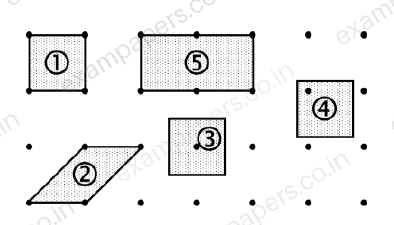
Your answerChoose one option.
Log in to check the answer
You can attempt this question now. Sign in to view the answer key, explanations and discussion.Log in to check answerQuestion 12
Open questionPHMCQ1 markNeeds review
At low temperatures (
), the specific heat of common metals is described by (with
and
as constants)Your answerChoose one option.
Log in to check the answer
You can attempt this question now. Sign in to view the answer key, explanations and discussion.Log in to check answerQuestion 16
Open questionPHMCQ1 markNeeds review
The high temperature magnetic susceptibility of solids having ions with magnetic moments can be described by
with
as absolute temperature and
as constant. The three behaviors i.e. paramagnetic, ferromagnetic and anti-ferromagnetic are described, respectively, byYour answerChoose one option.
Log in to check the answer
You can attempt this question now. Sign in to view the answer key, explanations and discussion.Log in to check answerQuestion 24
Open questionPHNAT1 markNeeds review
If X is the dimensionality of a free electron gas, the energy (E) dependence of density of states is given by
, where Y is ________.Log in to check the answer
You can attempt this question now. Sign in to view the answer key, explanations and discussion.Log in to check answerQuestion 35
Open questionPHMCQ2 marksNeeds review
The energy dispersion for electrons in one dimensional lattice with lattice parameter
is given by
, where
and
are constants. The effective mass of the electron near the bottom of the band isYour answerChoose one option.
Log in to check the answer
You can attempt this question now. Sign in to view the answer key, explanations and discussion.Log in to check answerQuestion 36
Open questionPHMCQ2 marksNeeds review
Amongst electrical resistivity (
), thermal conductivity (
), specific heat (
), Young’s modulus (Y), and magnetic susceptibility (
), which quantities show a sharp change at the superconducting transition temperature?Your answerChoose one option.
Log in to check the answer
You can attempt this question now. Sign in to view the answer key, explanations and discussion.Log in to check answerQuestion 7
Open questionPHNAT1 markNeeds review
The atomic mass and mass density of Sodium are 23 and 0.968 g cm
, respectively. The number density of valence electrons is ______
cm
. (Up to two decimal places.) (Avogadro number,
).Log in to check the answer
You can attempt this question now. Sign in to view the answer key, explanations and discussion.Log in to check answer