
Physics
GATE PH topic:classical-mechanics PYQs
Build your understanding with focused practice from past exam papers.
How to practice topic:classical-mechanics
Attempt a question, record the concept and assumptions, then check the available answer. Rework mistakes after revising the relevant concepts. Topic tags can overlap; review the question context.
Questions 1–10 of 51. Imported answers require independent review unless marked reviewed.
Question 11
Open questionPHMCQ1 markNeeds review
If
is the generating function of a canonical transformation from
to
, then which one of the following relations is correct?Your answerChoose one option.
Log in to check the answer
You can attempt this question now. Sign in to view the answer key, explanations and discussion.Log in to check answerQuestion 23
Open questionPHMCQ1 markNeeds review
Let
be the phase space density of an ensemble of a system. The Hamiltonian of the system is
. If
denotes the Poisson bracket of
and
, then
implies
Your answerChoose one option.
Log in to check the answer
You can attempt this question now. Sign in to view the answer key, explanations and discussion.Log in to check answerQuestion 25
Open questionPHMCQ1 markNeeds review
An inertial observer sees two spaceships S and T flying away from each other along x-axis with individual speed
, where c is the speed of light. The speed of T with respect to S isYour answerChoose one option.
Log in to check the answer
You can attempt this question now. Sign in to view the answer key, explanations and discussion.Log in to check answerQuestion 38
Open questionPHMCQ2 marksNeeds review
Consider the Lagrangian
. If
and
denote the generalized momenta conjugate to
and
, respectively, then the canonical equations of motion areYour answerChoose one option.
Log in to check the answer
You can attempt this question now. Sign in to view the answer key, explanations and discussion.Log in to check answerQuestion 41
Open questionPHMCQ2 marksNeeds review
The equation of motion for the forced simple harmonic oscillator is
where
and
. Which one of the following options is correct?Your answerChoose one option.
Log in to check the answer
You can attempt this question now. Sign in to view the answer key, explanations and discussion.Log in to check answerQuestion 60
Open questionPHNAT2 marksNeeds review
Lagrangian of a particle of mass
is
, where
is a positive constant. If the particle oscillates with total energy
, then the time period of oscillations is
The value of
is _____ (in integer).Log in to check the answer
You can attempt this question now. Sign in to view the answer key, explanations and discussion.Log in to check answerQuestion 40
Open questionPHMCQ2 marksNeeds review
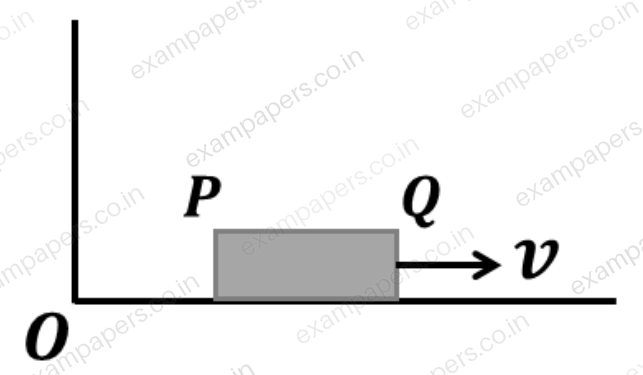
A rod
of proper length
lies along the
-axis and moves towards the positive
direction with speed
with respect to the ground (see figure), where
is the speed of light in vacuum. An observer on the ground measures the positions of
and
at different times
and
respectively in the ground frame, and finds the difference between them to be
. What is the value of
? 
Your answerChoose one option.
Log in to check the answer
You can attempt this question now. Sign in to view the answer key, explanations and discussion.Log in to check answerQuestion 41
Open questionPHMCQ2 marksNeeds review
A symmetric top has principal moments of inertia
about a set of principal axes 1, 2, 3, respectively, passing through its center of mass, where
is a positive constant. There is no force acting on the body and the angular speed of the body about the 3-axis is
rad/s. With what angular frequency in rad/s does the angular velocity vector
precess about the 3-axis?Your answerChoose one option.
Log in to check the answer
You can attempt this question now. Sign in to view the answer key, explanations and discussion.Log in to check answerQuestion 42
Open questionPHMCQ2 marksNeeds review
A particle of mass
is free to move on a frictionless horizontal two dimensional
plane, and is acted upon by a force
with
being a positive constant. If
and
are the generalised momenta corresponding to
and
respectively, then what is the value of
?Your answerChoose one option.
Log in to check the answer
You can attempt this question now. Sign in to view the answer key, explanations and discussion.Log in to check answerQuestion 21
Open questionPHMSQ1 markNeeds review
From the pairs of operators given below, identify the ones which commute. Here
and
correspond to the orbital angular momentum and the total angular momentum, respectively.Your answerSelect all correct options. You can choose more than one.
Log in to check the answer
You can attempt this question now. Sign in to view the answer key, explanations and discussion.Log in to check answer