
Physics
GATE PH topic:lagrangian-formulation PYQs
Build your understanding with focused practice from past exam papers.
How to practice topic:lagrangian-formulation
Attempt a question, record the concept and assumptions, then check the available answer. Rework mistakes after revising the relevant concepts. Topic tags can overlap; review the question context.
Questions 1–10 of 14. Imported answers require independent review unless marked reviewed.
Question 16
Open questionPHMCQ1 markNeeds review
On a horizontal plane, a projectile of mass
is launched from the ground with speed
at an angle
with the horizontal. In addition to the gravitational force (
), it also experiences a drag force
, where
is its velocity and
is a constant. It hits the ground at a distance
from the point of launch with its velocity making an angle
with the horizontal, as shown schematically in the figure. Then which of the following options is correct? 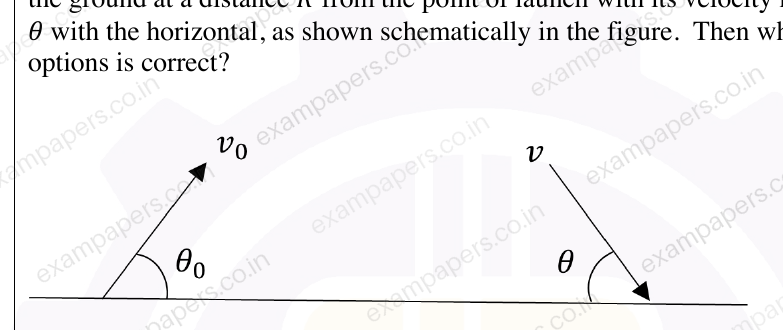
Your answerChoose one option.
Log in to check the answer
You can attempt this question now. Sign in to view the answer key, explanations and discussion.Log in to check answerQuestion 28
Open questionPHNAT1 markNeeds review
A projectile of mass
is launched from the ground with the initial speed
at an angle
from the horizontal. Take the ground to be horizontal. Ignoring the drag, the magnitude of Hamilton’s action
for the particle from the beginning till it hits the ground is
. The value of
(rounded off to two decimal places) is ____Log in to check the answer
You can attempt this question now. Sign in to view the answer key, explanations and discussion.Log in to check answerQuestion 46
Open questionPHMCQ2 marksNeeds review
The Lagrangian
with the generalized coordinate
is transformed to
. Consider the following statements:
(i) Expression for the canonical momentum does not change.
(ii) The equation of the motion does not change.
Which of the following options is correct for the above statements?Your answerChoose one option.
Log in to check the answer
You can attempt this question now. Sign in to view the answer key, explanations and discussion.Log in to check answerQuestion 49
Open questionPHMCQ2 marksNeeds review
Two frames
(solid lines) and
(dashed lines) with common origin are shown in the figure below. Frame
is inertial while
is rotating about the common
-axis. There is a point mass fixed at
on the
-axis of the
frame. The magnitude of the centrifugal force and the Coriolis force experienced by the mass in the
frame is
and
, respectively. Which of the following options is correct for these forces? 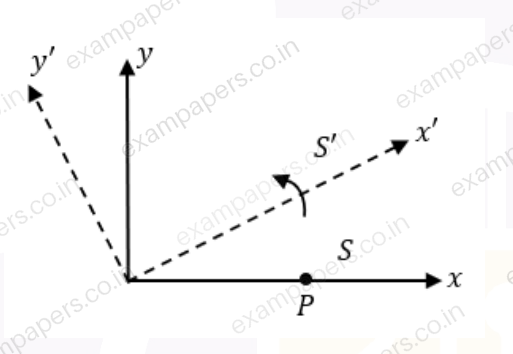
Your answerChoose one option.
Log in to check the answer
You can attempt this question now. Sign in to view the answer key, explanations and discussion.Log in to check answerQuestion 55
Open questionPHMSQ2 marksNeeds review
A symmetric rigid body has moment of inertia
about its principal axes 1, 2, and 3, respectively, with
and
. It is rotating in space with no torque on it so that its angular momentum
is constant. Let
be the components of its angular velocity along the principal axes 1, 2, and 3, respectively. Which of the following quantities is/are constant during the motion of this rigid body?Your answerSelect all correct options. You can choose more than one.
Log in to check the answer
You can attempt this question now. Sign in to view the answer key, explanations and discussion.Log in to check answerQuestion 64
Open questionPHNAT2 marksNeeds review
Two 1 kg blocks are connected to two massless springs of spring constants 8 N.m
and 4 N.m
. The system is kept on a frictionless horizontal floor with one end of a spring attached to a wall (see figure below). They are performing oscillatory motion along the
-axis with the normal mode frequencies
and
(
). The ratio
(rounded off to two decimal places) is _____. 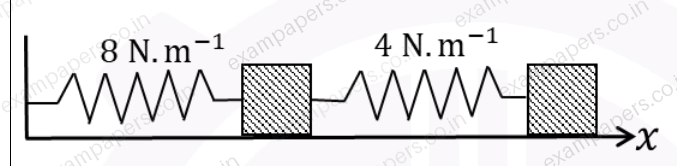
Log in to check the answer
You can attempt this question now. Sign in to view the answer key, explanations and discussion.Log in to check answerQuestion 65
Open questionPHNAT2 marksNeeds review
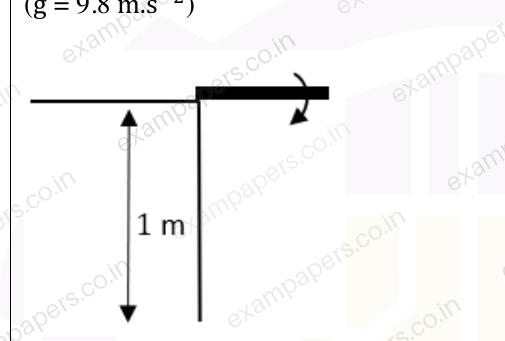
A 15 cm long scale is held horizontally with one of its ends on the edge of a 1 m high table and the other end resting on one’s index finger. As the finger is removed (see figure below), the scale starts rotating about its end on the table. After 0.1 s, during which it has rotated by a negligibly small angle but has gained a rotational speed as it leaves the table and falls vertically towards the ground. When its centre of mass has fallen by 0.5 m, it has rotated by an angle
. The value of
in degrees (rounded off to one decimal place) is _____(
m.s
) 
Log in to check the answer
You can attempt this question now. Sign in to view the answer key, explanations and discussion.Log in to check answerQuestion 38
Open questionPHMCQ2 marksNeeds review
The figure shows a system of two equal masses
and three massless horizontal springs with spring constants
. Ignore gravity. The masses can move only in the horizontal direction and there is no dissipation. If
,
and
(all in appropriate units), the frequencies of the normal modes of the system in the same system of units are 
Your answerChoose one option.
Log in to check the answer
You can attempt this question now. Sign in to view the answer key, explanations and discussion.Log in to check answerQuestion 51
Open questionPHMSQ2 marksNeeds review
The Lagrangian of a particle of mass
and charge
moving in a uniform magnetic field of magnitude
that points in the
direction, is given by
where
are the components of its velocity
. If
denote the conjugate momenta in the
directions and
is the Hamiltonian, which of the following option(s) is/are correct?Your answerSelect all correct options. You can choose more than one.
Log in to check the answer
You can attempt this question now. Sign in to view the answer key, explanations and discussion.Log in to check answerQuestion 52
Open questionPHMSQ2 marksNeeds review
A bead is constrained to move along a long, massless, frictionless horizontal rod parallel to the
axis. The rod itself is moving vertically upward along the
direction against gravity with a constant speed, starting from
at
, and remains horizontal. The conjugate momenta are denoted by
,
,
and the Hamiltonian by
. Which of the following option(s) is/are correct?Your answerSelect all correct options. You can choose more than one.
Log in to check the answer
You can attempt this question now. Sign in to view the answer key, explanations and discussion.Log in to check answer