
Physics
GATE PH topic:nuclear-particle-physics PYQs
Build your understanding with focused practice from past exam papers.
How to practice topic:nuclear-particle-physics
Attempt a question, record the concept and assumptions, then check the available answer. Rework mistakes after revising the relevant concepts. Topic tags can overlap; review the question context.
Questions 1–10 of 61. Imported answers require independent review unless marked reviewed.
Question 23
Open questionPHMCQ1 markNeeds review
Which one of the following is an allowed process?
Your answerChoose one option.
Log in to check the answer
You can attempt this question now. Sign in to view the answer key, explanations and discussion.Log in to check answerQuestion 24
Open questionPHMSQ1 markNeeds review
Given
is the electromagnetic charge and
is the strangeness quantum number, identify the particle(s) for which
is satisfied.Your answerSelect all correct options. You can choose more than one.
Log in to check the answer
You can attempt this question now. Sign in to view the answer key, explanations and discussion.Log in to check answerQuestion 38
Open questionPHMCQ2 marksNeeds review
Which one of the following statements is true?
Your answerChoose one option.
Log in to check the answer
You can attempt this question now. Sign in to view the answer key, explanations and discussion.Log in to check answerQuestion 56
Open questionPHMSQ2 marksNeeds review
An
particle moves towards a fixed nucleus carrying charge
, with initial speed
and impact parameter
. Starting from a large distance from the nucleus, its distance of closest approach is
and its speed there is
. Then which of the following options is/are correct? (
and
)Your answerSelect all correct options. You can choose more than one.
Log in to check the answer
You can attempt this question now. Sign in to view the answer key, explanations and discussion.Log in to check answerQuestion 18
Open questionPHMCQ1 markNeeds review
Which one of the following baryons has strangeness quantum number
?Your answerChoose one option.
Log in to check the answer
You can attempt this question now. Sign in to view the answer key, explanations and discussion.Log in to check answerQuestion 20
Open questionPHMCQ1 markNeeds review
The nuclear energy levels of mirror nuclei are similar. Using this empirical fact alone, the nuclear force can be said to be independent of which one of the following properties of the nucleons?
Your answerChoose one option.
Log in to check the answer
You can attempt this question now. Sign in to view the answer key, explanations and discussion.Log in to check answerQuestion 27
Open questionPHMSQ1 markNeeds review
Which of the following consideration(s) is/are shown that nuclear beta decay,
, has to be a three-body decay?Your answerSelect all correct options. You can choose more than one.
Log in to check the answer
You can attempt this question now. Sign in to view the answer key, explanations and discussion.Log in to check answerQuestion 29
Open questionPHMSQ1 markNeeds review
Nuclear radiation emitted from a
radioactive source is detected by a photomultiplier tube (PMT) coupled to a scintillator crystal. Which of the following option(s) is/are correct?Your answerSelect all correct options. You can choose more than one.
Log in to check the answer
You can attempt this question now. Sign in to view the answer key, explanations and discussion.Log in to check answerQuestion 35
Open questionPHNAT1 markNeeds review
The
baryon with spin
, at rest, decays to a proton and a pion (
). The
has positive intrinsic parity and
has negative intrinsic parity. The orbital angular momentum of the proton-pion system (in integer) is _____Log in to check the answer
You can attempt this question now. Sign in to view the answer key, explanations and discussion.Log in to check answerQuestion 39
Open questionPHMCQ2 marksNeeds review
Two projectile protons
and
both with spin up (along the +
direction) are scattered from another fixed target proton
with spin up at rest in the
plane, as shown in the figure. They scatter one at a time. The nuclear interaction potential between both the projectiles and the target proton is
, where
is the orbital angular momentum of the system with respect to the target,
is the spin angular momentum of the system and
is a negative constant in appropriate units. Which one of the following is correct? 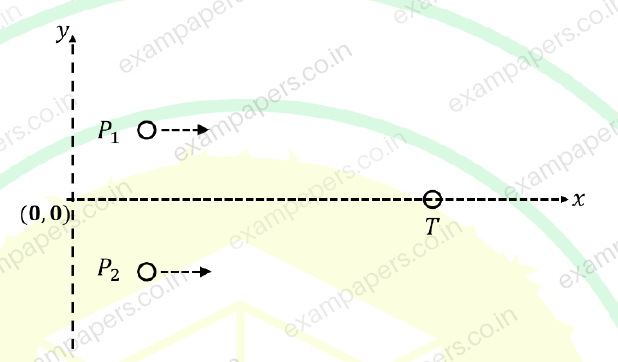
Your answerChoose one option.
Log in to check the answer
You can attempt this question now. Sign in to view the answer key, explanations and discussion.Log in to check answer