
Physics
GATE PH topic:physical-sciences PYQs
Build your understanding with focused practice from past exam papers.
Questions 111–120 of 650. Imported answers require independent review unless marked reviewed.
Question 46
Open questionPHMCQ2 marksNeeds review
A system of three non-identical spin
particles has the Hamiltonian
, where
,
and
are the spin operators of particles labelled 1, 2 and 3 respectively and
is a constant with appropriate dimensions. The set of possible energy eigenvalues of the system isYour answerChoose one option.
Log in to check the answer
You can attempt this question now. Sign in to view the answer key, explanations and discussion.Log in to check answerQuestion 47
Open questionPHMSQ2 marksNeeds review
Which of the following option(s) is/are correct for a Type I superconductor?
Your answerSelect all correct options. You can choose more than one.
Log in to check the answer
You can attempt this question now. Sign in to view the answer key, explanations and discussion.Log in to check answerQuestion 48
Open questionPHMSQ2 marksNeeds review
Consider two hypothetical nuclei
and
undergoing
decay, resulting in nuclei
and
, respectively. The decay scheme and the corresponding
values of the nuclei are given in the figure. Which of the following option(s) is/are correct? (
is the total angular momentum and
is parity) 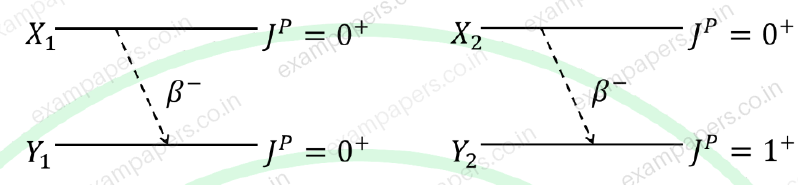
Your answerSelect all correct options. You can choose more than one.
Log in to check the answer
You can attempt this question now. Sign in to view the answer key, explanations and discussion.Log in to check answerQuestion 49
Open questionPHMSQ2 marksNeeds review
A point charge
is placed at a distance
above an infinite, grounded conducting plate placed on the
plane at
. The electrostatic potential in
region is given by
, where
and
. Which of the following option(s) is/are correct?Your answerSelect all correct options. You can choose more than one.
Log in to check the answer
You can attempt this question now. Sign in to view the answer key, explanations and discussion.Log in to check answerQuestion 50
Open questionPHMSQ2 marksNeeds review
In coordinates
, a contravariant second rank tensor
has non-zero diagonal components
and
, with all other components vanishing, and
being real constants. Here,
is time and
is space coordinate. Consider a Lorentz transformation
to another frame that moves with relative speed
in the
direction, so that
. If
and
are the diagonal components of
, then setting the speed of light
, and with
, which of the following option(s) is/are correct?Your answerSelect all correct options. You can choose more than one.
Log in to check the answer
You can attempt this question now. Sign in to view the answer key, explanations and discussion.Log in to check answerQuestion 51
Open questionPHMSQ2 marksNeeds review
The Lagrangian of a particle of mass
and charge
moving in a uniform magnetic field of magnitude
that points in the
direction, is given by
where
are the components of its velocity
. If
denote the conjugate momenta in the
directions and
is the Hamiltonian, which of the following option(s) is/are correct?Your answerSelect all correct options. You can choose more than one.
Log in to check the answer
You can attempt this question now. Sign in to view the answer key, explanations and discussion.Log in to check answerQuestion 52
Open questionPHMSQ2 marksNeeds review
A bead is constrained to move along a long, massless, frictionless horizontal rod parallel to the
axis. The rod itself is moving vertically upward along the
direction against gravity with a constant speed, starting from
at
, and remains horizontal. The conjugate momenta are denoted by
,
,
and the Hamiltonian by
. Which of the following option(s) is/are correct?Your answerSelect all correct options. You can choose more than one.
Log in to check the answer
You can attempt this question now. Sign in to view the answer key, explanations and discussion.Log in to check answerQuestion 53
Open questionPHMSQ2 marksNeeds review
In a one-dimensional Hamiltonian system with position
and momentum
, consider the canonical transformation
, where
and
are the new position and momentum, respectively. Which of the following option(s) regarding the generating function
is/are correct?Your answerSelect all correct options. You can choose more than one.
Log in to check the answer
You can attempt this question now. Sign in to view the answer key, explanations and discussion.Log in to check answerQuestion 54
Open questionPHMSQ2 marksNeeds review
The energy of a free, relativistic particle of rest mass
moving along the
axis in one dimension, is denoted by
. When moving in a given potential
, its Hamiltonian is
. In the presence of this potential, its speed is
, conjugate momentum
, and the Lagrangian
. Then, which of the following option(s) is/are correct?Your answerSelect all correct options. You can choose more than one.
Log in to check the answer
You can attempt this question now. Sign in to view the answer key, explanations and discussion.Log in to check answerQuestion 55
Open questionPHMSQ2 marksNeeds review
Consider the integral
where
is a complex variable and
are positive real numbers. The integral is taken over a unit circle with center at the origin. Which of the following option(s) is/are correct?Your answerSelect all correct options. You can choose more than one.
Log in to check the answer
You can attempt this question now. Sign in to view the answer key, explanations and discussion.Log in to check answer