
Physics
GATE PH year:2021 PYQs
Build your understanding with focused practice from past exam papers.
Questions 41–50 of 65. Imported answers require independent review unless marked reviewed.
Question 31
Open questionPHMCQ2 marksNeeds review
Consider two concentric conducting spherical shells as shown in the figure. The inner shell has a radius
and carries a charge +Q. The outer shell has a radius
and carries a charge
. The empty space between them is half-filled by a hemispherical shell of a dielectric having permittivity
. The remaining space between the shells is filled with air having the permittivity
. 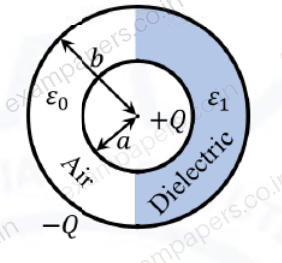
The electric field at a radial distance
from the center and between the shells (
) isYour answerChoose one option.
Log in to check the answer
You can attempt this question now. Sign in to view the answer key, explanations and discussion.Log in to check answerQuestion 32
Open questionPHMCQ2 marksNeeds review
For the given sets of energy levels of nuclei X and Y whose mass numbers are odd and even, respectively, choose the best suited interpretation.
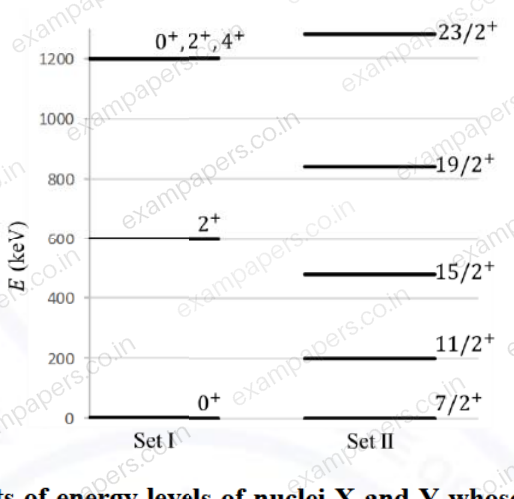
Your answerChoose one option.
Log in to check the answer
You can attempt this question now. Sign in to view the answer key, explanations and discussion.Log in to check answerQuestion 33
Open questionPHMCQ2 marksNeeds review
Consider a system of three distinguishable particles, each having spin
such that
with corresponding magnetic moments
. When the system is placed in an external magnetic field
pointing along the z-axis, the total energy of the system is
. Let
be the state where the first spin has
. The probability of having the state
and the mean magnetic moment (in the +z direction) of the system in state
areYour answerChoose one option.
Log in to check the answer
You can attempt this question now. Sign in to view the answer key, explanations and discussion.Log in to check answerQuestion 34
Open questionPHMCQ2 marksNeeds review
Consider a particle in a one-dimensional infinite potential well with its walls at
and
. The system is perturbed as shown in the figure. 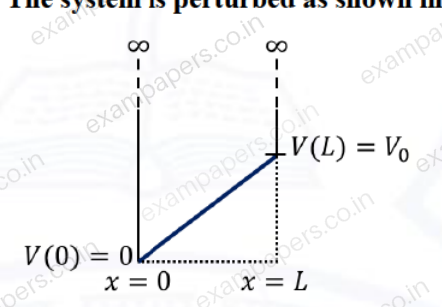
The first order correction to the energy eigenvalue is
Your answerChoose one option.
Log in to check the answer
You can attempt this question now. Sign in to view the answer key, explanations and discussion.Log in to check answerQuestion 35
Open questionPHMCQ2 marksNeeds review
Consider a state described by
, where
and
are respectively the second and fourth normalized harmonic oscillator wave functions and
is the angular frequency of the harmonic oscillator. The wave function
will be orthogonal to
at time
equal toYour answerChoose one option.
Log in to check the answer
You can attempt this question now. Sign in to view the answer key, explanations and discussion.Log in to check answerQuestion 36
Open questionPHMCQ2 marksNeeds review
Consider a single one-dimensional harmonic oscillator of angular frequency
, in equilibrium at temperature
. The states of the harmonic oscillator are all non-degenerate having energy
with equal probability, where
is the quantum number. The Helmholtz free energy of the oscillator isYour answerChoose one option.
Log in to check the answer
You can attempt this question now. Sign in to view the answer key, explanations and discussion.Log in to check answerQuestion 37
Open questionPHMCQ2 marksNeeds review
A system of two atoms can be in three quantum states having energies
,
and
. The system is in equilibrium at temperature
. Match the following Statistics with the Partition function.Statistics | Partition function |
|---|---|
CD: Classical (distinguishable particles) | Z1: |
CI: Classical (indistinguishable particles) | Z2: |
FD: Fermi-Dirac | Z3: |
BE: Bose-Einstein | Z4: |
Your answerChoose one option.
Log in to check the answer
You can attempt this question now. Sign in to view the answer key, explanations and discussion.Log in to check answerQuestion 38
Open questionPHMCQ2 marksNeeds review
The free energy of a ferromagnet is given by
, where
,
, and
are positive constants,
is the magnetization,
is the temperature, and
is the Curie temperature. The relation between
and
is best depicted byYour answerChoose one option.
Log in to check the answer
You can attempt this question now. Sign in to view the answer key, explanations and discussion.Log in to check answerQuestion 39
Open questionPHMCQ2 marksNeeds review
Consider a spherical galaxy of total mass
and radius
, having a uniform matter distribution. In this idealized situation, the orbital speed
of a star of mass
(
) as a function of the distance
from the galactic centre is best described by(
is the universal gravitational constant)Your answerChoose one option.
Log in to check the answer
You can attempt this question now. Sign in to view the answer key, explanations and discussion.Log in to check answerQuestion 40
Open questionPHMCQ2 marksNeeds review
Consider the potential
defined as
where
and
are real constants of appropriate dimensions. According to the first Born approximation, the elastic scattering amplitude calculated with
for a (wave-vector) momentum transfer
and
, is proportional to(Useful integral:
)Your answerChoose one option.
Log in to check the answer
You can attempt this question now. Sign in to view the answer key, explanations and discussion.Log in to check answer