
Physics
GATE PH year:2023 PYQs
Build your understanding with focused practice from past exam papers.
Questions 11–20 of 65. Imported answers require independent review unless marked reviewed.
Question 11
Open questionPHMCQ1 markNeeds review
Which one of the following entropy (S) - temperature (T) diagrams CORRECTLY represents the Carnot cycle
shown in the
-
diagram?
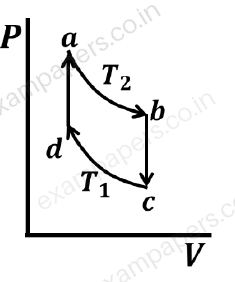
Your answerChoose one option.
Log in to check the answer
You can attempt this question now. Sign in to view the answer key, explanations and discussion.Log in to check answerQuestion 12
Open questionPHMCQ1 markNeeds review
Which one of the following is a dimensionless constant?
Your answerChoose one option.
Log in to check the answer
You can attempt this question now. Sign in to view the answer key, explanations and discussion.Log in to check answerQuestion 13
Open questionPHMCQ1 markNeeds review
Choose the most appropriate matching of the items in Column 1 with those in Column 2.
Column 1 | Column 2 |
|---|---|
(i) PIN diode | P. Voltage regulation |
(ii) Tunnel diode | Q. Radio frequency and microwave devices |
(iii) Zener diode | R. Optoelectronic detection |
(iv) Photo diode | S. Oscillator |
Your answerChoose one option.
Log in to check the answer
You can attempt this question now. Sign in to view the answer key, explanations and discussion.Log in to check answerQuestion 14
Open questionPHMCQ1 markNeeds review
The atomic number of an atom is 6. What is the spectroscopic notation of its ground state, according to Hund’s rules?
Your answerChoose one option.
Log in to check the answer
You can attempt this question now. Sign in to view the answer key, explanations and discussion.Log in to check answerQuestion 15
Open questionPHMCQ1 markNeeds review
is the Hamiltonian,
the orbital angular momentum and
is the z-component of
. The
state of the hydrogen atom in the non-relativistic formalism is an eigen function of which one of the following sets of operators?Your answerChoose one option.
Log in to check the answer
You can attempt this question now. Sign in to view the answer key, explanations and discussion.Log in to check answerQuestion 16
Open questionPHMCQ1 markNeeds review
The Hall experiment is carried out with a non-magnetic semiconductor. The current
is along the
-axis and the magnetic field
is along the
-axis. Which one of the following is the CORRECT representation of the variation of the magnitude of the Hall resistivity
as a function of the magnetic field?Your answerChoose one option.
Log in to check the answer
You can attempt this question now. Sign in to view the answer key, explanations and discussion.Log in to check answerQuestion 17
Open questionPHMCQ1 markNeeds review
Consider a two dimensional Cartesian coordinate system in which a rank 2 contravariant tensor is represented by the matrix
. The coordinate system is rotated anticlockwise by an acute angle
with the origin fixed. Which one of the following matrices represents the tensor in the new coordinate system?Your answerChoose one option.
Log in to check the answer
You can attempt this question now. Sign in to view the answer key, explanations and discussion.Log in to check answerQuestion 18
Open questionPHMCQ1 markNeeds review
A compound consists of three ions X, Y and Z. The Z ions are arranged in an FCC arrangement. The X ions occupy
of the tetrahedral voids and the Y ions occupy
of the octahedral voids. Which one of the following is the CORRECT chemical formula of the compound?Your answerChoose one option.
Log in to check the answer
You can attempt this question now. Sign in to view the answer key, explanations and discussion.Log in to check answerQuestion 19
Open questionPHMCQ1 markNeeds review
For a non-magnetic metal, which one of the following graphs best represents the behavior of
vs.
, where
is the heat capacity and
is the temperature?Your answerChoose one option.
Log in to check the answer
You can attempt this question now. Sign in to view the answer key, explanations and discussion.Log in to check answerQuestion 20
Open questionPHMCQ1 markNeeds review
For nonrelativistic electrons in a solid, different energy dispersion relations (with effective masses
,
, and
) are schematically shown in the plots. Which one of the following options is CORRECT? 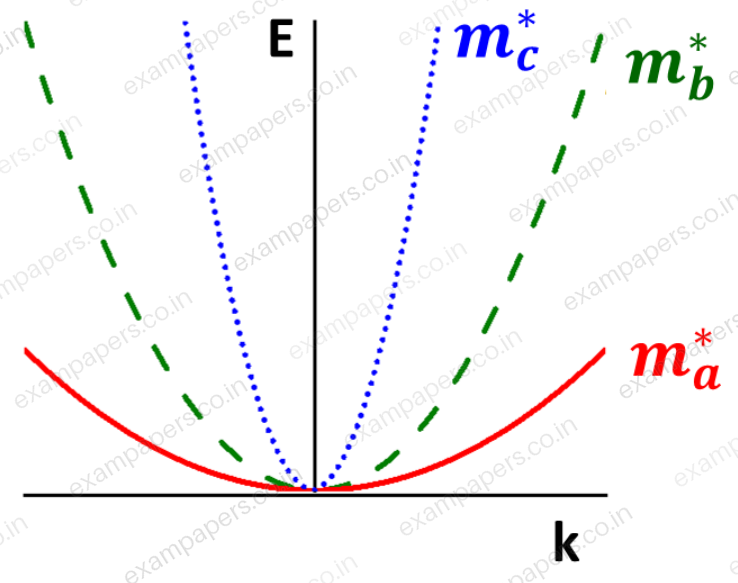
Your answerChoose one option.
Log in to check the answer
You can attempt this question now. Sign in to view the answer key, explanations and discussion.Log in to check answer