
Production and Industrial Engineering
GATE PI concept:extrusion PYQs
Build your understanding with focused practice from past exam papers.
How to practice concept:extrusion
Attempt a question, record the concept and assumptions, then check the available answer. Rework mistakes after revising the relevant concepts. Topic tags can overlap; review the question context.
Questions 1–10 of 11. Imported answers require independent review unless marked reviewed.
Question 26
Open questionPIMSQ1 markNeeds review
Which ONE or MORE among the following options CORRECTLY match(es) the type of defects with the corresponding metal working processes in which they are likely to occur?
Defect | Process |
|---|---|
P: Centerburst | 1: Deep drawing |
Q: Earing | 2: Rolling |
R: Zipper cracks | 3: Extrusion |
S: Cold shut | 4: Closed die forging |
| 5: Casting |
Your answerSelect all correct options. You can choose more than one.
Log in to check the answer
You can attempt this question now. Sign in to view the answer key, explanations and discussion.Log in to check answerQuestion 36
Open questionPIMCQ2 marksNeeds review
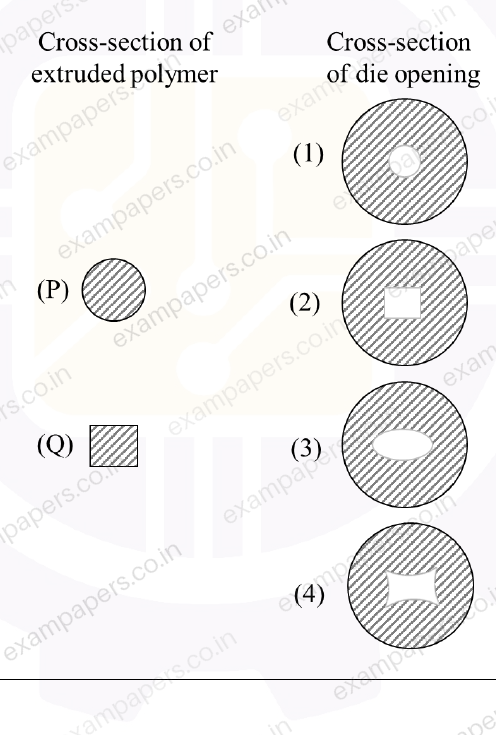
In a polymer extrusion process, some cross-sectional shapes of the extruded polymers are shown. Cross-sections of available dies are also shown.
Which ONE of the following CORRECTLY matches the extruded cross section with the die opening that most likely generated it?
Note: The cross-sections are in a plane orthogonal to the extrusion direction. Figures are not to scale.
Cross-section of extruded polymer: (P) circle; (Q) square.
Cross-section of die opening: (1) circular opening; (2) square opening; (3) oval opening; (4) concave, waisted opening.
Your answerChoose one option.
Log in to check the answer
You can attempt this question now. Sign in to view the answer key, explanations and discussion.Log in to check answerQuestion 38
Open questionPIMCQ2 marksNeeds review
For polymers, match each process with the most suitable application listed.
Process: P — Extrusion; Q — Injection molding; R — Blow molding; S — Compression molding.
Application: 1 — Producing complex parts with close tolerance; 2 — Producing thermosetting plastic components; 3 — Producing long uniform sections; 4 — Producing hollow shapes.
Your answerChoose one option.
Log in to check the answer
You can attempt this question now. Sign in to view the answer key, explanations and discussion.Log in to check answerQuestion 22
Open questionPIMCQ1 markNeeds review
A copper rod of 200 mm diameter and 400 mm length is extruded to the final diameter of 100 mm. The extrusion ratio is
Your answerChoose one option.
Log in to check the answer
You can attempt this question now. Sign in to view the answer key, explanations and discussion.Log in to check answerQuestion 43
Open questionPIMCQ2 marksNeeds review
Match the products to be manufactured with the given metal working processes.
Product: P—Beverage can; Q—Seamless pipe; R—Connecting rod; S—Steel balls for bearing.
Process: 1—Forging; 2—Skew Rolling; 3—Extrusion; 4—Deep Drawing.
Your answerChoose one option.
Log in to check the answer
You can attempt this question now. Sign in to view the answer key, explanations and discussion.Log in to check answerQuestion 47
Open questionPIMCQ2 marksNeeds review
The most appropriate process for manufacturing of plastic chair is
Your answerChoose one option.
Log in to check the answer
You can attempt this question now. Sign in to view the answer key, explanations and discussion.Log in to check answerQuestion 13
Open questionPIMCQ1 markNeeds review
The process used for producing long bars of fiber reinforced plastics (FRP) with uniform cross-section is
Your answerChoose one option.
Log in to check the answer
You can attempt this question now. Sign in to view the answer key, explanations and discussion.Log in to check answerQuestion 44
Open questionPINAT2 marksNeeds review
A cylindrical billet of 90 mm diameter is extruded to produce an I-section as shown in the figure (all dimensions in mm).
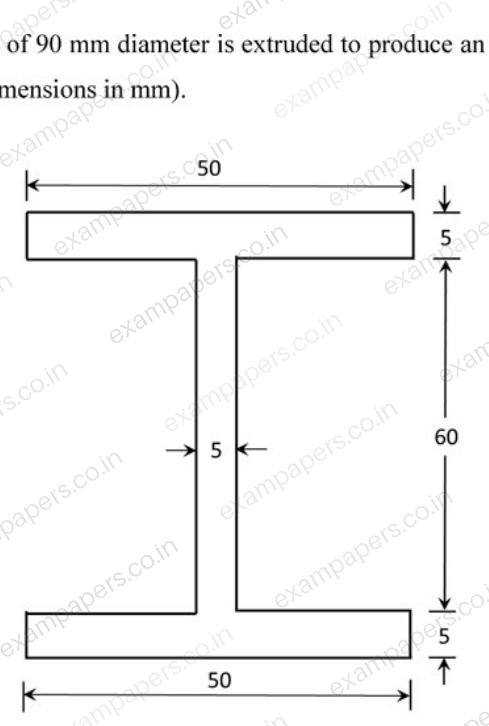
The total extrusion pressure (
) in MPa required for the above process is given by
where,
is the mean flow stress of the material, and
and
are the initial and the final cross-sectional areas, respectively. If the mean flow stress of the extruded material is 80 MPa, the force required for the above extrusion (rounded off to one decimal place) in kN is __________.Log in to check the answer
You can attempt this question now. Sign in to view the answer key, explanations and discussion.Log in to check answerQuestion 8
Open questionPIMCQ1 markNeeds review
The process used for producing continuous insulation coating on an electrical wire is
Your answerChoose one option.
Log in to check the answer
You can attempt this question now. Sign in to view the answer key, explanations and discussion.Log in to check answerQuestion 32
Open questionPIMCQ2 marksNeeds review
A 100 mm long cylindrical workpiece of diameter 50 mm is reduced to 25 mm diameter using extrusion process. The flow curve for the metal has strength coefficient as
MPa and the strain hardening co-efficient is 0.15. Assuming no friction and no redundant work, the required ram pressure (in MPa) is closest toYour answerChoose one option.
Log in to check the answer
You can attempt this question now. Sign in to view the answer key, explanations and discussion.Log in to check answer