
Production and Industrial Engineering
GATE PI concept:linear-programming PYQs
Build your understanding with focused practice from past exam papers.
How to practice concept:linear-programming
Attempt a question, record the concept and assumptions, then check the available answer. Rework mistakes after revising the relevant concepts. Topic tags can overlap; review the question context.
Questions 1–8 of 8. Imported answers require independent review unless marked reviewed.
Question 14
Open questionPIMCQ1 markNeeds review
Which ONE of the following options represents correctly ALL the constraints resulting in the feasible region for the given linear programming problem as shown in the figure?
Note: Figure not to scale
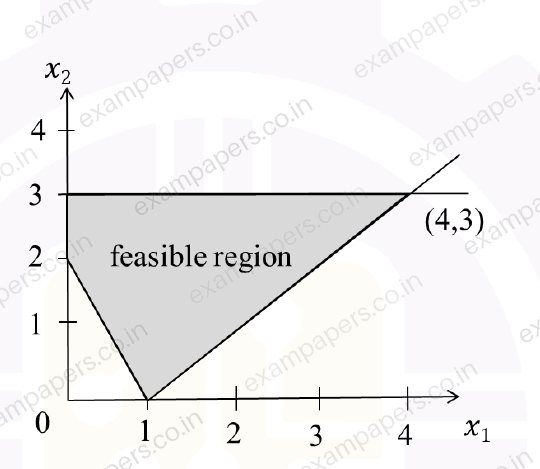
Your answerChoose one option.
Log in to check the answer
You can attempt this question now. Sign in to view the answer key, explanations and discussion.Log in to check answerQuestion 58
Open questionPINAT2 marksNeeds review
A company must allocate oil produced from their two plants to meet all the demands of two markets. The cost per litre of allocation from plant
to market
is denoted by
. The market demand
, plant production capacity
and
values are given in the table. | Market 1 ( ) | Market 2 ( ) | Capacity in litres |
|---|---|---|---|
Plant 1 ( ) | | | |
Plant 2 ( ) | | | |
Demand in litres | | | |
The company hired an intern to formulate an optimization model to decide on the quantity (
) to be allocated from plant
to market
and the formulation is given below:Minimize
Subject to
The optimal value of the objective function of the linear programming problem formulated by the intern is _____ (in integer).
Log in to check the answer
You can attempt this question now. Sign in to view the answer key, explanations and discussion.Log in to check answerQuestion 27
Open questionPIMCQ1 markNeeds review
The starting simplex table of a linear programming problem is given below, where
,
,
and
are the slack variables. The objective of the problem isMaximize
The leaving variable among the basic variables is
Basic | | | | | | | Solution |
|---|---|---|---|---|---|---|---|
| 6 | 3 | 1 | 0 | 0 | 0 | 36 |
| 2 | 1 | 0 | 1 | 0 | 0 | 40 |
| | 3 | 0 | 0 | 1 | 0 | 2 |
| 0 | 3 | 0 | 0 | 0 | 1 | 3 |
Your answerChoose one option.
Log in to check the answer
You can attempt this question now. Sign in to view the answer key, explanations and discussion.Log in to check answerQuestion 23
Open questionPIMCQ1 markNeeds review
Which of the following is NOT an assumption of a linear programming problem?
Your answerChoose one option.
Log in to check the answer
You can attempt this question now. Sign in to view the answer key, explanations and discussion.Log in to check answerQuestion 42
Open questionPIMCQ2 marksNeeds review
Consider the following linear programming problem with two decision variables
and
. There are three constraints involving resources R1, R2 and R3 as indicated.Maximize
Subject to
R1
R2
R3
The optimal solution of the problem is:
and
.For which one of the following options, the shadow price of the resource(s) will have non-zero value?
Your answerChoose one option.
Log in to check the answer
You can attempt this question now. Sign in to view the answer key, explanations and discussion.Log in to check answerQuestion 63
Open questionPINAT2 marksNeeds review
Consider the linear programming problem:
Maximize
,subject to
(C₁)
(C₂)
(C₃)
The optimal solution is given as
,
and
. The dual variables of constraints C₁, C₂ and C₃ are
,
and
, respectively. The optimal values of dual variables are
,
and
. The value of parameter P in the objective function is____________. [round off to one decimal place]Log in to check the answer
You can attempt this question now. Sign in to view the answer key, explanations and discussion.Log in to check answerQuestion 21
Open questionPIMCQ1 markNeeds review
The Bellman’s principle of optimality is related to
Your answerChoose one option.
Log in to check the answer
You can attempt this question now. Sign in to view the answer key, explanations and discussion.Log in to check answerQuestion 33
Open questionPIMCQ2 marksNeeds review
A company manufactures products P and Q in quantities
and
, respectively, using two resources. The following Linear Programming Problem (LPP) is formulated to maximize the profit Z.Maximize
subject to
(for Resource 1)
(for Resource 2)
and
.The shadow price for Resource 2 is
Your answerChoose one option.
Log in to check the answer
You can attempt this question now. Sign in to view the answer key, explanations and discussion.Log in to check answer