
Production and Industrial Engineering
GATE PI topic:manufacturing PYQs
Build your understanding with focused practice from past exam papers.
Questions 401–410 of 650. Imported answers require independent review unless marked reviewed.
Question 1
Open questionPIMCQ1 markNeeds review
The divergence of the vector
isYour answerChoose one option.
Log in to check the answer
You can attempt this question now. Sign in to view the answer key, explanations and discussion.Log in to check answerQuestion 2
Open questionPIMCQ1 markNeeds review
An integrating factor for the differential equation
isYour answerChoose one option.
Log in to check the answer
You can attempt this question now. Sign in to view the answer key, explanations and discussion.Log in to check answerQuestion 3
Open questionPIMCQ1 markNeeds review
For the complex numbers
and
, the value of
isYour answerChoose one option.
Log in to check the answer
You can attempt this question now. Sign in to view the answer key, explanations and discussion.Log in to check answerQuestion 4
Open questionPIMCQ1 markNeeds review
To solve
, the Newton-Raphson method has been employed. If the initial guess
, the next estimate of the root,
, will beYour answerChoose one option.
Log in to check the answer
You can attempt this question now. Sign in to view the answer key, explanations and discussion.Log in to check answerQuestion 5
Open questionPIMCQ1 markNeeds review
If
is a random variable with the expected value of 5 and the variance of 1, then the expected value of
isYour answerChoose one option.
Log in to check the answer
You can attempt this question now. Sign in to view the answer key, explanations and discussion.Log in to check answerQuestion 6
Open questionPIMCQ1 markNeeds review
Group I lists phases of steel and Group II lists crystal structures in the table below.
Group I
P. Ferrite
Q. Austenite
R. Martensite
Group II
Hexagonal Close Packed (HCP)
Body Centered Cubic (BC)
Body Centered Tetragonal (BT)
Face Centered Cubic (FC)
Match the phase with the corresponding crystal structure.
Your answerChoose one option.
Log in to check the answer
You can attempt this question now. Sign in to view the answer key, explanations and discussion.Log in to check answerQuestion 7
Open questionPIMCQ1 markNeeds review
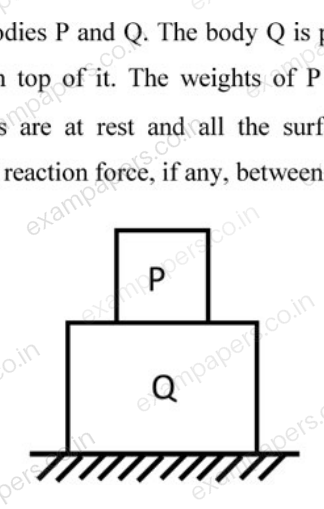
The figure shows two bodies P and Q. The body Q is placed on the ground and the body P is placed on top of it. The weights of P and Q are
and
, respectively. The bodies are at rest and all the surfaces are assumed to be frictionless.
represents reaction force, if any, between the bodies.The correct free body diagram of the body P is
Your answerChoose one option.
Log in to check the answer
You can attempt this question now. Sign in to view the answer key, explanations and discussion.Log in to check answerQuestion 8
Open questionPIMCQ1 markNeeds review
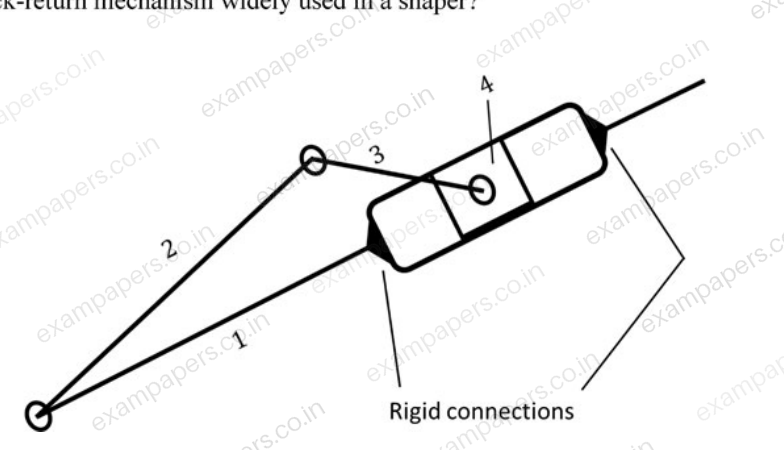
The figure shows a mechanism with 3 revolute pairs (between the links 1 and 2, 2 and 3, and 3 and 4) and a prismatic pair (between the links 1 and 4). Which one of the four links should be fixed to obtain the mechanism that forms the basis of the quick-return mechanism widely used in a shaper?
Your answerChoose one option.
Log in to check the answer
You can attempt this question now. Sign in to view the answer key, explanations and discussion.Log in to check answerQuestion 9
Open questionPIMCQ1 markNeeds review
The state of stress at a point in a body under plane stress condition is shown in the figure. The positive directions of
and
axes are also shown. The material of the body is homogeneous and isotropic, with modulus of elasticity
and Poisson’s ratio
. The longitudinal strain in the
-direction is 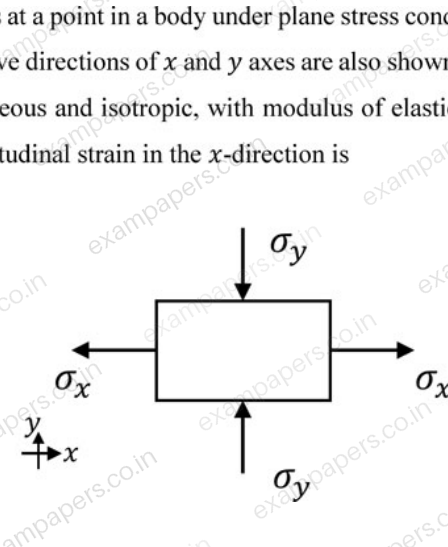
Your answerChoose one option.
Log in to check the answer
You can attempt this question now. Sign in to view the answer key, explanations and discussion.Log in to check answerQuestion 10
Open questionPIMCQ1 markNeeds review
The figure shows two bodies connected through a riveted joint with one rivet. The diameter of the rivet is
(in m). The joint transmits a load of
(in N) whose line of action is perpendicular to and intersects the vertical axis of the rivet. Neglect any effect of bending of the rivet. If the allowable shear stress for the material of the rivet is
N/m
, the diameter of the rivet required to prevent failure in shear is 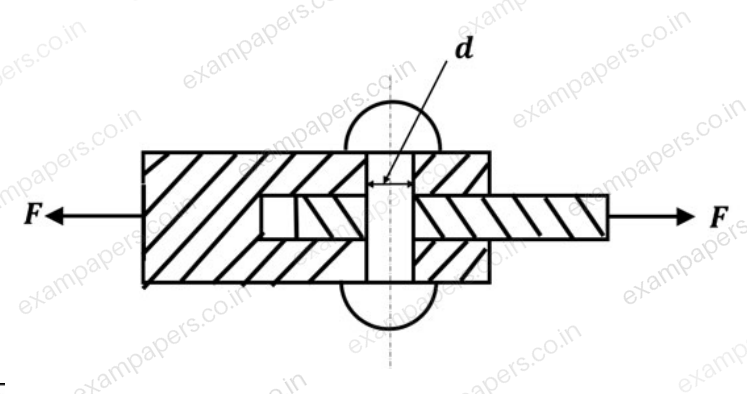
Your answerChoose one option.
Log in to check the answer
You can attempt this question now. Sign in to view the answer key, explanations and discussion.Log in to check answer