
Production and Industrial Engineering
GATE PI topic:thermal-fluids-engineering PYQs
Build your understanding with focused practice from past exam papers.
How to practice topic:thermal-fluids-engineering
Attempt a question, record the concept and assumptions, then check the available answer. Rework mistakes after revising the relevant concepts. Topic tags can overlap; review the question context.
Questions 1–10 of 39. Imported answers require independent review unless marked reviewed.
Question 29
Open questionPIMSQ1 markNeeds review
Which ONE or MORE among the following process of the Carnot cycle is/are isentropic?
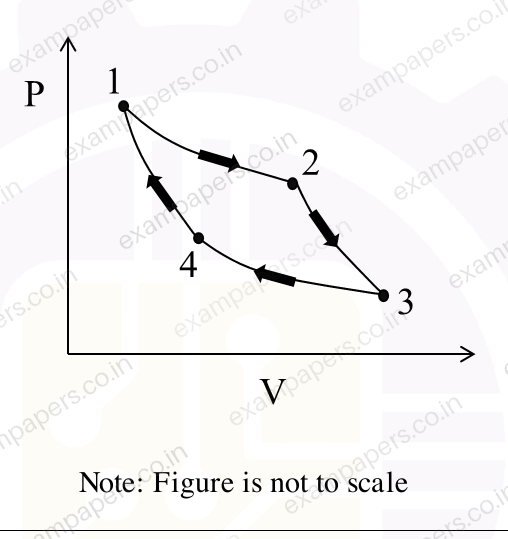
Your answerSelect all correct options. You can choose more than one.
Log in to check the answer
You can attempt this question now. Sign in to view the answer key, explanations and discussion.Log in to check answerQuestion 43
Open questionPIMCQ2 marksNeeds review
A glass tube of 2.5 mm diameter is immersed vertically in a fluid.
Assume contact angle is zero. The surface tension of the fluid is 0.1 N/m, density of the fluid is 1000 kg/m³ and acceleration due to gravity is 10 m/s².
The approximate capillary rise is _____ mm.
Your answerChoose one option.
Log in to check the answer
You can attempt this question now. Sign in to view the answer key, explanations and discussion.Log in to check answerQuestion 28
Open questionPIMCQ1 markNeeds review
For an ideal Diesel cycle, the heat addition is an
Your answerChoose one option.
Log in to check the answer
You can attempt this question now. Sign in to view the answer key, explanations and discussion.Log in to check answerQuestion 64
Open questionPINAT2 marksNeeds review
Water flows through a smooth circular pipe of diameter 10 cm and length 10 m. The pressure drop across the length of the pipe is 0.2 Pa. Kinematic viscosity and density of water are 1×10⁻⁶ m²/s and 1000 kg/m³, respectively. Assuming laminar and fully developed flow throughout the pipe, the velocity of water (in m/s) at the center of the pipe is __________. (Rounded off to one decimal place)
Log in to check the answer
You can attempt this question now. Sign in to view the answer key, explanations and discussion.Log in to check answerQuestion 65
Open questionPINAT2 marksNeeds review
The left-hand side of a 20 cm thick wall is maintained at 25 °C. The right-hand side of the wall is exposed to hot air at 50 °C. There is no heat generation inside the wall and its thermal conductivity is 100 W/m·K. The convective heat transfer coefficient is 50 W/m²·K. Under steady state condition, the temperature (in °C) of the right-hand side surface of the wall is__________. (Rounded off to one decimal place)
Log in to check the answer
You can attempt this question now. Sign in to view the answer key, explanations and discussion.Log in to check answerQuestion 14
Open questionPIMCQ1 markNeeds review
A thin copper wire carries electric current and is insulated by putting a sleeve of thickness
, over it. In steady state conditions, the rate of heat loss from the insulated wire per unit length is
. Which of the following is TRUE?Your answerChoose one option.
Log in to check the answer
You can attempt this question now. Sign in to view the answer key, explanations and discussion.Log in to check answerQuestion 48
Open questionPINAT2 marksNeeds review
An irrigation pump is used to draw water from a pond. One end of a 5.05 cm diameter hose pipe is connected to the outlet of the pump at 1.02 m below the surface level, and just after the pump, the static gauge pressure and flow rate of the water are 50 kPa and 8 kg/s, respectively. The pumped water is discharged at the ground level through a nozzle. Assume that the flow through the hose pipe and nozzle is steady and laminar, and friction and viscous losses are negligible. The density of water is 1000 kg/m
and the acceleration due to gravity is 9.81 m/s
. If the static pressure at the nozzle exit of the nozzle jet reduces to atmospheric pressure then the nozzle diameter (in cm) of the nozzle is __________. (Rounded off to 2 decimal places)Log in to check the answer
You can attempt this question now. Sign in to view the answer key, explanations and discussion.Log in to check answerQuestion 49
Open questionPINAT2 marksNeeds review
In an air-standard Otto cycle, the pressure and temperature of air just before the compression stroke are 200 kPa and 26.85 °C, respectively. The combustion process is assumed to be a constant volume process, where 1.02 MJ/kg heat is added. The cycle efficiency is 50%. The adiabatic index
and specific heat at constant volume
can be considered to be constant during the process (corresponding values taken at the mean cycle temperature).Assuming that the ideal gas law is applicable,
and
kJ/kg-K, the maximum pressure (in MPa) reached during the cycle is __________. (Rounded off to 1 decimal place)Log in to check the answer
You can attempt this question now. Sign in to view the answer key, explanations and discussion.Log in to check answerQuestion 15
Open questionPIMCQ1 markNeeds review
Two plane parallel surfaces exchange heat by thermal radiation. A radiation shield is placed in between at equal distance from the two surfaces to reduce heat transfer. All surfaces are black with infinite length and width. The ratio of heat transfer rate between surfaces with and without radiation shield is
Your answerChoose one option.
Log in to check the answer
You can attempt this question now. Sign in to view the answer key, explanations and discussion.Log in to check answerQuestion 31
Open questionPINAT1 markNeeds review
A wooden cubical block of side 0.1 m has specific gravity (SG) of 0.75. It is held submerged in a pool of oil and water by a massless rigid wire as shown in figure. The density of water is 1000 kg/m
and acceleration due to gravity is 9.8 m/s
. The tension, in N, in the wire is _____ (round off to 2 decimal places). 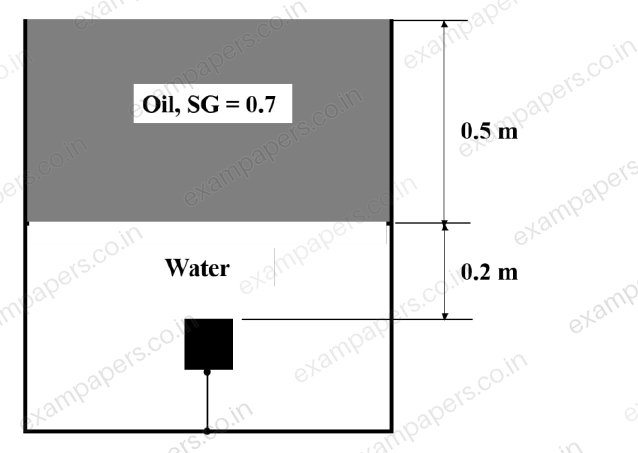
Log in to check the answer
You can attempt this question now. Sign in to view the answer key, explanations and discussion.Log in to check answer