
Engineering Sciences
GATE XE Bernoulli’s Equation and its Applications, Potential Flows PYQs
Build your understanding with focused practice from past exam papers.
Questions 21–30 of 34. Imported answers require independent review unless marked reviewed.
Question 10
Open questionXE-BMCQ2 marksNeeds review
Column I represents a list of elementary plane flows and Column II represents flow past geometry obtained by superposition of these elementary plane flows.
Column I
P: Source, Sink, Uniform flow
Q: Doublet, Uniform flow
R: Source, Uniform flow
S: Doublet, Free vortex, Uniform flow
Column II
1: Rankine half body
2: Rotating Cylinder
3: Rankine oval
4: Cylinder
The correct match between Columns I and II is,
Your answerChoose one option.
Log in to check the answer
You can attempt this question now. Sign in to view the answer key, explanations and discussion.Log in to check answerQuestion 15
Open questionXE-BNAT2 marksNeeds review
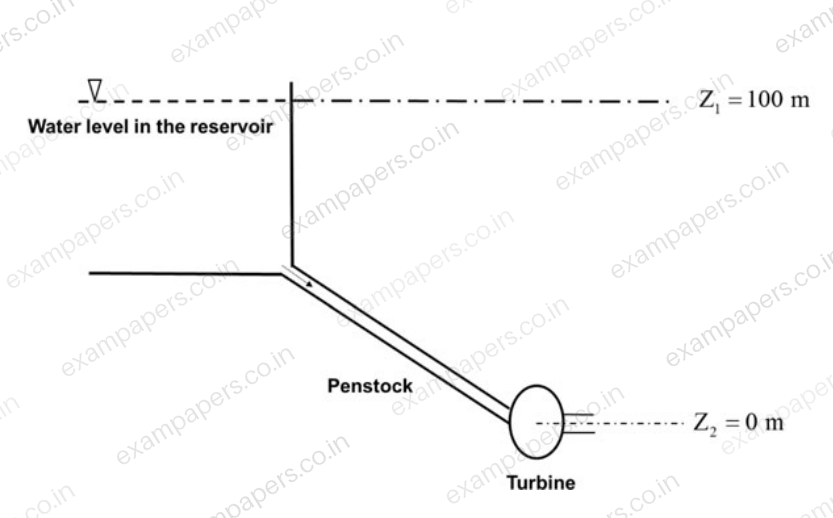
A hydroelectric power plant takes in 30 m
/s of water through its turbine and discharges it to the atmosphere with
m/s. The total head loss in the turbine and penstock system is 20 m. (Assume turbulent flow with kinetic energy correction factor as 1.1. Density of water is 1000 kg/m
and acceleration due to gravity, g is 10 m/s
).The net head available to the turbine for power generation is --------------- m.
(rounded off to one decimal place).
Log in to check the answer
You can attempt this question now. Sign in to view the answer key, explanations and discussion.Log in to check answerQuestion 19
Open questionXE-BNAT2 marksNeeds review
A venturimeter with 75 mm diameter throat is placed in a 150 mm diameter pipeline carrying water at 25°C. The pressure drop between the upstream tap and the venturi throat is 40 kPa. (Density of water = 1000 kg/m
).The flow rate is ______ m
/s (rounded off to three decimal places).Log in to check the answer
You can attempt this question now. Sign in to view the answer key, explanations and discussion.Log in to check answerQuestion 3
Open questionXE-BMCQ1 markNeeds review
In which one of the following devices the difference between static and total pressure is used to determine the flow velocity?
Your answerChoose one option.
Log in to check the answer
You can attempt this question now. Sign in to view the answer key, explanations and discussion.Log in to check answerQuestion 9
Open questionXE-BNAT1 markNeeds review
The theoretical discharge for the flow through an orificemeter is
. If the measured discharge in an experiment is
, then the discharge coefficient (rounded off to one decimal place) is ________Log in to check the answer
You can attempt this question now. Sign in to view the answer key, explanations and discussion.Log in to check answerQuestion 16
Open questionXE-BMCQ2 marksNeeds review
A fluid with constant density of
flows past a semi-cylindrical structure with a freestream velocity of
as shown in the figure below. The difference in static pressure between points P and Q is
. If the gravitational acceleration
is
and the flow is assumed to be potential, what is the radius
(in m) of the semi-cylindrical structure? 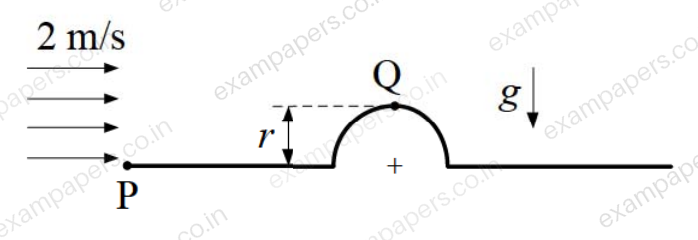
Your answerChoose one option.
Log in to check the answer
You can attempt this question now. Sign in to view the answer key, explanations and discussion.Log in to check answerQuestion 19
Open questionXE-BNAT2 marksNeeds review
A uniform flow with a velocity of 2 m/s in the
-direction approaches a line source placed on the
-axis at a distance of 0.1 m from the origin. If the origin is the stagnation point in the resulting flow, the strength of the source (in
, rounded off to 2 decimal places) is ______.Log in to check the answer
You can attempt this question now. Sign in to view the answer key, explanations and discussion.Log in to check answerQuestion 3
Open questionXE-BMCQ1 markNeeds review
The inviscid flow past a rotating circular cylinder can be generated by the superposition of
Your answerChoose one option.
Log in to check the answer
You can attempt this question now. Sign in to view the answer key, explanations and discussion.Log in to check answerQuestion 9
Open questionXE-BNAT1 markNeeds review
A pitot-static tube is used to measure air velocity in a duct by neglecting losses. The density of air is 1.2 kg/m
. If the difference between the total and static pressures is 1 kPa, the velocity of air at the measuring location, in m/s, is ________.Log in to check the answer
You can attempt this question now. Sign in to view the answer key, explanations and discussion.Log in to check answerQuestion 22
Open questionXE-BNAT2 marksNeeds review
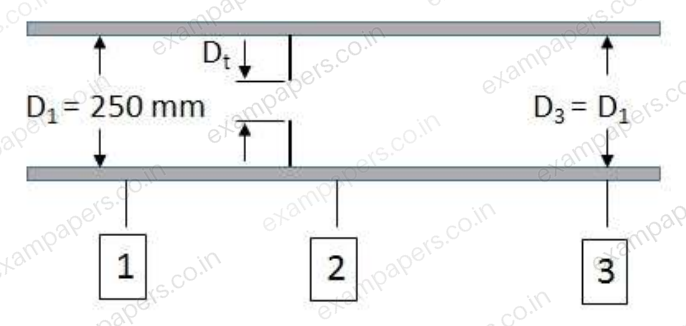
An orifice plate is used to measure flow rate of air (density = 1.23 kg/m³) in a duct of 250 mm diameter as shown in figure. The volume flow rate is 1 m³/s. Flow at sections 1 and 3 are uniform and section 2 is located at vena contracta. The diameter ratio, D_t/D_1, is 0.66. The flow area at vena contracta, A_2 = 0.65A_t, where A_t is area of the orifice. The pressure difference between locations 2 and 3 in N/m² is __________.
Log in to check the answer
You can attempt this question now. Sign in to view the answer key, explanations and discussion.Log in to check answer