
Engineering Sciences
GATE XE branch:xe PYQs
Build your understanding with focused practice from past exam papers.
Questions 1191–1200 of 1772. Imported answers require independent review unless marked reviewed.
Question 10
Open questionXE-FMCQ2 marksNeeds review
Match the polymers in Column A with their corresponding polymerization methods in Column B.
Column A | Column B |
|---|---|
P — Bisphenol A polycarbonate | 1 — Cationic |
Q — Polyethylene | 2 — Step-growth |
R — Poly(styrene-b-butadiene) | 3 — Coordination |
S — Butyl rubber | 4 — Anionic |
Your answerChoose one option.
Log in to check the answer
You can attempt this question now. Sign in to view the answer key, explanations and discussion.Log in to check answerQuestion 11
Open questionXE-FMCQ2 marksNeeds review
Match the appropriate process technique in Column A to fabricate the product in Column B.
Column A | Column B |
|---|---|
P — Blow molding | 1 — Plastic buckets |
Q — Rotational molding | 2 — PVC sheet |
R — Injection molding | 3 — Basket ball |
S — Calendering | 4 — Plastic bottles |
Your answerChoose one option.
Log in to check the answer
You can attempt this question now. Sign in to view the answer key, explanations and discussion.Log in to check answerQuestion 12
Open questionXE-FMCQ2 marksNeeds review
Match the appropriate characterization technique in Column A used to determine the polymer attributes in Column B
Column A: P Gel permeation chromatography; Q FT-IR spectroscopy; R Differential scanning calorimetry; S X-ray diffraction.
Column B: 1 Functional group; 2 Crystal structure; 3 Glass transition temperature; 4 Molecular weight
Your answerChoose one option.
Log in to check the answer
You can attempt this question now. Sign in to view the answer key, explanations and discussion.Log in to check answerQuestion 13
Open questionXE-FMCQ2 marksNeeds review
Match each additive in Column A with its function given in Column B
Column A: P Azodiformamide; Q Di-octyl phthalate; R Benzoyl peroxide; S 2-(2′-hydroxy phenyl)benzotriazole.
Column B: 1 Curing agent; 2 UV stabilizer; 3 Blowing agent; 4 Plasticizer
Your answerChoose one option.
Log in to check the answer
You can attempt this question now. Sign in to view the answer key, explanations and discussion.Log in to check answerQuestion 14
Open questionXE-FMCQ2 marksNeeds review
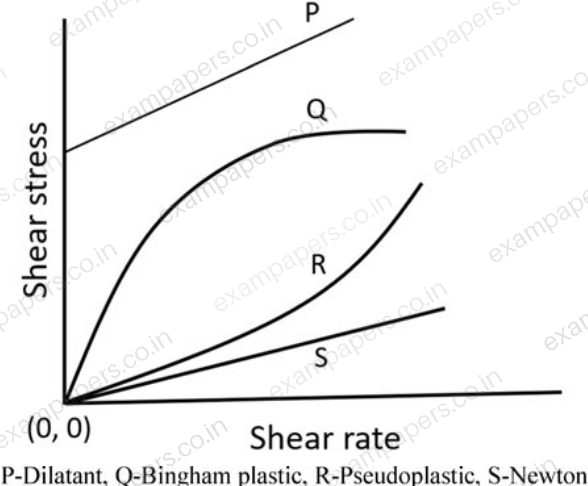
Plot of shear stress against shear rate for various types of fluids is given below. The appropriate assignment for P, Q, R and S is
Your answerChoose one option.
Log in to check the answer
You can attempt this question now. Sign in to view the answer key, explanations and discussion.Log in to check answerQuestion 15
Open questionXE-FNAT2 marksNeeds review
The number average molecular weight of a polyester formed from equimolar mixture of adipic acid and ethylene glycol at a conversion of 99.5% will be ______ (round off to nearest integer).
Log in to check the answer
You can attempt this question now. Sign in to view the answer key, explanations and discussion.Log in to check answerQuestion 16
Open questionXE-FNAT2 marksNeeds review
For a freely jointed linear polyethylene chain with molar mass of 1.4×10⁵ g mol⁻¹, the value of root mean square end-to-end distance in nanometer is ______ (round off to 1 decimal place). [Given: C-C bond length = 0.154 nanometer]
Log in to check the answer
You can attempt this question now. Sign in to view the answer key, explanations and discussion.Log in to check answerQuestion 17
Open questionXE-FNAT2 marksNeeds review
Viscosity measurements were performed for a set of PMMA solutions of different concentrations in toluene at 25 °C. The plot of reduced viscosity against concentration (c) of the PMMA solutions produced an intercept of 21.0 cm³ g⁻¹ on the ordinate at c = 0. The value of viscosity average molecular weight of PMMA in toluene at 25 °C is ______ (round off to nearest integer). [Given: Mark-Houwink constants K = 7.5×10⁻³ cm³ g⁻¹ and a = 0.72 for PMMA in toluene at 25 °C]
Log in to check the answer
You can attempt this question now. Sign in to view the answer key, explanations and discussion.Log in to check answerQuestion 18
Open questionXE-FNAT2 marksNeeds review
Glass fibre reinforced PP composite is to be prepared with 20 volume % of glass fibre. The densities of glass fibre and PP are 2540 kg m⁻³ and 900 kg m⁻³, respectively. The mass of glass fibre required to produce 1 kg of the composite in kg is ______ (round off to 2 decimal places).
Log in to check the answer
You can attempt this question now. Sign in to view the answer key, explanations and discussion.Log in to check answerQuestion 19
Open questionXE-FNAT2 marksNeeds review
A polymer solution flows through a cylindrical tube with a diameter of 4 mm at a volumetric flow rate of 10⁻⁹ m³ s⁻¹. Under laminar flow condition and assuming the polymer solution to be a Newtonian fluid with viscosity 10² N s m⁻², the value of pressure drop per unit length of the tube in N m⁻³ is ______ (round off to nearest integer). [Consider the value of π as 3.14]
Log in to check the answer
You can attempt this question now. Sign in to view the answer key, explanations and discussion.Log in to check answer