
Engineering Sciences
GATE XE Chemistry of high polymers PYQs
Build your understanding with focused practice from past exam papers.
Questions 51–60 of 66. Imported answers require independent review unless marked reviewed.
Question 20
Open questionXE-FNAT2 marksNeeds review
For ABN initiated polymerization of styrene, if both the monomer and initiator concentration are doubled, then the rate of polymerization increases by a factor of ______ (round off to two decimal places).
Log in to check the answer
You can attempt this question now. Sign in to view the answer key, explanations and discussion.Log in to check answerQuestion 3
Open questionXE-FMCQ1 markNeeds review
Rubbers are a class of polymer known for
Your answerChoose one option.
Log in to check the answer
You can attempt this question now. Sign in to view the answer key, explanations and discussion.Log in to check answerQuestion 7
Open questionXE-FMCQ1 markNeeds review
The monomers, A and B with reactivity ratios
and
, form alternate copolymers when,Your answerChoose one option.
Log in to check the answer
You can attempt this question now. Sign in to view the answer key, explanations and discussion.Log in to check answerQuestion 8
Open questionXE-FNAT1 markNeeds review
The degree of polymerization of a poly(methyl methacrylate) sample having number average molecular weight of 1,50,000 g/mol is__________. (C = 12, H = 1, O = 16 g/mol).
Log in to check the answer
You can attempt this question now. Sign in to view the answer key, explanations and discussion.Log in to check answerQuestion 9
Open questionXE-FNAT1 markNeeds review
If the heat of fusion of 100 % crystalline polyethylene is 290 mJ/mg, a sample of polyethylene with heat of fusion of 141 mJ/mg will have _______ % crystallinity.
Log in to check the answer
You can attempt this question now. Sign in to view the answer key, explanations and discussion.Log in to check answerQuestion 10
Open questionXE-FMCQ2 marksNeeds review
Match the following:
| |
|---|---|
P. Butyl rubber | 1. Metallocene polymerization |
Q. Cold SBR | 2. Cationic polymerization |
R. Poly(ethylene terephthalate) | 3. Redox polymerization |
S. Polypropylene | 4. Condensation polymerization |
Your answerChoose one option.
Log in to check the answer
You can attempt this question now. Sign in to view the answer key, explanations and discussion.Log in to check answerQuestion 17
Open questionXE-FMCQ2 marksNeeds review
Plot of the modulus versus temperature of different types of polymers is given below. Based on this plot and the nature of the polymers as mentioned below, find out the correct combination.
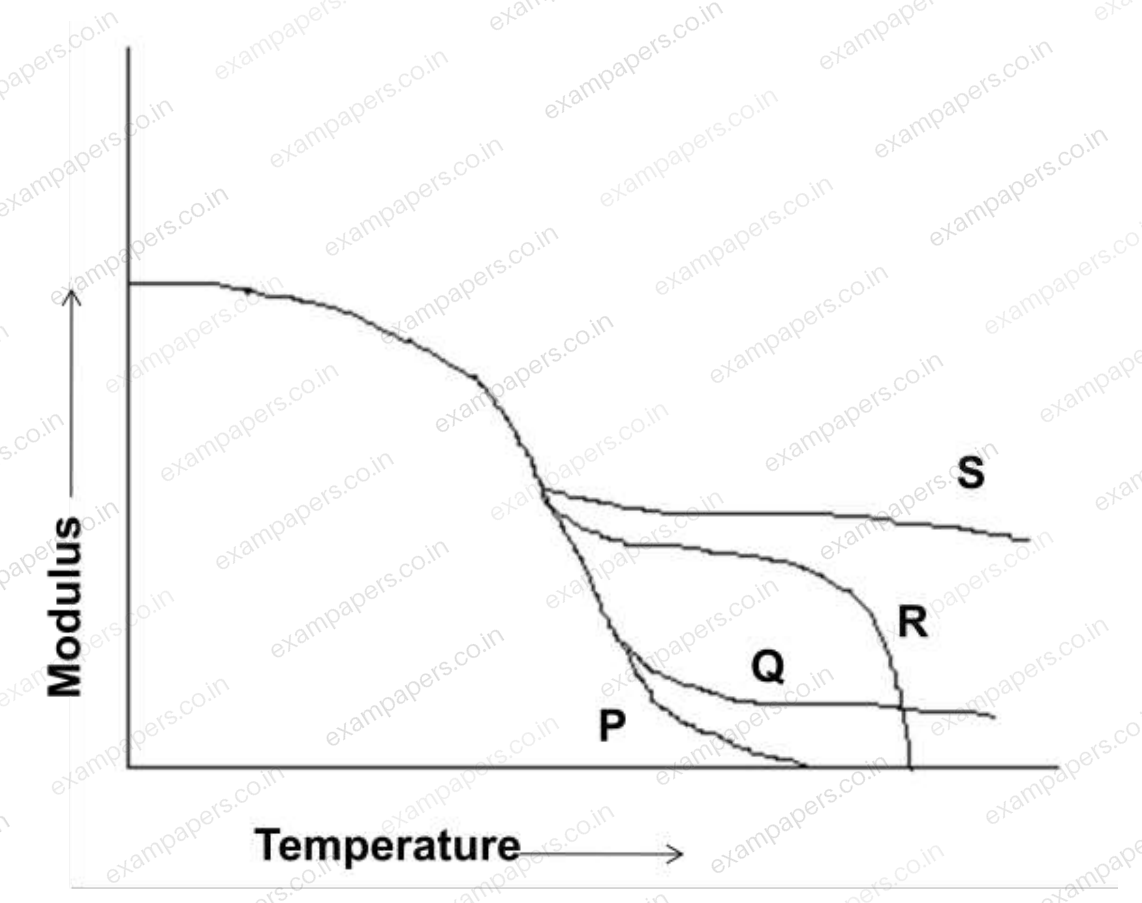
1 = An amorphous polymer of high molecular weight having entanglements
2 = An amorphous polymer of moderate molecular weight
3 = Highly crosslinked polymer
4 = Semi-crystalline polymer
Your answerChoose one option.
Log in to check the answer
You can attempt this question now. Sign in to view the answer key, explanations and discussion.Log in to check answerQuestion 18
Open questionXE-FNAT2 marksNeeds review
The
of homopolymers of A and B are +100 °C and −70 °C respectively. The
of a random copolymer of A and B having 40 wt% A and 60 wt% B is _______ °C.Log in to check the answer
You can attempt this question now. Sign in to view the answer key, explanations and discussion.Log in to check answerQuestion 19
Open questionXE-FNAT2 marksNeeds review
The number average molecular weight of a polymer prepared from HO(CH
)
COOH is 24,000 g/mol. The conversion of the monomer required to reach the above molecular weight is________%. (C = 12, H = 1, O = 16 g/mol).Log in to check the answer
You can attempt this question now. Sign in to view the answer key, explanations and discussion.Log in to check answerQuestion 21
Open questionXE-FNAT2 marksNeeds review
The solubility parameter of a polymer having cohesive energy density (E
) 43870 J/mol and molar volume (V) 136 cm
/mol is ________ (J/cm
)
.Log in to check the answer
You can attempt this question now. Sign in to view the answer key, explanations and discussion.Log in to check answer