
Engineering Sciences
GATE XE Classification and Structure of Materials PYQs
Build your understanding with focused practice from past exam papers.
Questions 21–30 of 40. Imported answers require independent review unless marked reviewed.
Question 3
Open questionXE-CMCQ1 markNeeds review
The most favoured slip system in face centered cubic metal is
Your answerChoose one option.
Log in to check the answer
You can attempt this question now. Sign in to view the answer key, explanations and discussion.Log in to check answerQuestion 14
Open questionXE-CNAT2 marksNeeds review
Fe - 10 atom % C austenite (fcc), having no Fe vacancies, has a lattice parameter of 4 Å. The density of austenite in g cm
is ________ (round off to 2 decimal places)(Given: atomic weight of Fe = 55.8; atomic weight of C = 12.0; Avogadro’s number = 6.023 × 10²³)
Log in to check the answer
You can attempt this question now. Sign in to view the answer key, explanations and discussion.Log in to check answerQuestion 3
Open questionXE-CMCQ1 markNeeds review
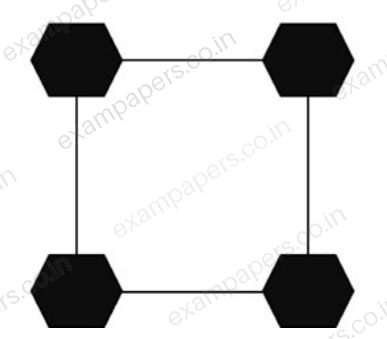
Following diagram shows a square 2-D lattice with a hexagonal motif (dark colored). The rotational symmetry element that must be present in the system is:
Your answerChoose one option.
Log in to check the answer
You can attempt this question now. Sign in to view the answer key, explanations and discussion.Log in to check answerQuestion 5
Open questionXE-CMCQ1 markNeeds review
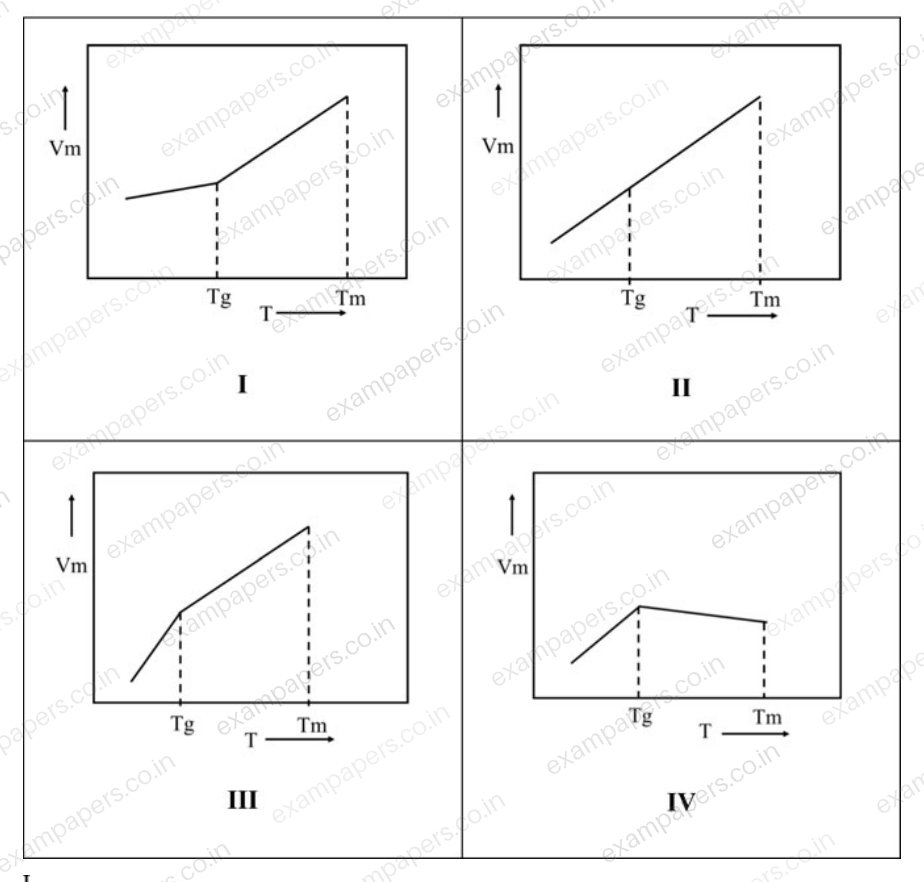
The variation of molar volume (Vm) of a liquid showing glass transition temperature (Tg) while cooling from its melting temperature (Tm) is depicted by:
Your answerChoose one option.
Log in to check the answer
You can attempt this question now. Sign in to view the answer key, explanations and discussion.Log in to check answerQuestion 6
Open questionXE-CMCQ1 markNeeds review
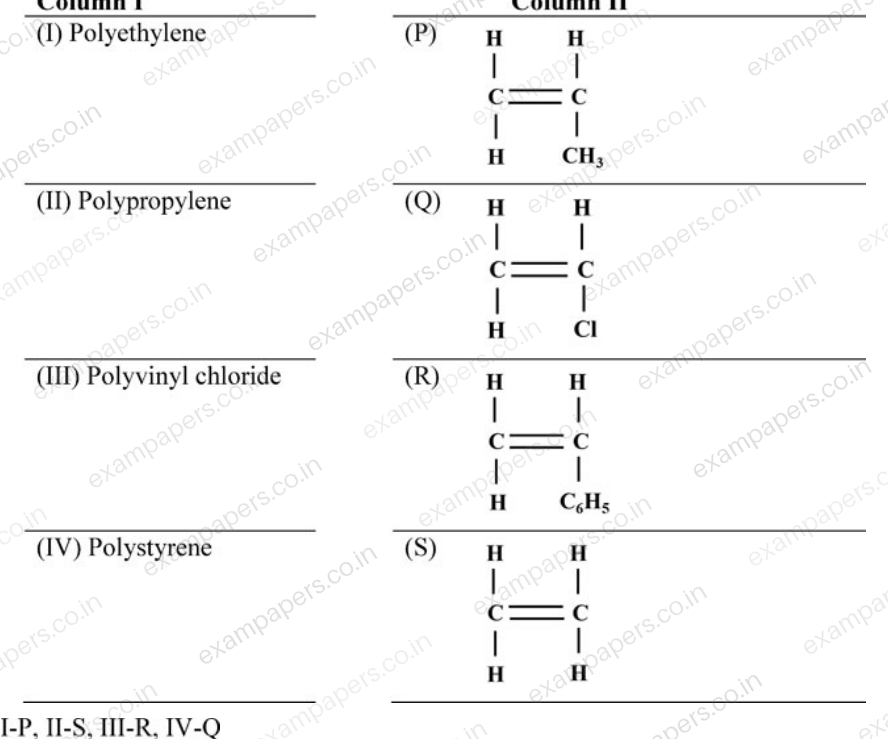
Find the correct match between polymer name in Column I and the monomer type in Column II.
Column I
(I) Polyethylene
(II) Polypropylene
(III) Polyvinyl chloride
(IV) Polystyrene
Column II
(P) alkene with H and CH₃ substituents
(Q) alkene with H and Cl substituents
(R) alkene with H and C₆H₅ substituents
(S) alkene with H substituents
Your answerChoose one option.
Log in to check the answer
You can attempt this question now. Sign in to view the answer key, explanations and discussion.Log in to check answerQuestion 12
Open questionXE-CMCQ2 marksNeeds review
Consider a FCC structured metal with lattice parameter a = 3.5 Å. If the material is irradiated using X-rays of wavelength λ = 1.5405 Å, the Bragg angle (2θ) corresponding to the fourth reflection will be:
Your answerChoose one option.
Log in to check the answer
You can attempt this question now. Sign in to view the answer key, explanations and discussion.Log in to check answerQuestion 13
Open questionXE-CMCQ2 marksNeeds review
The number of Schottky defects per mole of KCl at 300 °C under equilibrium condition will be:
Given:
Activation energy for the formation of Schottky defect = 250 kJ.mol⁻¹
Avogadro number = 6.023 × 10²³ mol⁻¹
Universal Gas Constant = 8.314 J.K⁻¹.mol⁻¹
Your answerChoose one option.
Log in to check the answer
You can attempt this question now. Sign in to view the answer key, explanations and discussion.Log in to check answerQuestion 15
Open questionXE-CNAT2 marksNeeds review
For a FCC metal, the ratio of surface energy of surface to surface is ______ (round-off to two decimal places). Assume that only the nearest neighbor broken bonds contribute to the surface energy.
Log in to check the answer
You can attempt this question now. Sign in to view the answer key, explanations and discussion.Log in to check answerQuestion 3
Open questionXE-CMCQ1 markNeeds review
In NaCl, the substitution of a Na
ion by a Ca
ion would most probably lead toYour answerChoose one option.
Log in to check the answer
You can attempt this question now. Sign in to view the answer key, explanations and discussion.Log in to check answerQuestion 13
Open questionXE-CNAT2 marksNeeds review
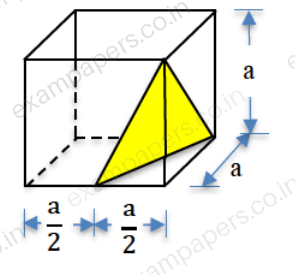
A monochromatic X-ray beam of wavelength 0.154 nm is incident on a cubic crystal having lattice parameter a = 0.245 nm. The diffraction angle (2θ) for the first order reflection from a set of planes represented by the schematic plane below is _____ degrees. (round off to 1 decimal place)
Log in to check the answer
You can attempt this question now. Sign in to view the answer key, explanations and discussion.Log in to check answer