
Engineering Sciences
GATE XE concept:gradient PYQs
Build your understanding with focused practice from past exam papers.
How to practice concept:gradient
Attempt a question, record the concept and assumptions, then check the available answer. Rework mistakes after revising the relevant concepts. Topic tags can overlap; review the question context.
Questions 1–10 of 15. Imported answers require independent review unless marked reviewed.
Question 168
Open questionXE-HMSQ2 marksNeeds review
Which of the following combinations of forces is/are balanced in a cyclostrophic motion?
Your answerSelect all correct options. You can choose more than one.
Log in to check the answer
You can attempt this question now. Sign in to view the answer key, explanations and discussion.Log in to check answerQuestion 163
Open questionXE-HMCQ2 marksNeeds review
A rotating weather system has a tangential velocity of 100 m s
, diameter of 1 km, and located at a latitude where the Coriolis parameter is 10
s
. Which one of the following statements is true about this weather system?Your answerChoose one option.
Log in to check the answer
You can attempt this question now. Sign in to view the answer key, explanations and discussion.Log in to check answerQuestion 169
Open questionXE-HMSQ2 marksNeeds review
In the figures given below, L and H indicate low and high pressure centers, respectively; PGF, CoF and CeF indicate Pressure Gradient Force, Coriolis Force and Centrifugal Force, respectively; V is Velocity. [The arrows indicate only the directions but not the magnitudes of the forces and velocity.]
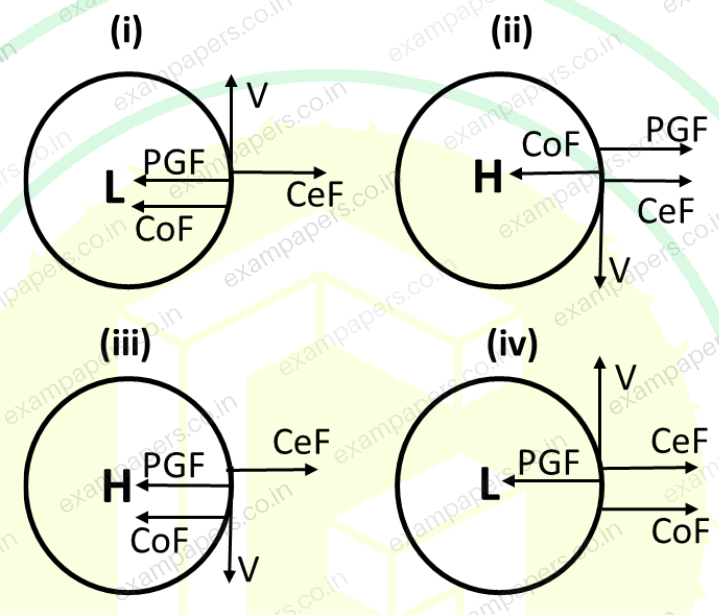
Which of the following is/are the correct representation(s) of the directions of various forces and velocity in the gradient wind balance in the northern hemisphere?
Your answerSelect all correct options. You can choose more than one.
Log in to check the answer
You can attempt this question now. Sign in to view the answer key, explanations and discussion.Log in to check answerQuestion 155
Open questionXE-HMCQ1 markNeeds review
Which one of the following feature is NOT necessary for the formation of Indian summer monsoon?
Your answerChoose one option.
Log in to check the answer
You can attempt this question now. Sign in to view the answer key, explanations and discussion.Log in to check answerQuestion 167
Open questionXE-HMSQ2 marksNeeds review
Consider an atmospheric flow at 45 °N, which is parallel to latitude and isobars. Which of the following is/are true when there is no friction?
Your answerSelect all correct options. You can choose more than one.
Log in to check the answer
You can attempt this question now. Sign in to view the answer key, explanations and discussion.Log in to check answerQuestion 169
Open questionXE-HMSQ2 marksNeeds review
Balance of forces and different types of flows/weather phenomena in the northern hemisphere are given. Match the following:
Balance of forces | Flow type/weather phenomena |
|---|---|
P: Balance between pressure gradient force, centrifugal force and Coriolis force in anticlockwise rotation | X: Geostrophic flow |
Q: Balance between pressure gradient force and centrifugal force in clockwise/anticlockwise rotation | Y: Cyclones |
R: Balance between pressure gradient force and Coriolis force in a uniform flow | Z: Tornado |
Your answerSelect all correct options. You can choose more than one.
Log in to check the answer
You can attempt this question now. Sign in to view the answer key, explanations and discussion.Log in to check answerQuestion 157
Open questionXE-HMCQ1 markNeeds review
The variation in geostrophic winds with height, in particular, at the atmospheric boundary layer, considering the variation in pressure gradient as a function of height, is referred to as ________.
Your answerChoose one option.
Log in to check the answer
You can attempt this question now. Sign in to view the answer key, explanations and discussion.Log in to check answerQuestion 165
Open questionXE-HMCQ2 marksNeeds review
Match the following physical phenomena from the perspective of monsoonal circulation:
Column-1 | Column-2 |
|---|---|
a) Reversal of East-West temperature gradient with seasons | i) Over the tropics |
b) Reversal of North-South temperature gradient with seasons | ii) Indian Ocean |
c) Surface cooling and deepening of mixed layer | iii) Over mid-latitudes |
d) Northward movement of south equatorial current | iv) Arabian Sea |
Your answerChoose one option.
Log in to check the answer
You can attempt this question now. Sign in to view the answer key, explanations and discussion.Log in to check answerQuestion 174
Open questionXE-HNAT2 marksNeeds review
Consider the two parallel isobars separated by a spacing of 250 km at 30° N (air density = 0.70 kg m
, 2Ω = 14.6×10
rad s
) with a pressure gradient of 5 hPa. Calculate the geostrophic velocity in m s
(rounded off to two decimal places).Log in to check the answer
You can attempt this question now. Sign in to view the answer key, explanations and discussion.Log in to check answerQuestion 169
Open questionXE-HMSQ2 marksNeeds review
In gradient wind balance, which of the following statement(s) is/are true for flow around a region of low pressure in the northern hemisphere?
Your answerSelect all correct options. You can choose more than one.
Log in to check the answer
You can attempt this question now. Sign in to view the answer key, explanations and discussion.Log in to check answer