
Engineering Sciences
GATE XE concept:uniform-flow PYQs
Build your understanding with focused practice from past exam papers.
How to practice concept:uniform-flow
Attempt a question, record the concept and assumptions, then check the available answer. Rework mistakes after revising the relevant concepts. Topic tags can overlap; review the question context.
Questions 1–7 of 7. Imported answers require independent review unless marked reviewed.
Question 34
Open questionXE-BMCQ2 marksNeeds review
A two-dimensional source flow (with stream function,
) is placed at the origin in a uniform flow (with stream function,
). Here, the strength of the source is
and the freestream velocity is
. The velocity components
and
of the combined flow in
- and
-directions, respectively, areYour answerChoose one option.
Log in to check the answer
You can attempt this question now. Sign in to view the answer key, explanations and discussion.Log in to check answerQuestion 27
Open questionXE-BMCQ1 markNeeds review
An inviscid steady incompressible flow is formed by combining a uniform flow with velocity
and a clockwise vortex of strength
at the origin, as shown in the figure. Velocity potential (
) for the combined flow in polar coordinate
is
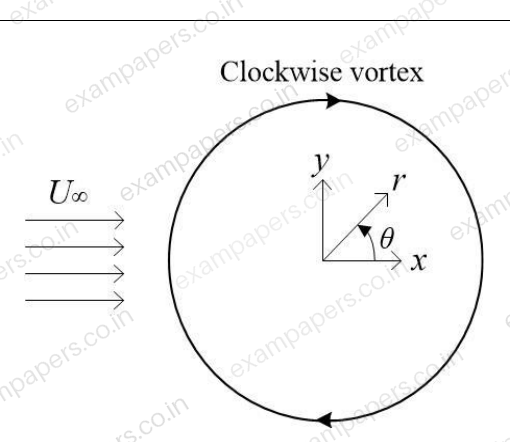
Your answerChoose one option.
Log in to check the answer
You can attempt this question now. Sign in to view the answer key, explanations and discussion.Log in to check answerQuestion 33
Open questionXE-BMCQ2 marksNeeds review
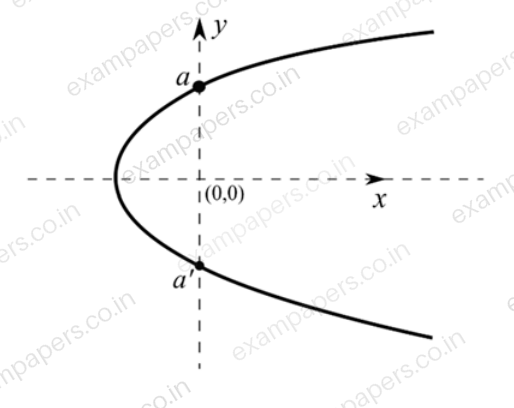
A two-dimensional flow field is described by a combination of a source of strength
at the origin and a uniform flow,
, in the positive
-direction such that the velocity potential is given by
The stagnation streamline is shown in the figure. Find the distance
. 
Your answerChoose one option.
Log in to check the answer
You can attempt this question now. Sign in to view the answer key, explanations and discussion.Log in to check answerQuestion 10
Open questionXE-BMCQ2 marksNeeds review
Column I represents a list of elementary plane flows and Column II represents flow past geometry obtained by superposition of these elementary plane flows.
Column I
P: Source, Sink, Uniform flow
Q: Doublet, Uniform flow
R: Source, Uniform flow
S: Doublet, Free vortex, Uniform flow
Column II
1: Rankine half body
2: Rotating Cylinder
3: Rankine oval
4: Cylinder
The correct match between Columns I and II is,
Your answerChoose one option.
Log in to check the answer
You can attempt this question now. Sign in to view the answer key, explanations and discussion.Log in to check answerQuestion 19
Open questionXE-BNAT2 marksNeeds review
A uniform flow with a velocity of 2 m/s in the
-direction approaches a line source placed on the
-axis at a distance of 0.1 m from the origin. If the origin is the stagnation point in the resulting flow, the strength of the source (in
, rounded off to 2 decimal places) is ______.Log in to check the answer
You can attempt this question now. Sign in to view the answer key, explanations and discussion.Log in to check answerQuestion 3
Open questionXE-BMCQ1 markNeeds review
The inviscid flow past a rotating circular cylinder can be generated by the superposition of
Your answerChoose one option.
Log in to check the answer
You can attempt this question now. Sign in to view the answer key, explanations and discussion.Log in to check answerQuestion 20
Open questionXE-BMCQ1 markNeeds review
In a two-dimensional potential flow, a point source is located at the origin (
) as shown in the figure. The strength of the point source is 2 cm²/s. A uniform flow with velocity 1 cm/s is approaching towards the point source at an angle of 30° from the horizontal axis. What is the distance (cm) of the stagnation point in the flow field from the point source?
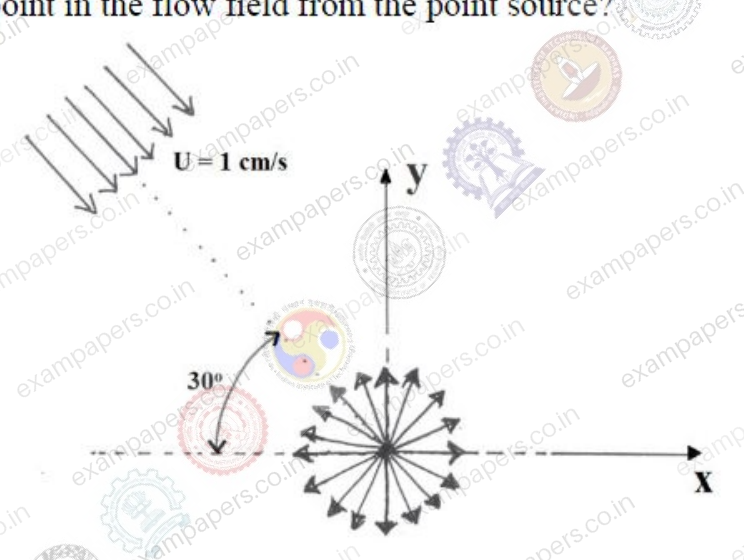
Your answerChoose one option.
Log in to check the answer
You can attempt this question now. Sign in to view the answer key, explanations and discussion.Log in to check answer