
Engineering Sciences
GATE XE Differential Analysis PYQs
Build your understanding with focused practice from past exam papers.
How to practice Differential Analysis
Attempt a question, record the concept and assumptions, then check the available answer. Rework mistakes after revising the relevant concepts. Topic tags can overlap; review the question context.
Questions 1–10 of 53. Imported answers require independent review unless marked reviewed.
Question 28
Open questionXE-BMCQ1 markNeeds review
The velocity components in
- and
-directions of a two-dimensional, incompressible flow field are
and
, respectively. Here,
is a polynomial function and
is a polynomial function of
only. Which one of the following options for
is correct?Your answerChoose one option.
Log in to check the answer
You can attempt this question now. Sign in to view the answer key, explanations and discussion.Log in to check answerQuestion 31
Open questionXE-BMCQ2 marksNeeds review
A steady, laminar, and incompressible flow between a pair of infinite parallel plates is driven by a constant pressure gradient
. The plates are separated by a distance
, as shown in the figure. The fully-developed velocity profile of the flow is
where
is the dynamic viscosity.The values of
, for which the local flow velocity is equal to the average flow velocity, are 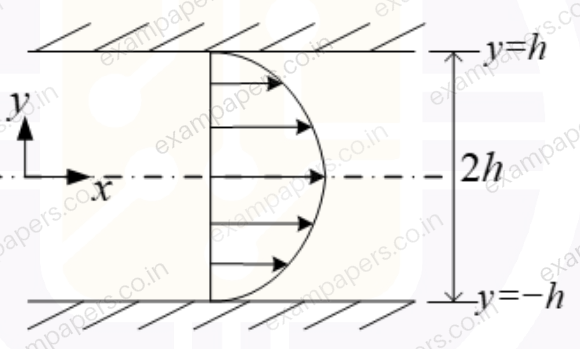
Your answerChoose one option.
Log in to check the answer
You can attempt this question now. Sign in to view the answer key, explanations and discussion.Log in to check answerQuestion 32
Open questionXE-BMCQ2 marksNeeds review
An incompressible fluid flows between a pair of infinite plates separated by a distance
. The top plate is moving with a constant velocity
, whereas the bottom plate is stationary, as shown in the figure. The difference of the stream functions (
) at the two plates for a laminar and fully-developed flow is equal to 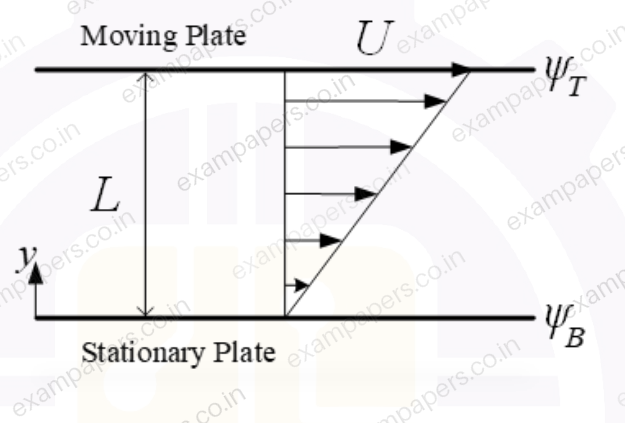
Your answerChoose one option.
Log in to check the answer
You can attempt this question now. Sign in to view the answer key, explanations and discussion.Log in to check answerQuestion 42
Open questionXE-BNAT2 marksNeeds review
The axial velocity profile of a laminar, incompressible, and fully-developed flow in a circular pipe of radius
is given as
, where
,
,
, and
are dynamic viscosity, pressure, axial coordinate, and radial coordinate, respectively. If the magnitude of shear stress at the pipe wall is given as
, then the value of
is __________. (answer in integer)Log in to check the answer
You can attempt this question now. Sign in to view the answer key, explanations and discussion.Log in to check answerQuestion 26
Open questionXE-BMCQ1 markNeeds review
For a steady and incompressible flow, the velocity field (
) in Cartesian
coordinate system is given as:
Here,
,
, and
are unit vectors along
,
, and
directions, respectively and
is a constant. Which one of the following options is the correct value of
that satisfies the conservation of mass for the given velocity field?Your answerChoose one option.
Log in to check the answer
You can attempt this question now. Sign in to view the answer key, explanations and discussion.Log in to check answerQuestion 27
Open questionXE-BMCQ1 markNeeds review
Conservation of mass for a steady axisymmetric flow field in the cylindrical
coordinates is:
Here,
and
are radial and axial components of velocity, respectively.
Which one of the following options is correct if
is the stream function?Your answerChoose one option.
Log in to check the answer
You can attempt this question now. Sign in to view the answer key, explanations and discussion.Log in to check answerQuestion 31
Open questionXE-BMCQ2 marksNeeds review
Figure shows two parallel plates (upper plate at
and lower one at
) of length L (aligned in
direction) and infinite width (in
direction, normal to the plane of the figure). Two immiscible, incompressible liquids are flowing steadily in the
direction through the thin passage between the plates under the influence of horizontal pressure gradient
. During the flow, the passage is always half-filled with denser fluid I (viscosity
) at the bottom and rest is occupied by lighter fluid II (viscosity
;
). Considering exactly planar interface between the fluids and no instabilities in the flow, the shear stress,
is expressed as:
Which one of the following options correctly identifies the location of the point having maximum velocity of the flow?
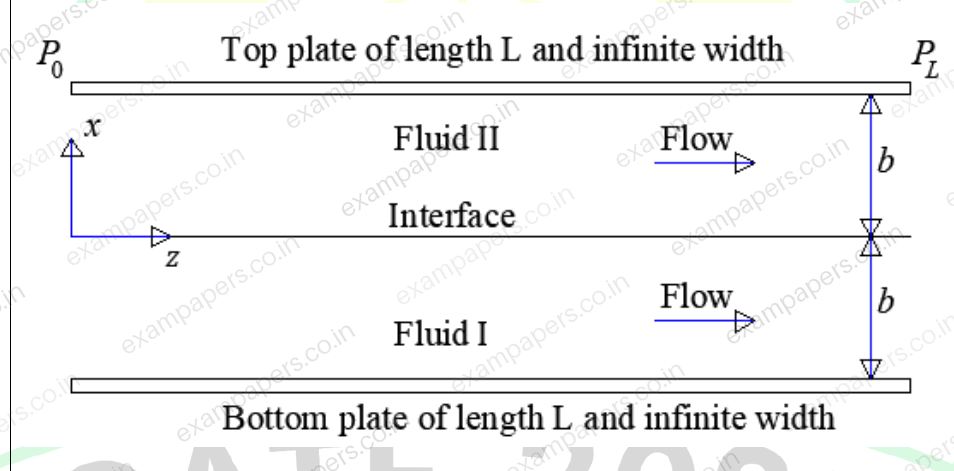
Your answerChoose one option.
Log in to check the answer
You can attempt this question now. Sign in to view the answer key, explanations and discussion.Log in to check answerQuestion 36
Open questionXE-BNAT2 marksNeeds review
Consider,
and
are unit vectors along x and y directions of a Cartesian
coordinate system, respectively and
is time. Temperature (
) and fluid velocity (
) are given for a flow field as:
The total rate of change of temperature in the flow field (in integer) for time
at a point
is ________Log in to check the answer
You can attempt this question now. Sign in to view the answer key, explanations and discussion.Log in to check answerQuestion 37
Open questionXE-BNAT2 marksNeeds review
Driven by a pressure gradient of 100 kPa/m, a fluid of dynamic viscosity 0.1 Pa.s flows between two fixed infinite large parallel plates under steady, incompressible, and fully developed laminar conditions. The average velocity of the flow is 2 m/s. The gap between the parallel plates in mm (rounded off to 2 decimal places) is ________
Log in to check the answer
You can attempt this question now. Sign in to view the answer key, explanations and discussion.Log in to check answerQuestion 38
Open questionXE-BNAT2 marksNeeds review
An incompressible fluid is flowing between two infinitely large parallel plates separated by 5 mm distance. The bottom plate is stationary and the top plate is moving at a constant velocity of 5 mm/s in the direction parallel to the bottom plate. The flow of the fluid between the plates is steady, two-dimensional, laminar, and the variation of fluid velocity is linear between the plates. A square fluid element of 1 mm side is considered at equal distance from the plates in the flow field such that one of its sides is parallel to the plates. The magnitude of circulation in mm
/s (in integer) along the edges of the square fluid element is ________Log in to check the answer
You can attempt this question now. Sign in to view the answer key, explanations and discussion.Log in to check answer