
Engineering Sciences
GATE XE Differential Analysis PYQs
Build your understanding with focused practice from past exam papers.
Questions 21–30 of 53. Imported answers require independent review unless marked reviewed.
Question 38
Open questionXE-BNAT2 marksNeeds review
For an inviscid fluid with density 1 kg/m
, the Cartesian velocity field is given as:
Neglecting the body forces, find the magnitude of pressure gradient (in Pa/m) at
at
.
(Round off to two decimal places)Log in to check the answer
You can attempt this question now. Sign in to view the answer key, explanations and discussion.Log in to check answerQuestion 43
Open questionXE-BNAT2 marksNeeds review
The horizontal belt of negligible weight shown in the figure moves with a steady velocity (
) of 2.5 m/s and skims over the top surface of an oil-film of depth
= 3 cm. The length (
) and width (
) of the belt are, respectively, 2 m and 60 cm. Find the viscosity of the oil (in Pa-s), given that the minimum power required to move the belt is 100 W. Neglect the end effects. (Round off to two decimal places) 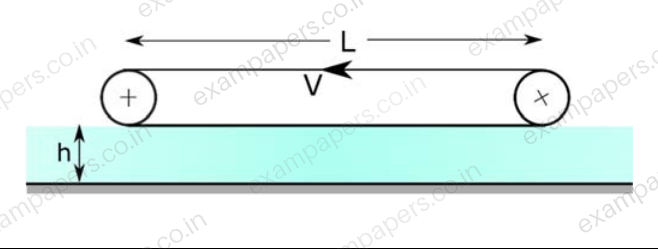
Log in to check the answer
You can attempt this question now. Sign in to view the answer key, explanations and discussion.Log in to check answerQuestion 3
Open questionXE-BMCQ1 markNeeds review
If
and
are the average pressures at inlet and outlet respectively for a fully-developed flow inside a channel having a height of
, then the absolute value of average shear stress (in Pa) acting on the walls of the channel of length
isYour answerChoose one option.
Log in to check the answer
You can attempt this question now. Sign in to view the answer key, explanations and discussion.Log in to check answerQuestion 6
Open questionXE-BMCQ1 markNeeds review
Which one of the following statements is TRUE about the continuity equation
(where
are the velocity components along the
and
coordinates respectively):Your answerChoose one option.
Log in to check the answer
You can attempt this question now. Sign in to view the answer key, explanations and discussion.Log in to check answerQuestion 12
Open questionXE-BMCQ2 marksNeeds review
In a Cartesian coordinate system, a steady, incompressible velocity field of a Newtonian fluid is given by
Here, V is the velocity vector in m/s, i is the unit vector in the x-direction,
is a positive, real constant (in m/s), and
is a positive, real constant (in m
). The viscosity of the fluid is
(in Pa-s). The absolute value of the pressure gradient (in Pa/m) isYour answerChoose one option.
Log in to check the answer
You can attempt this question now. Sign in to view the answer key, explanations and discussion.Log in to check answerQuestion 14
Open questionXE-BNAT2 marksNeeds review
The two-dimensional velocity field
of a flow in a Cartesian coordinate system is given in dimensionless form by
. Here,
and
are the unit vectors along the x and y directions respectively,
and
are independent of
,
and time. If the flow is incompressible, then the value of
, up to one decimal place, is ________.Log in to check the answer
You can attempt this question now. Sign in to view the answer key, explanations and discussion.Log in to check answerQuestion 1
Open questionXE-BMCQ1 markNeeds review
Figures given below show the velocity and shear stress profiles for the flow in a duct. In each option, ‘1’ represents velocity profile and ‘2’ represents shear stress profile.
Choose the correct option that closely represents the turbulent flow condition.
Your answerChoose one option.
Log in to check the answer
You can attempt this question now. Sign in to view the answer key, explanations and discussion.Log in to check answerQuestion 7
Open questionXE-BMCQ1 markNeeds review
The volume flow between any two points not lying on the same stream in a flow field is equal to
Your answerChoose one option.
Log in to check the answer
You can attempt this question now. Sign in to view the answer key, explanations and discussion.Log in to check answerQuestion 11
Open questionXE-BMCQ2 marksNeeds review
The velocity field for a flow is
, where
is time. Choose the correct option representing the total acceleration at
Your answerChoose one option.
Log in to check the answer
You can attempt this question now. Sign in to view the answer key, explanations and discussion.Log in to check answerQuestion 12
Open questionXE-BMCQ2 marksNeeds review
An incompressible viscous fluid is placed between two infinite horizontal parallel plates as shown in Figure. The plates move in opposite direction with constant velocities
and
. The pressure gradient in the x-direction is zero and the only body force is due to the fluid weight. The flow is steady, laminar and two-dimensional. Assume velocity component in ‘y’ direction to be zero.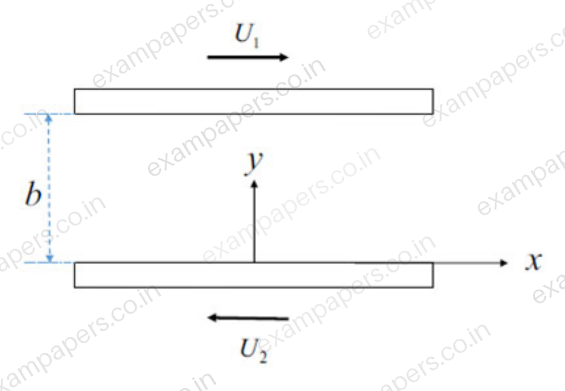
The correct expression for the velocity distribution between the plates is:
Your answerChoose one option.
Log in to check the answer
You can attempt this question now. Sign in to view the answer key, explanations and discussion.Log in to check answer