
Engineering Sciences
GATE XE discipline:engineering-sciences PYQs
Build your understanding with focused practice from past exam papers.
Questions 1121–1130 of 1772. Imported answers require independent review unless marked reviewed.
Question 6
Open questionXE-CMCQ1 markNeeds review
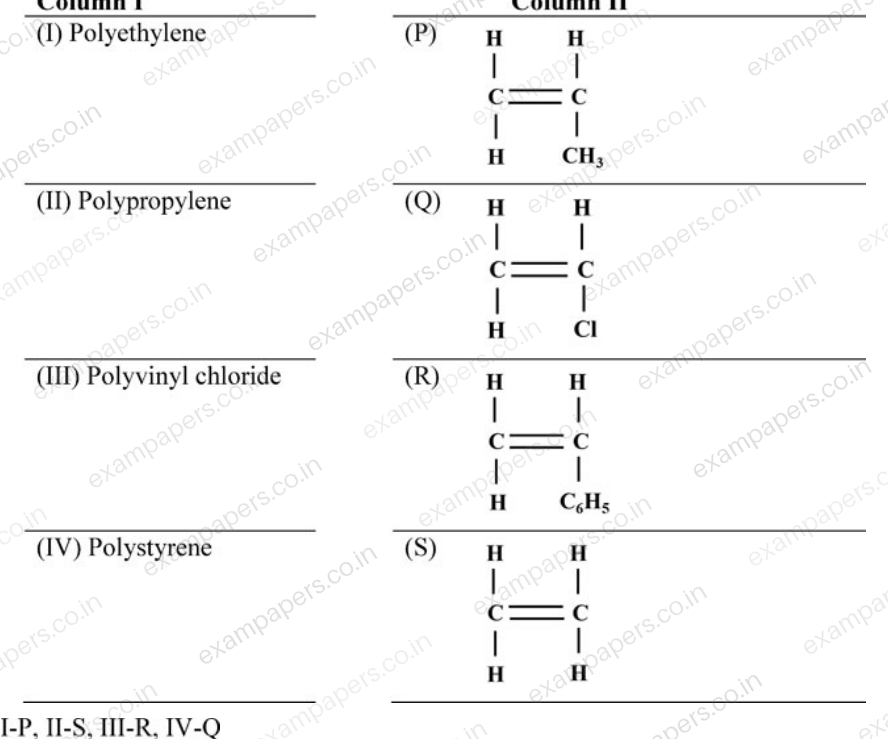
Find the correct match between polymer name in Column I and the monomer type in Column II.
Column I
(I) Polyethylene
(II) Polypropylene
(III) Polyvinyl chloride
(IV) Polystyrene
Column II
(P) alkene with H and CH₃ substituents
(Q) alkene with H and Cl substituents
(R) alkene with H and C₆H₅ substituents
(S) alkene with H substituents
Your answerChoose one option.
Log in to check the answer
You can attempt this question now. Sign in to view the answer key, explanations and discussion.Log in to check answerQuestion 7
Open questionXE-CNAT1 markNeeds review
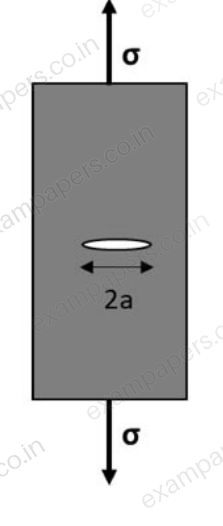
A ceramic has a fracture toughness (Kᵢc) of 1 MPa·m¹ᐟ². If this ceramic is to be exposed to a maximum stress (σ) of 200 MPa, the maximum value of half crack length ‘a’ (in micrometer, μm), below which the material does not fail, is ______ μm (round off to one decimal place). Loading condition for the sample is shown in the schematic. Assume geometrical factor f = 1.2.
Log in to check the answer
You can attempt this question now. Sign in to view the answer key, explanations and discussion.Log in to check answerQuestion 8
Open questionXE-CNAT1 markNeeds review
A ceramic material is periodically heated and cooled between 25°C and a higher temperature, Tf. During thermal cycling, the material remains dimensionally constrained. The material can withstand a maximum compressive stress of 200 MPa without failure. Material’s coefficient of thermal expansion is 7.5×10⁻⁶ °C⁻¹ and modulus of elasticity (E) is 200 GPa. The lowest value of Tf (in °C) at which material will fail is ______ °C (round-off to the nearest integer). Assume that there is no plastic deformation during the thermal cycling.
Log in to check the answer
You can attempt this question now. Sign in to view the answer key, explanations and discussion.Log in to check answerQuestion 9
Open questionXE-CNAT1 markNeeds review
During homogeneous solidification of a liquid metal, the radius of critical nucleus (in nanometer, nm) at a temperature Ts which is below the melting point (Tm), is ______ nm (round-off to one decimal place). Given that γsl (solid liquid interfacial energy) is 0.18 J.m⁻² and ΔGv (change in volume free energy upon transformation from liquid to solid) at Ts is 0.18 × 10⁹ J.m⁻³.
Log in to check the answer
You can attempt this question now. Sign in to view the answer key, explanations and discussion.Log in to check answerQuestion 10
Open questionXE-CMCQ2 marksNeeds review
Read the two statements related to sintering and select the correct option.
Statement-1: Sintering in vacuum leads to improved densification as compared to sintering under ambient (at atmospheric pressure) condition.
Statement-2: Closed pores formed during sintering inhibit full densification.
Your answerChoose one option.
Log in to check the answer
You can attempt this question now. Sign in to view the answer key, explanations and discussion.Log in to check answerQuestion 11
Open questionXE-CMCQ2 marksNeeds review
Select the correct option that appropriately matches the process to the material/product that can be fabricated using them.
Process
(I) Powder processing
(II) Spin coating
(III) Czochralski process
(IV) Chemical vapor deposition
Material/Product
(P) Organic semiconductor thin films
(Q) Single crystal silicon
(R) Poly-silicon
(S) Porous bronze bearings
Your answerChoose one option.
Log in to check the answer
You can attempt this question now. Sign in to view the answer key, explanations and discussion.Log in to check answerQuestion 12
Open questionXE-CMCQ2 marksNeeds review
Consider a FCC structured metal with lattice parameter a = 3.5 Å. If the material is irradiated using X-rays of wavelength λ = 1.5405 Å, the Bragg angle (2θ) corresponding to the fourth reflection will be:
Your answerChoose one option.
Log in to check the answer
You can attempt this question now. Sign in to view the answer key, explanations and discussion.Log in to check answerQuestion 13
Open questionXE-CMCQ2 marksNeeds review
The number of Schottky defects per mole of KCl at 300 °C under equilibrium condition will be:
Given:
Activation energy for the formation of Schottky defect = 250 kJ.mol⁻¹
Avogadro number = 6.023 × 10²³ mol⁻¹
Universal Gas Constant = 8.314 J.K⁻¹.mol⁻¹
Your answerChoose one option.
Log in to check the answer
You can attempt this question now. Sign in to view the answer key, explanations and discussion.Log in to check answerQuestion 14
Open questionXE-CNAT2 marksNeeds review
In an industry, the probability of an accident occurring in a given month is 1/100. Let P(n) denote the probability that there will be no accident over a period of ‘n’ months. Assume that the events of individual months are independent of each other. The smallest integer value of ‘n’ such that P(n) ≤ 1/2 is ______ (round off to the nearest integer).
Log in to check the answer
You can attempt this question now. Sign in to view the answer key, explanations and discussion.Log in to check answerQuestion 15
Open questionXE-CNAT2 marksNeeds review
For a FCC metal, the ratio of surface energy of surface to surface is ______ (round-off to two decimal places). Assume that only the nearest neighbor broken bonds contribute to the surface energy.
Log in to check the answer
You can attempt this question now. Sign in to view the answer key, explanations and discussion.Log in to check answer