
Engineering Sciences
GATE XE discipline:engineering-sciences PYQs
Build your understanding with focused practice from past exam papers.
Questions 1521–1530 of 1772. Imported answers require independent review unless marked reviewed.
Question 12
Open questionXE-EMCQ2 marksNeeds review
A reversible engine receives 75 kJ/s of energy from a reservoir at 750 K and does 12 kJ/s of work. The heat is rejected to two reservoirs at 650 K and 550 K. The rate of heat rejection (in kJ/s) to the reservoir at 650 K is
Your answerChoose one option.
Log in to check the answer
You can attempt this question now. Sign in to view the answer key, explanations and discussion.Log in to check answerQuestion 13
Open questionXE-EMCQ2 marksNeeds review
A gas obeys the following equation of state:
where
is molar volume, and
,
are constants with values
J.K/Pa
.kmol and
m
/kmol. Take
kJ/kmol.K. At 10 bar and 500 K, the value of the Joule-Thomson coefficient (in K/Pa) isYour answerChoose one option.
Log in to check the answer
You can attempt this question now. Sign in to view the answer key, explanations and discussion.Log in to check answerQuestion 14
Open questionXE-EMCQ2 marksNeeds review
In an ideal Rankine cycle, steam enters the turbine at 10 MPa and 500 °C (
kJ/kg,
kJ/kg.K). It is cooled in the condenser at a pressure of 10 kPa. At 10 kPa,
kJ/kg,
kJ/kg.K,
kJ/kg and
kJ/kg.K. The heat rejected in the condenser (in kJ/kg) isYour answerChoose one option.
Log in to check the answer
You can attempt this question now. Sign in to view the answer key, explanations and discussion.Log in to check answerQuestion 15
Open questionXE-EMCQ2 marksNeeds review
Methane has compressibility factor value of 0.9 at reduced pressure of 1.0 and reduced temperature of 1.5. For propane, the critical temperature and pressure are 369.8 K and 42.48 bar, respectively. Take R = 8.314 kJ/kmol.K. Applying the principle of corresponding states, the molar volume of propane (in m
/kmol) at the same reduced pressure and temperature isYour answerChoose one option.
Log in to check the answer
You can attempt this question now. Sign in to view the answer key, explanations and discussion.Log in to check answerQuestion 16
Open questionXE-ENAT2 marksNeeds review
A rigid insulated vessel is divided into two compartments by a partition. One compartment contains 12 kg of oxygen at 200 kPa and 280 K. The other compartment contains 26 kg of carbon dioxide at 400 kPa and 360 K. The specific heats at constant volume in kJ/kg.K for oxygen and carbon dioxide are 0.662 and 0.653, respectively. The partition is removed and the gases are allowed to mix. Considering both gases are ideal, the final temperature (in K) of the mixture (up to 1 decimal place) is ________.
Log in to check the answer
You can attempt this question now. Sign in to view the answer key, explanations and discussion.Log in to check answerQuestion 17
Open questionXE-ENAT2 marksNeeds review
Moist air having 60% relative humidity, enters a steady-flow air-conditioning unit at 102 kPa and 30 °C. The volume flow rate of the moist air entering the unit is 0.1 m
/s. The moist air leaves the unit at 95 kPa and 15 °C with a relative humidity of 100%. Liquid condensate leaves the unit at 15 °C.
For water: at 15 °C,
kJ/kg,
kJ/kg,
kPa.
At 30 °C,
kJ/kg,
kJ/kg,
kPa.
For air, specific heat at constant pressure is 1.004 kJ/kg.K and the specific gas constant is 0.287 kJ/kg.K.
Neglecting heat leakage to the surrounding, the magnitude of heat extracted (in kW) from the air stream (up to 2 decimal places) is ________.Log in to check the answer
You can attempt this question now. Sign in to view the answer key, explanations and discussion.Log in to check answerQuestion 18
Open questionXE-ENAT2 marksNeeds review
Air at 150 kPa and 323 K is filled in a rigid vessel of 0.05 m
capacity. For air, assumed as an ideal gas, specific heat at constant volume is 0.7163 kJ/kg.K and the specific gas constant is 0.287 kJ/kg.K. Neglect kinetic and potential energy changes. If 30 kJ of heat is added, the final temperature (in K) of air (up to 1 decimal place) is __________.Log in to check the answer
You can attempt this question now. Sign in to view the answer key, explanations and discussion.Log in to check answerQuestion 19
Open questionXE-ENAT2 marksNeeds review
Superheated steam at 2 bar and 300 °C, with an enthalpy of 3072.1 kJ/kg, enters a horizontal adiabatic nozzle with negligible velocity and leaves at 0.2 bar as saturated vapour with an enthalpy of 2609.9 kJ/kg. Assuming steady flow and neglecting the potential energy changes, the exit velocity (in m/s) of the steam (up to 1 decimal place) is __________.
Log in to check the answer
You can attempt this question now. Sign in to view the answer key, explanations and discussion.Log in to check answerQuestion 20
Open questionXE-ENAT2 marksNeeds review
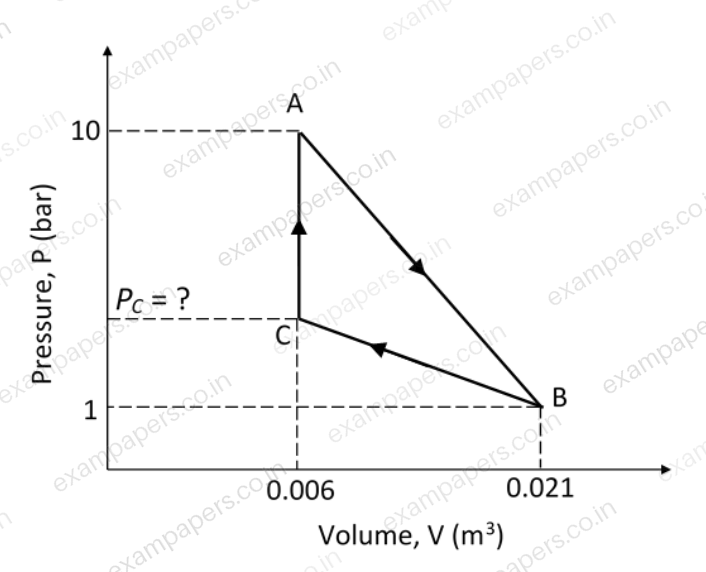
A given mass of a simple compressible substance undergoes a reversible cycle, as shown in the P-V diagram. The magnitude of the net work done during the cycle is 3 kJ. The pressure (in bar) at point C (up to 1 decimal place) is ________.
Log in to check the answer
You can attempt this question now. Sign in to view the answer key, explanations and discussion.Log in to check answerQuestion 21
Open questionXE-ENAT2 marksNeeds review
One kmol of an ideal gas at 300 K and 10 bar is reversibly heated in a constant volume process to 500 K. It is then reversibly and isothermally expanded to 2 bar. Take
kJ/kmol.K and R = 8.314 kJ/kmol.K. The total heat supplied (in kJ) to the gas (up to 1 decimal place) is ________.Log in to check the answer
You can attempt this question now. Sign in to view the answer key, explanations and discussion.Log in to check answer