
Engineering Sciences
GATE XE discipline:engineering-sciences PYQs
Build your understanding with focused practice from past exam papers.
Questions 361–370 of 1772. Imported answers require independent review unless marked reviewed.
Question 164
Open questionXE-HMCQ2 marksNeeds review
The sea surface height concentric isolines (L1 and L2 in cm) and the distance between them (dx in km) for three different eddies at the same latitude are given in the figure below. (The figures are not to scale.)
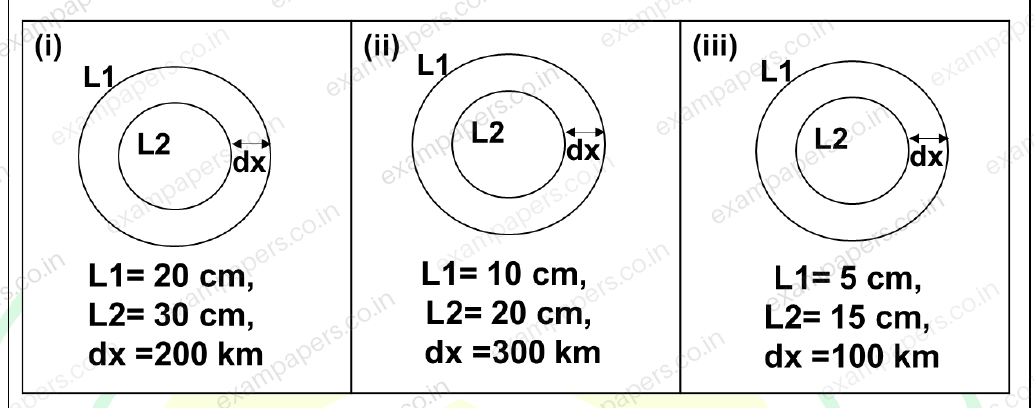
Which one of the following orders is correct about the magnitudes of the geostrophic currents within the isolines?
Your answerChoose one option.
Log in to check the answer
You can attempt this question now. Sign in to view the answer key, explanations and discussion.Log in to check answerQuestion 165
Open questionXE-HMCQ2 marksNeeds review
The vertical (depth) profiles for three parameters P1, P2, and P3 in the northern Indian Ocean are given in the figure below. The values along the x-axis are the normalized values of the parameters and y-axis is the depth (m).
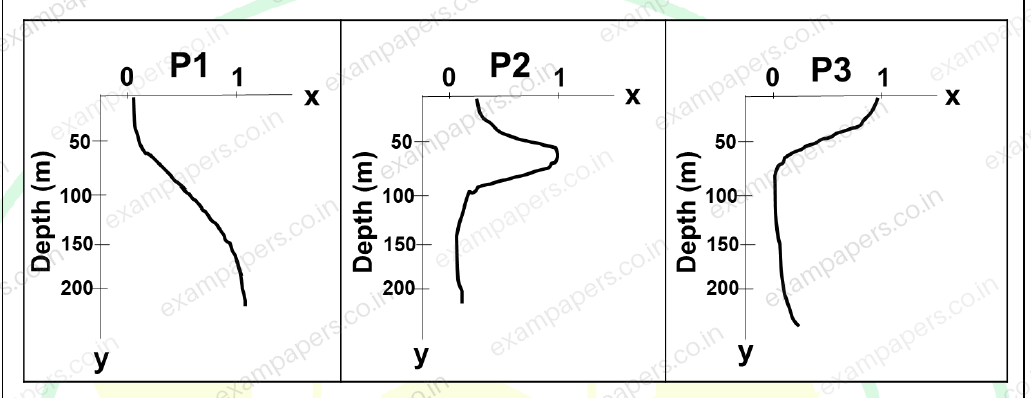
Identify the parameters P1, P2, and P3 from the options given below.
Your answerChoose one option.
Log in to check the answer
You can attempt this question now. Sign in to view the answer key, explanations and discussion.Log in to check answerQuestion 166
Open questionXE-HMCQ2 marksNeeds review
The zonal gradient of meridional current and the meridional gradient of zonal current is −0.3 × 10
s
and 0.3 × 10
s
, respectively, at a location P (87 °E, 15 °N). Which one of the following best explains the nature of the flow?Your answerChoose one option.
Log in to check the answer
You can attempt this question now. Sign in to view the answer key, explanations and discussion.Log in to check answerQuestion 167
Open questionXE-HMCQ2 marksNeeds review
The north-Atlantic deep-water is associated with ____________.
Your answerChoose one option.
Log in to check the answer
You can attempt this question now. Sign in to view the answer key, explanations and discussion.Log in to check answerQuestion 168
Open questionXE-HMCQ2 marksNeeds review
Which of the following is the correct form of the mass divergence form of the continuity equation for a compressible fluid?
[In the given equations,
is the density and
the three dimensional velocity vector of the fluid.]Your answerChoose one option.
Log in to check the answer
You can attempt this question now. Sign in to view the answer key, explanations and discussion.Log in to check answerQuestion 169
Open questionXE-HMSQ2 marksNeeds review
In the figures given below, L and H indicate low and high pressure centers, respectively; PGF, CoF and CeF indicate Pressure Gradient Force, Coriolis Force and Centrifugal Force, respectively; V is Velocity. [The arrows indicate only the directions but not the magnitudes of the forces and velocity.]
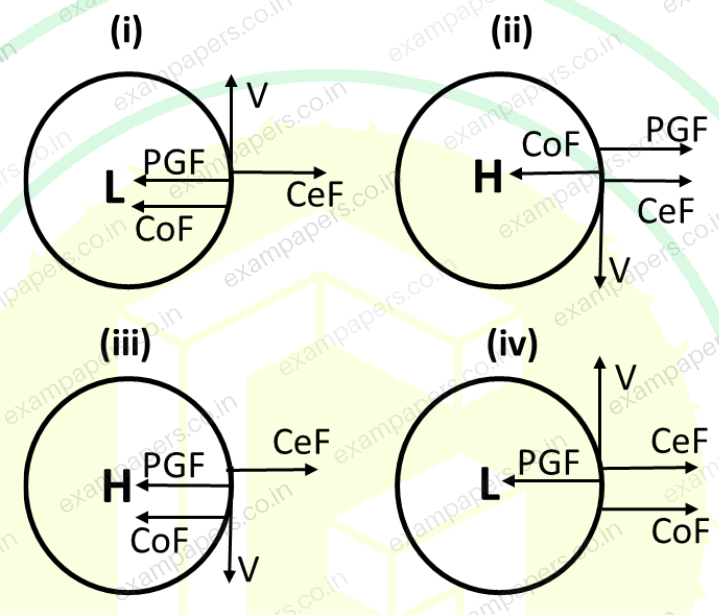
Which of the following is/are the correct representation(s) of the directions of various forces and velocity in the gradient wind balance in the northern hemisphere?
Your answerSelect all correct options. You can choose more than one.
Log in to check the answer
You can attempt this question now. Sign in to view the answer key, explanations and discussion.Log in to check answerQuestion 170
Open questionXE-HNAT2 marksNeeds review
One kg of dry air at 15 °C is isothermally compressed to one-tenth of its initial volume. The work done on the system is ________________ kJ. (Round off to the nearest integer.) [Assume that the gas constant for dry air is 287 × 10⁻⁵ J K⁻¹ kg⁻¹.]
Log in to check the answer
You can attempt this question now. Sign in to view the answer key, explanations and discussion.Log in to check answerQuestion 171
Open questionXE-HNAT2 marksNeeds review
In hot weather, a human body cools by the evaporation of sweat from its skin. The amount of water that must evaporate to cool the body by 1 °C is __________ % of the body mass. (Round off to two decimal places.) [Assume that latent heat of vaporization of water is 2.25 × 10⁶ J kg⁻¹ and specific heat capacities of both human body and liquid water is 4.2 × 10³ J K⁻¹ kg⁻¹.]
Log in to check the answer
You can attempt this question now. Sign in to view the answer key, explanations and discussion.Log in to check answerQuestion 172
Open questionXE-HNAT2 marksNeeds review
A floating hot air balloon with volume 1000 m³ and gross mass (excluding the air in the balloon) 100 kg is in hydrostatic balance where the external air temperature is 10 °C and density is 1 kg m⁻³. The temperature of the air inside the balloon is __________ °C. (Round off to the nearest integer.)
Log in to check the answer
You can attempt this question now. Sign in to view the answer key, explanations and discussion.Log in to check answerQuestion 173
Open questionXE-HNAT2 marksNeeds review
The solar constant for the Earth is 1368 W m⁻². Consider the planet Jupiter whose mass is 320 times that of the Earth and distance from the Sun is 5.2 times that of the Earth. The solar constant for Jupiter is __________ W m⁻². (Round off to the nearest integer.)
Log in to check the answer
You can attempt this question now. Sign in to view the answer key, explanations and discussion.Log in to check answer