
Engineering Sciences
GATE XE discipline:engineering-sciences PYQs
Build your understanding with focused practice from past exam papers.
Questions 51–60 of 1772. Imported answers require independent review unless marked reviewed.
Question 51
Open questionXE-CNAT1 markNeeds review
The interplanar spacing of
planes is 4.5 nm in a given crystal. For the
planes, the interplanar spacing, in nm, is ________ (rounded off to one decimal place).Log in to check the answer
You can attempt this question now. Sign in to view the answer key, explanations and discussion.Log in to check answerQuestion 52
Open questionXE-CNAT1 markNeeds review
The equilibrium vacancy concentration in aluminum at 900 K is
. The enthalpy of formation of vacancies, in kJ·mol
, is ________ (rounded off to one decimal place).Given: Universal gas constant = 8.314 J·K
·mol
Log in to check the answer
You can attempt this question now. Sign in to view the answer key, explanations and discussion.Log in to check answerQuestion 53
Open questionXE-CMCQ2 marksNeeds review
Three phases, α, β and L are shown in the binary phase diagram below. Identify the correct G − X (Gibbs free energy vs Composition) plot corresponding to temperature T₀.
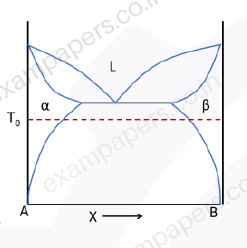
Your answerChoose one option.
Log in to check the answer
You can attempt this question now. Sign in to view the answer key, explanations and discussion.Log in to check answerQuestion 54
Open questionXE-CMCQ2 marksNeeds review
In a cubic crystal, the Burgers vector for a mixed dislocation line is
. The dislocation line lies along the [011] direction. The slip plane of the dislocation isYour answerChoose one option.
Log in to check the answer
You can attempt this question now. Sign in to view the answer key, explanations and discussion.Log in to check answerQuestion 55
Open questionXE-CMCQ2 marksNeeds review
Match the Thermodynamic laws in Column I with the description given in Column II.
Column I: P — Zeroth law; Q — First law; R — Second law; S — Third law.
Column II: 1 — Entropy of a perfect crystal at 0 K is zero; 2 — Introduces Entropy; 3 — Defines thermal equilibrium; 4 — Defines internal energy.
Your answerChoose one option.
Log in to check the answer
You can attempt this question now. Sign in to view the answer key, explanations and discussion.Log in to check answerQuestion 56
Open questionXE-CMCQ2 marksNeeds review
Match the material property in Column I with the measurement technique in Column II.
Column I: P — Electrical conductivity; Q — Band gap energy; R — Young’s modulus; S — Heat of fusion.
Column II: 1 — UV-Vis spectroscopy; 2 — 4-Probe method; 3 — Differential scanning calorimetry; 4 — Acoustic measurement.
Your answerChoose one option.
Log in to check the answer
You can attempt this question now. Sign in to view the answer key, explanations and discussion.Log in to check answerQuestion 57
Open questionXE-CMCQ2 marksNeeds review
Which one of the following statements regarding point defects in ionic solids is correct?
Your answerChoose one option.
Log in to check the answer
You can attempt this question now. Sign in to view the answer key, explanations and discussion.Log in to check answerQuestion 58
Open questionXE-CMSQ2 marksNeeds review
Consider 3 crystals (all having FCC lattice) labeled as P, Q and R as described below:
Crystal P: Cu crystal with 4 Cu atoms per unit cell
Crystal Q: NaCl crystal with 4 Na⁺ ions and 4 Cl⁻ ions per unit cell
Crystal R: Diamond crystal with 8 C atoms per unit cell
Which of the following options is/are correct?
Your answerSelect all correct options. You can choose more than one.
Log in to check the answer
You can attempt this question now. Sign in to view the answer key, explanations and discussion.Log in to check answerQuestion 59
Open questionXE-CMSQ2 marksNeeds review
Which of the following statements is/are applicable to Fick’s second law:
Your answerSelect all correct options. You can choose more than one.
Log in to check the answer
You can attempt this question now. Sign in to view the answer key, explanations and discussion.Log in to check answerQuestion 60
Open questionXE-CMSQ2 marksNeeds review
According to quantum free electron theory, which of the following statements is/are correct regarding the behavior of valence electrons in a metal?
Your answerSelect all correct options. You can choose more than one.
Log in to check the answer
You can attempt this question now. Sign in to view the answer key, explanations and discussion.Log in to check answer