
Engineering Sciences
GATE XE exam:gate PYQs
Build your understanding with focused practice from past exam papers.
Questions 1621–1630 of 1772. Imported answers require independent review unless marked reviewed.
Question 24
Open questionXE-BMCQ2 marksNeeds review
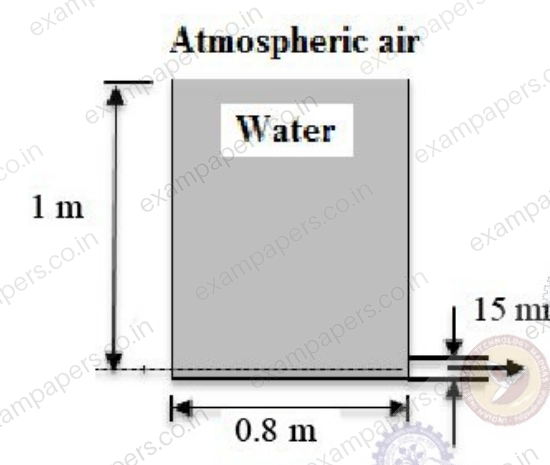
A cylindrical tank of 0.8 m diameter is completely filled with water and its top surface is open to atmosphere as shown in the figure. Water is being discharged to the atmosphere from a circular hole of 15 mm diameter located at the bottom of the tank. The value of acceleration due to gravity is 9.81 m/s². How much time (in seconds) would be required for water level to drop from a height of 1 m to 0.5 m?
Your answerChoose one option.
Log in to check the answer
You can attempt this question now. Sign in to view the answer key, explanations and discussion.Log in to check answerQuestion 25
Open questionXE-BNAT2 marksNeeds review
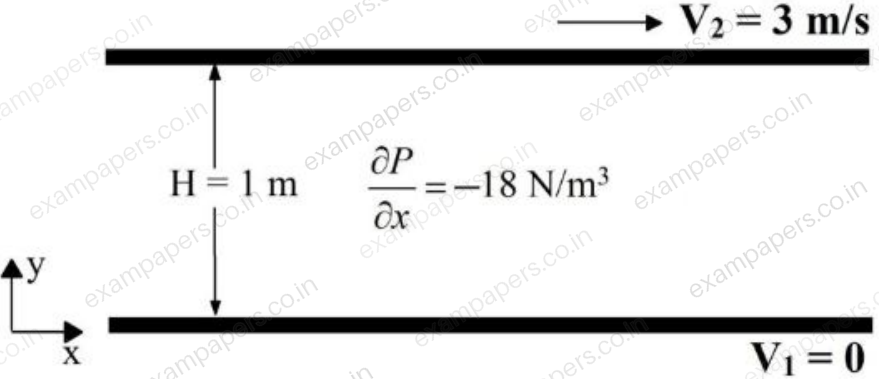
Consider steady laminar flow of an incompressible Newtonian fluid between two infinite parallel plates, separated by a distance of 1 m, as shown in the figure. The bottom plate is stationary but the top one is moving in positive
-direction with a velocity of 3 m/s. The fluid pressure gradient in the flow direction is:
. If the viscosity of the fluid is 1 kg m⁻¹ s⁻¹ then the distance of the point of maximum velocity (in meters, rounded off to the second decimal place) from the bottom plate would be __________
Log in to check the answer
You can attempt this question now. Sign in to view the answer key, explanations and discussion.Log in to check answerQuestion 26
Open questionXE-BNAT2 marksNeeds review
An inviscid incompressible fluid of density 1000 kg/m³ is flowing in a horizontal pipe of tapered cross-section with a flow rate of 4000 cm³/s. The area of cross-section at two different locations ‘A’ and ‘B’ are 10 cm² and 20 cm², respectively. The velocity of the fluid at the location ‘A’ is 4 m/s and pressure is 5 N/m². The pressure (N/m²) at the location ‘B’ would be __________
Log in to check the answer
You can attempt this question now. Sign in to view the answer key, explanations and discussion.Log in to check answerQuestion 27
Open questionXE-BNAT2 marksNeeds review
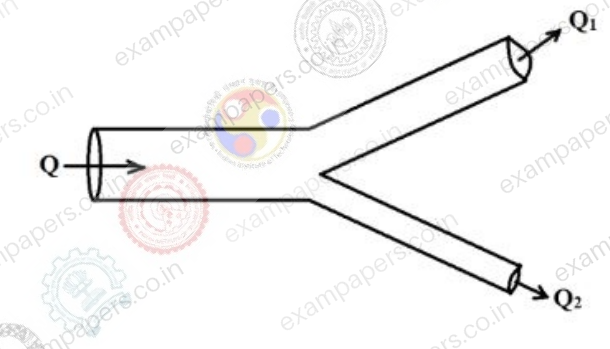
A viscous, incompressible and Newtonian fluid flowing through the main branch of a circular pipe bifurcates into two daughter branches whose radii are 4 cm and 2 cm, respectively. The flow in both the daughter branches are laminar and fully developed. If the pressure gradients in both the daughter branches are same, then the fraction of total volumetric flow rate (rounded off to the second decimal place) coming out from the branch with 4 cm diameter is __________
Log in to check the answer
You can attempt this question now. Sign in to view the answer key, explanations and discussion.Log in to check answerQuestion 28
Open questionXE-BMCQ2 marksNeeds review
The volumetric flow rate (
) of a triangular notch is a function of the upstream liquid surface elevation (
) measured from the bottom of the notch, acceleration due to gravity (
), notch angle (
) and the approach velocity (
). Which one of the following is the correct expression for
?Your answerChoose one option.
Log in to check the answer
You can attempt this question now. Sign in to view the answer key, explanations and discussion.Log in to check answerQuestion 29
Open questionXE-BNAT2 marksNeeds review
Model tests are to be carried out to study the flow through a large prototype valve of 0.6 m diameter at a flow rate of 10 m³/s. The same working fluid is used for both the model and the prototype. A complete geometric similarity is maintained between the model and the prototype. If the valve diameter of the model is 80 mm, its required flow rate (in m³/s, rounded off to the first decimal place) would be ________.
Log in to check the answer
You can attempt this question now. Sign in to view the answer key, explanations and discussion.Log in to check answerQuestion 30
Open questionXE-BNAT2 marksNeeds review
Water is flowing at a rate of 0.5 m³/s in a horizontal pipeline of inside diameter 0.5 m. The density and kinematic viscosity of water is 1000 kg/m³ and 10⁻⁶ m²/s, respectively. Assume Darcy-Weisbach friction factor value to be 0.0093 and acceleration due to gravity as 9.81 m/s². To maintain constant flow rate, the required power per unit length of the pipeline (in W/m, rounded off to the first decimal place) would be ________.
Log in to check the answer
You can attempt this question now. Sign in to view the answer key, explanations and discussion.Log in to check answerQuestion 31
Open questionXE-BNAT2 marksNeeds review
Air flows over a smooth flat plate at a velocity of 4.39 m/s. The density of air is 1.031 kg/m³ and the kinematic viscosity is 1.34×10⁻⁵ m²/s. The plate length is 12.2 m in the direction of the flow. The boundary layer thickness (
) is given as
, where
is the distance from the leading edge and
is the Reynolds number. The boundary layer thickness (in meters, rounded off to the second decimal place) at 12.2 m from the leading edge will be ________Log in to check the answer
You can attempt this question now. Sign in to view the answer key, explanations and discussion.Log in to check answerQuestion 32
Open questionXE-BNAT2 marksNeeds review
A venturimeter of diameter 0.2 m at the entrance and 0.1 m at the throat is inclined upwards. The vertical elevation difference between the entrance and the throat is 0.5 m. The density of water is 1000 kg/m³ and the coefficient of velocity is 0.97. The differential U-tube manometer connected to the entrance and throat shows a pressure difference of 30 kN/m². Assume acceleration due to gravity as 9.81 m/s². The velocity of the water (in m/s, rounded off to the first decimal place) at the throat would be ________
Log in to check the answer
You can attempt this question now. Sign in to view the answer key, explanations and discussion.Log in to check answerQuestion 33
Open questionXE-BMCQ2 marksNeeds review
A spherical bubble of radius
is rising upward with a constant velocity
, in quiescent water of dynamic viscosity
. The density of air and water are denoted by
and
, respectively, and
is acceleration due to gravity. The bubble motion is such that the Reynolds number,
. The density of air can be neglected in comparison to the water density (
). Which one of the following expressions is TRUE for the density of water?Your answerChoose one option.
Log in to check the answer
You can attempt this question now. Sign in to view the answer key, explanations and discussion.Log in to check answer