
Engineering Sciences
GATE XE exam:gate PYQs
Build your understanding with focused practice from past exam papers.
Questions 1671–1680 of 1772. Imported answers require independent review unless marked reviewed.
Question 74
Open questionXE-DNAT2 marksNeeds review
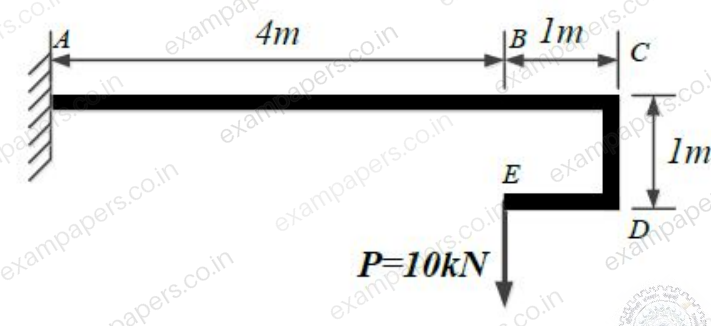
The structure shown below is of rectangular cross section and carries a load of 10kN at its free end E. Maximum bending stress (in MPa) developed in the beam due the external load is _________. The depth of the beam is 300mm and the width is 150mm.
Log in to check the answer
You can attempt this question now. Sign in to view the answer key, explanations and discussion.Log in to check answerQuestion 75
Open questionXE-DMCQ2 marksNeeds review
Two circular rods shown below carry the same axial load
. The Rod-A has uniform cross-section and the Rod-B has non-uniform cross-section as shown. The ratio of elongation of Rod-A to Rod-B is given by 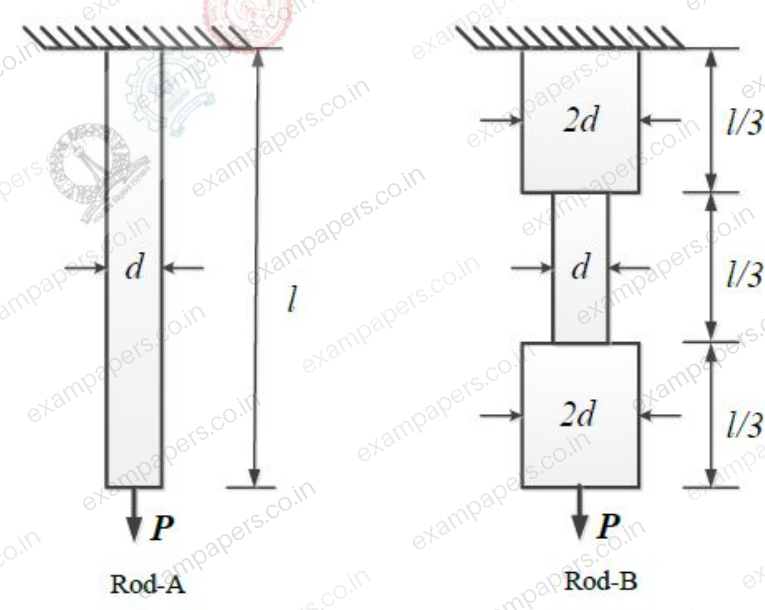
Your answerChoose one option.
Log in to check the answer
You can attempt this question now. Sign in to view the answer key, explanations and discussion.Log in to check answerQuestion 76
Open questionXE-DMCQ2 marksNeeds review
A composite shaft is made of a steel tube with an inner brass core perfectly bonded together as shown. The shaft is fixed at one end and subjected to a torque of
at the other end. Shear modulus of steel is
and that of brass is
. The outer radius of the steel tube is
and radius of the inner brass core is
. The magnitude of shear stress at the interface (point X) and in the steel tube is closest to 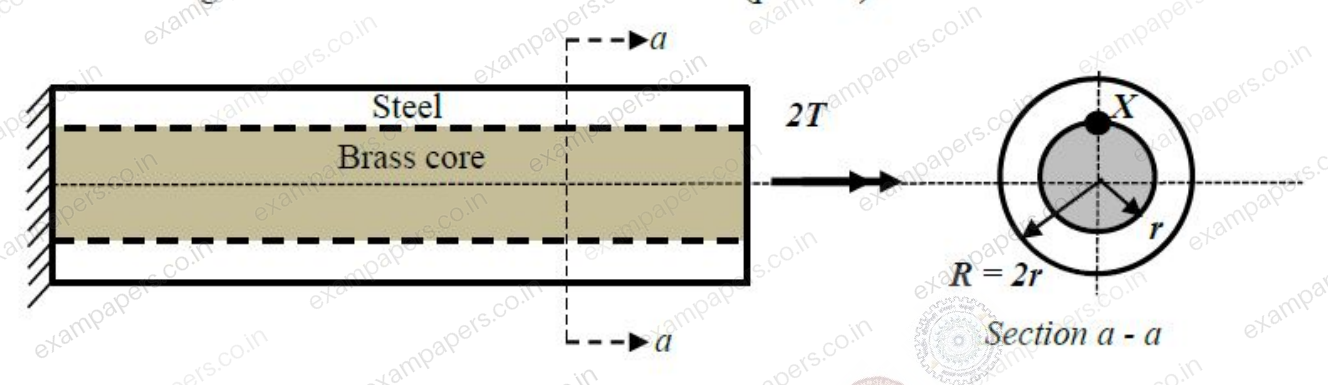
Your answerChoose one option.
Log in to check the answer
You can attempt this question now. Sign in to view the answer key, explanations and discussion.Log in to check answerQuestion 77
Open questionXE-DMCQ2 marksNeeds review
A massless rod of rectangular cross-section is subjected to a force
at origin
as shown. The expression for the stress
at point
is given by 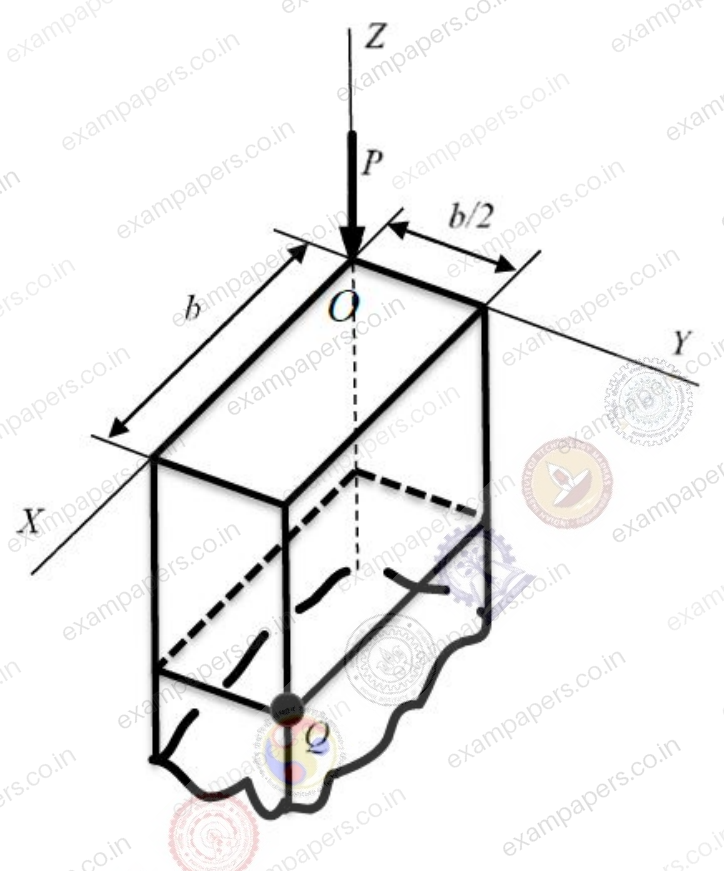
Your answerChoose one option.
Log in to check the answer
You can attempt this question now. Sign in to view the answer key, explanations and discussion.Log in to check answerQuestion 78
Open questionXE-EMCQ1 markNeeds review
Given
and
, thenYour answerChoose one option.
Log in to check the answer
You can attempt this question now. Sign in to view the answer key, explanations and discussion.Log in to check answerQuestion 79
Open questionXE-EMCQ1 markNeeds review
A paddle wheel is installed in a rigid insulated tank containing 10 kg air (
kJ/kg.K). A torque of 100 N.m is applied on the paddle wheel to rotate it at 60 revolutions per minute for 2 minutes. At the end of the process, the increase in temperature of air in °C isYour answerChoose one option.
Log in to check the answer
You can attempt this question now. Sign in to view the answer key, explanations and discussion.Log in to check answerQuestion 80
Open questionXE-EMCQ1 markNeeds review
Consider two systems each containing 20 kg of air at the same temperature and pressure. It is desired to increase the temperature of the air in both systems by 10°C. One system undergoes a constant pressure heat addition process and the other undergoes a constant volume heat addition. The difference in the values of heat transferred to the two systems in kJ is
Your answerChoose one option.
Log in to check the answer
You can attempt this question now. Sign in to view the answer key, explanations and discussion.Log in to check answerQuestion 81
Open questionXE-ENAT1 markNeeds review
A refrigerator is used to maintain certain space at 10°C. It pumps 18000 kJ/hour of heat from the space to the atmosphere at 30°C. If the power input to the refrigerator is 2 kW, the ratio of COP of this refrigerator to that of a Carnot refrigerator (up to 2 decimal places) is ________.
Log in to check the answer
You can attempt this question now. Sign in to view the answer key, explanations and discussion.Log in to check answerQuestion 82
Open questionXE-EMCQ1 markNeeds review
A thermal cycle receives 200 kJ of heat from a heat source at 1000 K. It rejects 300 kJ of heat to a heat sink at 300 K and also rejects 250 kJ of heat to another heat sink at 200 K during the cycle. The cycle is
Your answerChoose one option.
Log in to check the answer
You can attempt this question now. Sign in to view the answer key, explanations and discussion.Log in to check answerQuestion 83
Open questionXE-EMCQ1 markNeeds review
Saturated liquid water is slowly heated at a constant pressure of 200 kPa to a final state where its quality reaches 0.65. For water at 200 kPa:
°C,
kJ/kg,
kJ/kg. The change in the specific entropy in kJ/kg.K isYour answerChoose one option.
Log in to check the answer
You can attempt this question now. Sign in to view the answer key, explanations and discussion.Log in to check answer