
Engineering Sciences
GATE XE exam:gate PYQs
Build your understanding with focused practice from past exam papers.
Questions 751–760 of 1772. Imported answers require independent review unless marked reviewed.
Question 29
Open questionXE-BMSQ1 markNeeds review
A boundary layer develops due to a two-dimensional steady flow over a horizontal flat plate. Consider a vertical line away from the leading edge which extends from the wall to the edge of the boundary layer. Which of the following quantity/quantities is/are not constant along the vertical line?
and
represent the components of velocity in the direction along the plate and normal to it, respectively and
is taken along the length of the plate while
is the pressure. Neglect body forces.Your answerSelect all correct options. You can choose more than one.
Log in to check the answer
You can attempt this question now. Sign in to view the answer key, explanations and discussion.Log in to check answerQuestion 30
Open questionXE-BNAT1 markNeeds review
A 10 kg mass placed on an infinitely long horizontal massless flat platform is to be supported by a steady vertical water jet as shown in the figure. The diameter of the jet is 5 cm. What minimum average velocity is required to hold the mass in place? Assume
,
and
. Neglect friction. (Round off to two decimal places) 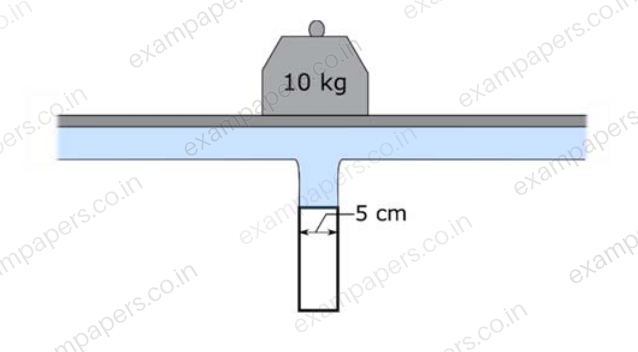
Log in to check the answer
You can attempt this question now. Sign in to view the answer key, explanations and discussion.Log in to check answerQuestion 31
Open questionXE-BMCQ2 marksNeeds review
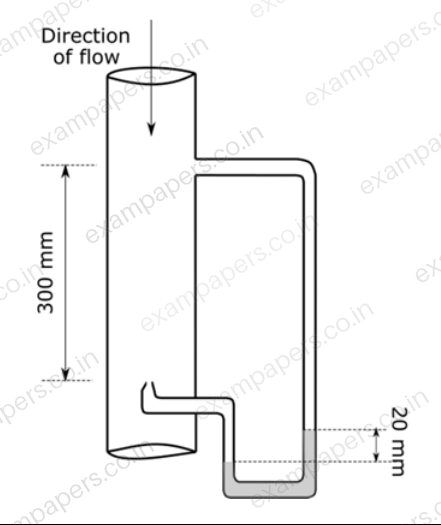
Consider an inviscid flow through a smooth pipe which has a pitot-static tube arrangement as shown. Find the centre-line velocity in the pipe. Consider that the density of the fluid is 1000 kg/m³, acceleration due to gravity is 10 m/s², and the specific gravity of the manometric fluid is 11.
Your answerChoose one option.
Log in to check the answer
You can attempt this question now. Sign in to view the answer key, explanations and discussion.Log in to check answerQuestion 32
Open questionXE-BMCQ2 marksNeeds review
The speed of propagation,
, of a capillary wave depends on the density of the fluid,
, the wavelength of the wave,
, and the surface tension,
. If the density and wavelength remain constant, halving the surface tension would lead to a new velocity,
, given byYour answerChoose one option.
Log in to check the answer
You can attempt this question now. Sign in to view the answer key, explanations and discussion.Log in to check answerQuestion 33
Open questionXE-BMCQ2 marksNeeds review
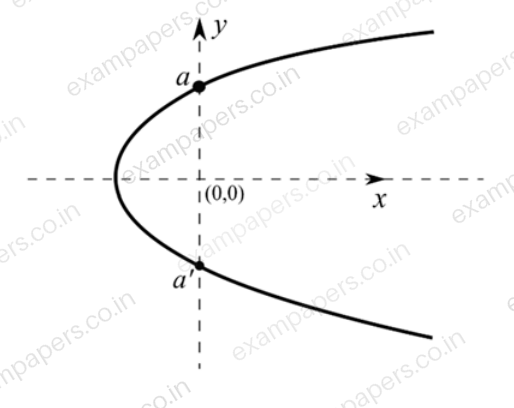
A two-dimensional flow field is described by a combination of a source of strength
at the origin and a uniform flow,
, in the positive
-direction such that the velocity potential is given by
The stagnation streamline is shown in the figure. Find the distance
. 
Your answerChoose one option.
Log in to check the answer
You can attempt this question now. Sign in to view the answer key, explanations and discussion.Log in to check answerQuestion 34
Open questionXE-BMCQ2 marksNeeds review
A typical boundary layer over a flat plate has a linear velocity profile with zero velocity at the wall and freestream velocity,
, at the outer edge of the boundary layer. What is the ratio of the momentum thickness to the thickness of the boundary layer?Your answerChoose one option.
Log in to check the answer
You can attempt this question now. Sign in to view the answer key, explanations and discussion.Log in to check answerQuestion 35
Open questionXE-BMSQ2 marksNeeds review
Identify the configuration(s) in which steady two-dimensional internal flow may show boundary layer separation if the flow direction is left to right.
Your answerSelect all correct options. You can choose more than one.
Log in to check the answer
You can attempt this question now. Sign in to view the answer key, explanations and discussion.Log in to check answerQuestion 36
Open questionXE-BNAT2 marksNeeds review
Consider steady fully developed flow of a liquid through two large horizontal flat parallel plates separated by a distance of 2 mm. One of the plate is fixed and the other plate moves at a speed of 0.5 m/s. What is the magnitude of the pressure gradient (in Pa/m) in the direction of the flow required to ensure that the net flow through the plates is zero?
Dynamic viscosity of the liquid is
Ns/m
(Round off to the nearest integer)Log in to check the answer
You can attempt this question now. Sign in to view the answer key, explanations and discussion.Log in to check answerQuestion 37
Open questionXE-BNAT2 marksNeeds review
Consider two-dimensional turbulent flow of air over a horizontal flat plate of length 1 m. Skin friction coefficient at a length
from the leading edge of the plate is obtained as:
where,
is the local Reynolds number.
Find out the drag force per unit width (in N/m
) on the plate if the free stream air velocity is 10 m/s.
Density and dynamic viscosity of air are given as 1.2 kg/m
and
N-s/m
, respectively.
(Round off to three decimal places)Log in to check the answer
You can attempt this question now. Sign in to view the answer key, explanations and discussion.Log in to check answerQuestion 38
Open questionXE-BNAT2 marksNeeds review
For an inviscid fluid with density 1 kg/m
, the Cartesian velocity field is given as:
Neglecting the body forces, find the magnitude of pressure gradient (in Pa/m) at
at
.
(Round off to two decimal places)Log in to check the answer
You can attempt this question now. Sign in to view the answer key, explanations and discussion.Log in to check answer