
Engineering Sciences
GATE XE First Law of Thermodynamics PYQs
Build your understanding with focused practice from past exam papers.
How to practice First Law of Thermodynamics
Attempt a question, record the concept and assumptions, then check the available answer. Rework mistakes after revising the relevant concepts. Topic tags can overlap; review the question context.
Questions 1–10 of 38. Imported answers require independent review unless marked reviewed.
Question 90
Open questionXE-EMCQ1 markNeeds review
In a mixing chamber hot water enters at a temperature of 80 °C with a flow rate of 0.5 kg/s. From another entry, cold water enters the chamber at 20 °C. The desired temperature after mixing at the exit of the chamber is 40 °C. There is no water leakage and the mixing happens at adiabatic conditions. Assume the specific heat capacity of water is 4.2 kJ/kg-K. For a steady state operation, the mass flow rate (in kg/s) of the cold-water stream is
Your answerChoose one option.
Log in to check the answer
You can attempt this question now. Sign in to view the answer key, explanations and discussion.Log in to check answerQuestion 101
Open questionXE-ENAT2 marksNeeds review
An adiabatic rigid and impermeable tank of volume
contains air at 800 kPa and 70 °C. The air is allowed to leave the tank until the pressure is one-fourth of its original value. During the process, the air in the tank is maintained at 70 °C using an electrical heater. Assume that the air behaves as an ideal gas having gas constant and ratio of specific heat capacities as 287 J/kg-K and 1.4, respectively. The total electrical energy (in MJ) supplied by the heater is ____________ (rounded off to two decimal places).Log in to check the answer
You can attempt this question now. Sign in to view the answer key, explanations and discussion.Log in to check answerQuestion 102
Open questionXE-ENAT2 marksNeeds review
Two kg of a gas is compressed in a process. Pressure (P) and mass specific volume (v) of the gas during the process follows:
. The temperature of the gas before and after compression is 300 K and 600 K, respectively. Assume that the gas behaves as an ideal gas with gas constant and ratio of specific heat capacities equal to 287 J/kg-K and 1.4, respectively. The heat rejected (in kJ) during the process is ____________ (rounded off to two decimal places).Log in to check the answer
You can attempt this question now. Sign in to view the answer key, explanations and discussion.Log in to check answerQuestion 89
Open questionXE-EMCQ1 markNeeds review
A cylinder of volume 0.1 m³ is filled with nitrogen at 10 MPa and 300 K. Consider nitrogen to be an ideal gas. The cylinder develops a leak and nitrogen escapes to atmosphere which is at 0.1 MPa. After some time, the pressure in the cylinder reduces to 5 MPa. Assuming the cylinder and the leaked gas temperature remains constant at 300 K, the work done (in MJ) by nitrogen gas is
Your answerChoose one option.
Log in to check the answer
You can attempt this question now. Sign in to view the answer key, explanations and discussion.Log in to check answerQuestion 90
Open questionXE-EMCQ1 markNeeds review
A closed system undergoes a process 1–2 in which it absorbs 150 kJ of energy as heat and does 90 kJ of work. Then it follows another process 2–3 in which 80 kJ of work is done on it while it rejects 60 kJ as heat. If it is desired to restore the system to the initial state (state 1) by an adiabatic path, the work interaction (in kJ) in this process will be
Your answerChoose one option.
Log in to check the answer
You can attempt this question now. Sign in to view the answer key, explanations and discussion.Log in to check answerQuestion 103
Open questionXE-ENAT2 marksNeeds review
A stream of superheated steam (2 MPa, 300 °C) mixes with another stream of superheated steam (2 MPa, 400 °C) through a steady-state adiabatic process. The flow rates of the streams are 3 kg/min and 2 kg/min, respectively. This mixture then expands in an adiabatic nozzle to a saturated mixture with a quality of 0.77 and 1 kPa. Neglect the velocity at the nozzle entrance and the change in potential energies. The velocity at the nozzle exit (in m/s) is __________ (rounded off to two decimal places).
Use the following data:
At 2 MPa, 300 °C: Specific enthalpy of superheated steam = 3024.2 kJ/kg
At 2 MPa, 400 °C: Specific enthalpy of superheated steam = 3248.4 kJ/kg
At 1 kPa: Specific enthalpy of saturated water = 29.3 kJ/kg
At 1 kPa: Specific enthalpy of saturated vapour = 2513.7 kJ/kg
Log in to check the answer
You can attempt this question now. Sign in to view the answer key, explanations and discussion.Log in to check answerQuestion 104
Open questionXE-ENAT2 marksNeeds review
A piston-cylinder assembly having 250 mm diameter contains 0.01 kg of water vapor at 1 MPa and 200 °C. The specific volume of the vapor is 0.20602 m
/kg. The system expands as per the relation
= constant, where p is pressure and V is volume. If the final pressure is 0.35 MPa, the value of the exponent (n) is __________ (rounded off to two decimal places).Log in to check the answer
You can attempt this question now. Sign in to view the answer key, explanations and discussion.Log in to check answerQuestion 106
Open questionXE-ENAT2 marksNeeds review
A steam boiler contains saturated water vapour at 200 °C. After a certain period, the temperature of the boiler drops to 110 °C. Assume that all the valves of the boiler are closed and the energy is lost as heat to the surroundings. The ratio of mass of liquid to the mass of vapour is ____________ (rounded off to two decimal places).
Saturated volume of vapor phase at 200 °C = 0.127 m
/kgSaturated volume of vapor phase at 110 °C = 1.210 m
/kgSaturated volume of liquid phase at 110 °C = 0.001 m
/kgLog in to check the answer
You can attempt this question now. Sign in to view the answer key, explanations and discussion.Log in to check answerQuestion 90
Open questionXE-EMCQ1 markNeeds review
The temperature of 10 g of liquid water (
J/g.K) in an insulated container is raised by 5 K by stirring. The amount of heat transferred to the water (in J) isYour answerChoose one option.
Log in to check the answer
You can attempt this question now. Sign in to view the answer key, explanations and discussion.Log in to check answerQuestion 91
Open questionXE-EMCQ1 markNeeds review
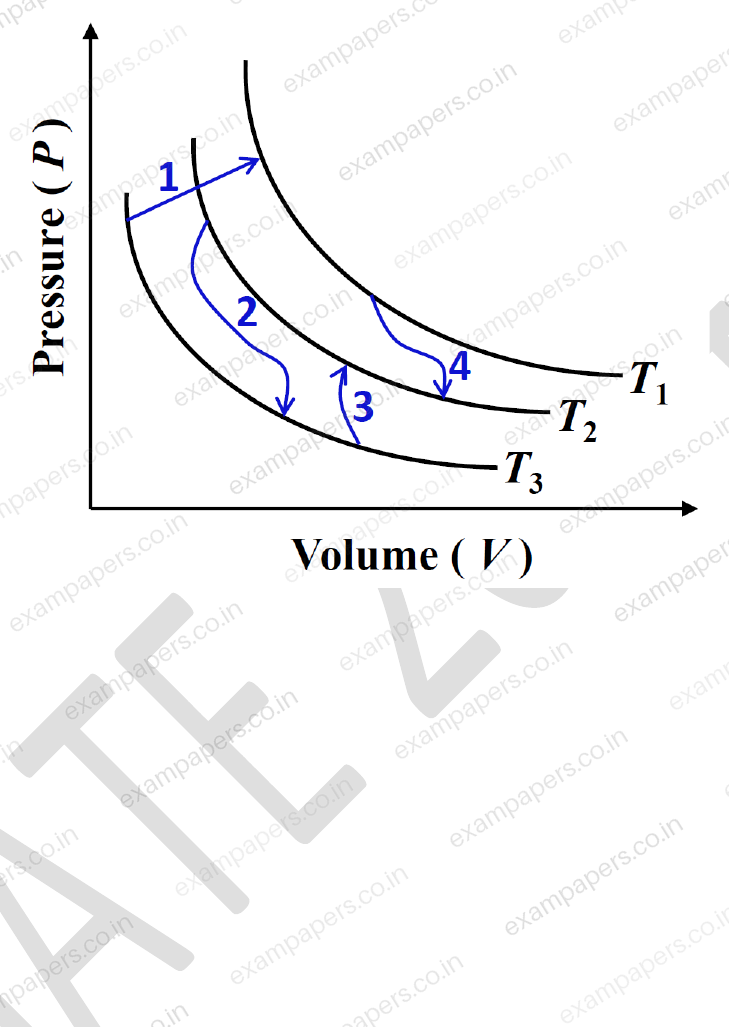
The figure shows four different processes labeled 1, 2, 3, and 4 for the same closed system containing an ideal gas. The curves labeled
,
, and
are isotherms. For which one of the four processes, the magnitude of internal energy change is the highest?
Your answerChoose one option.
Log in to check the answer
You can attempt this question now. Sign in to view the answer key, explanations and discussion.Log in to check answer