
Engineering Sciences
GATE XE Flow and Fluid Properties PYQs
Build your understanding with focused practice from past exam papers.
Questions 21–29 of 29. Imported answers require independent review unless marked reviewed.
Question 2
Open questionXE-BMCQ1 markNeeds review
The variation of shear stress (
) against strain rate (
) is given in the Figure. Identify the line/curve among P, Q, R and S, that represents an ideal fluid. 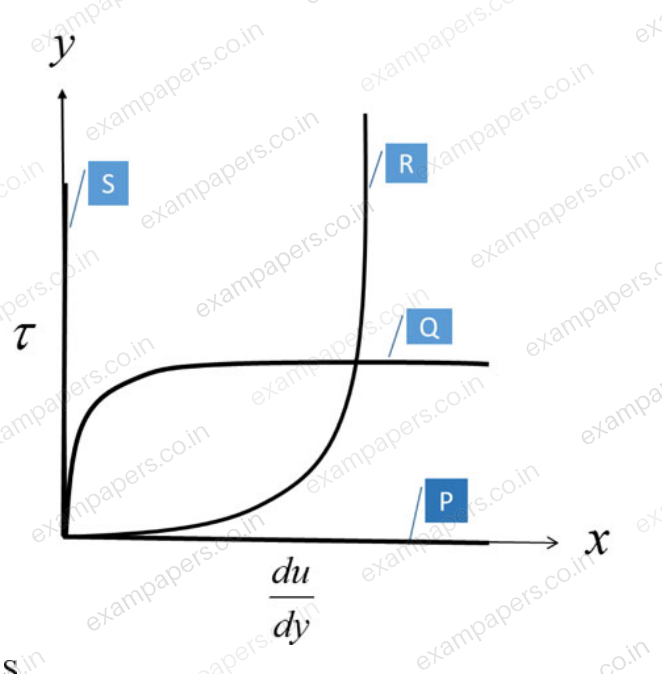
Your answerChoose one option.
Log in to check the answer
You can attempt this question now. Sign in to view the answer key, explanations and discussion.Log in to check answerQuestion 3
Open questionXE-BMCQ1 markNeeds review
A body is under stable equilibrium in a homogeneous fluid, where CG and CB are center of gravity and center of buoyancy, respectively.
Two statements ‘P’ and ‘Q’ are given below:
P: For a fully submerged condition, CG should always be below CB
Q: For a floating body, CG need not be below CB
Choose the option that is valid for the present situation.
Your answerChoose one option.
Log in to check the answer
You can attempt this question now. Sign in to view the answer key, explanations and discussion.Log in to check answerQuestion 21
Open questionXE-BNAT2 marksNeeds review
In an inverted manometer (as shown in the Figure), the pressure difference,
is 100 kPa.Use specific gravity of oil as 0.8, density of water as 1000 kg/m
, density of mercury as 13600 kg/m
and acceleration due to gravity as 10 m/s
.The height of the water column,
is ______ cm. (rounded off to one decimal place).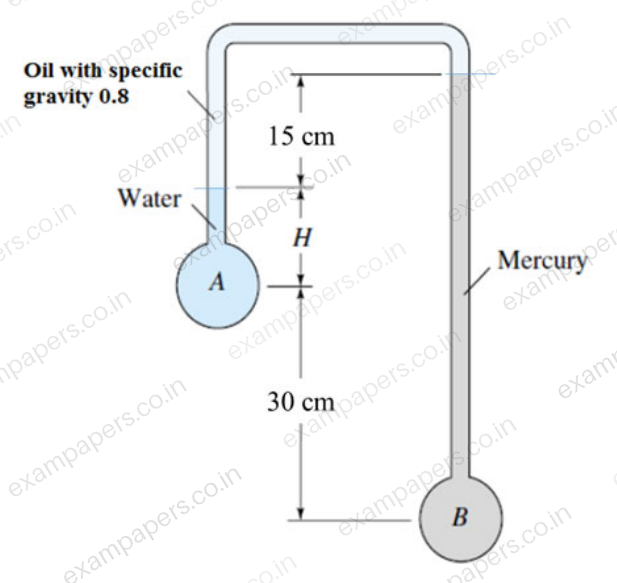
Log in to check the answer
You can attempt this question now. Sign in to view the answer key, explanations and discussion.Log in to check answerQuestion 1
Open questionXE-BMCQ1 markNeeds review
For stable equilibrium of a floating body, which one of the following statements is correct?
Your answerChoose one option.
Log in to check the answer
You can attempt this question now. Sign in to view the answer key, explanations and discussion.Log in to check answerQuestion 17
Open questionXE-BNAT2 marksNeeds review
The mercury manometer shown in the figure below is connected to a water pipe at one end while the other end is open to the atmosphere. The density of water is
, the specific gravity of mercury is 13.6 and the gravitational acceleration
is
. The gage pressure
(in
, rounded off to 2 decimal places) in the water pipe is ______. 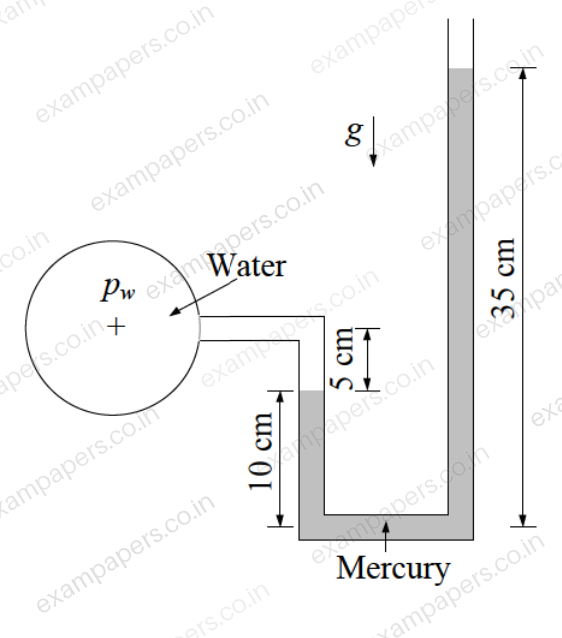
Log in to check the answer
You can attempt this question now. Sign in to view the answer key, explanations and discussion.Log in to check answerQuestion 1
Open questionXE-BMCQ1 markNeeds review
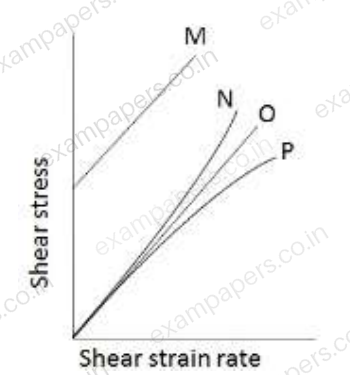
Rheological diagram of different types of fluids is shown in figure. Column I represents the nature of the fluid and column II represents the curve showing the variation of shear stress against shear strain rate.
Column I
(i) Newtonian
(ii) Shear thinning
(iii) Shear thickening
(iv) Bingham plastic
Column II
M
N
O
P
The most appropriate match between columns I and II is,
Your answerChoose one option.
Log in to check the answer
You can attempt this question now. Sign in to view the answer key, explanations and discussion.Log in to check answerQuestion 10
Open questionXE-BMCQ2 marksNeeds review
A parallelepiped of (2 m × 2 m) square cross-section and 10 m in length, is partially floating in water upto a depth of 1.2 m, with its longest side being horizontal. The specific gravity of the block is
Your answerChoose one option.
Log in to check the answer
You can attempt this question now. Sign in to view the answer key, explanations and discussion.Log in to check answerQuestion 19
Open questionXE-BNAT1 markNeeds review
In a 5 m deep vertical cylindrical tank, water is filled up to a level of 3 m from the bottom and the remaining space is filled with oil of specific gravity 0.88. Assume density of water as 1000 kg/m
and acceleration due to gravity to be 10 m/s
. The gauge pressure (in kN/m
, rounded off to the first decimal place) at a depth of 2.5 m from the top of the tank will be ________.Log in to check the answer
You can attempt this question now. Sign in to view the answer key, explanations and discussion.Log in to check answerQuestion 22
Open questionXE-BNAT2 marksNeeds review
A spherical balloon of diameter 15 m is supposed to lift a load of 3000 N. The lifting of load is achieved by heating the air inside the balloon. Assume, air to be an ideal gas and atmospheric pressure either outside or inside the balloon. The value of acceleration due to gravity is 9.81 m/s² and the values of temperature and density of atmospheric air are 15°C and 1.2 kg/m³, respectively. In order to lift the specified load, the air inside the balloon should be heated to a temperature (°C) of __________
Log in to check the answer
You can attempt this question now. Sign in to view the answer key, explanations and discussion.Log in to check answer