
Engineering Sciences
GATE XE format:mcq PYQs
Build your understanding with focused practice from past exam papers.
Questions 141–150 of 959. Imported answers require independent review unless marked reviewed.
Question 75
Open questionXE-DMCQ2 marksNeeds review
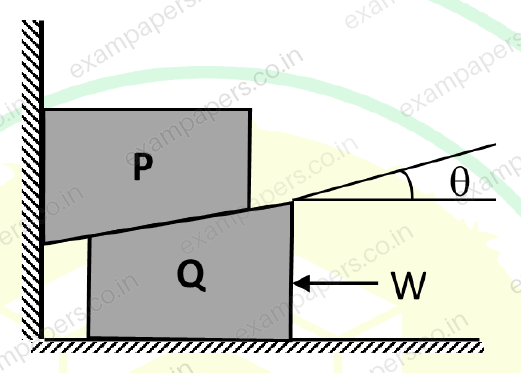
Consider two blocks, P of mass 100 kg and Q of mass 150 kg, resting as shown in the figure. The angle
. The coefficient of friction between the two blocks is 0.2. Assume no friction exists at all other interfaces. The minimum force required to move the block P upward is W.Which one of the following options is closest to the CORRECT magnitude of W (in N)?
Your answerChoose one option.
Log in to check the answer
You can attempt this question now. Sign in to view the answer key, explanations and discussion.Log in to check answerQuestion 76
Open questionXE-DMCQ2 marksNeeds review
Which one of the following vertical columns, of circular cross-section, sustains the highest load without buckling?
Your answerChoose one option.
Log in to check the answer
You can attempt this question now. Sign in to view the answer key, explanations and discussion.Log in to check answerQuestion 77
Open questionXE-DMCQ2 marksNeeds review
The figure shows a rod PQ, hinged at P, rotating counter-clockwise with a uniform angular speed of 15 rad/s. A block R translates along a slot cut in rod PQ. At the instant shown the distance PR = 0.5 m and
. The relative velocity of R with respect to the rod PQ is 5 m/s at the instant shown. The relative acceleration of R with respect to the rod PQ is zero at the instant shown.Which one of the following is the CORRECT magnitude of the absolute acceleration (in m/s
) of block R? 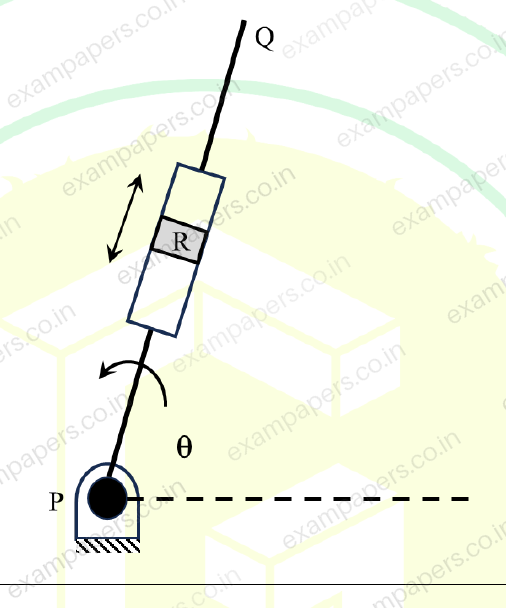
Your answerChoose one option.
Log in to check the answer
You can attempt this question now. Sign in to view the answer key, explanations and discussion.Log in to check answerQuestion 78
Open questionXE-DMCQ2 marksNeeds review
The frame shown in the figure is loaded at S with a force of 2000 N. The reactions at T are denoted by T
and T
, while the reaction at W is W
. Neglect the weight of the members.Which one of the following options for the magnitudes of the forces (in N), T
, T
and W
, is CORRECT? 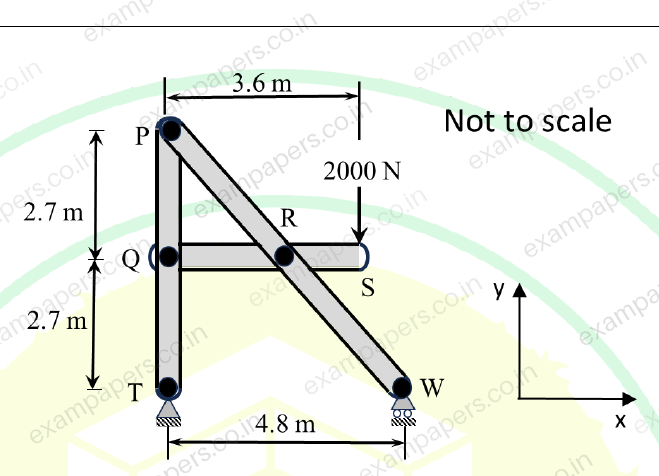
Your answerChoose one option.
Log in to check the answer
You can attempt this question now. Sign in to view the answer key, explanations and discussion.Log in to check answerQuestion 79
Open questionXE-DMCQ2 marksNeeds review
A closed thin cylindrical tank with a mean diameter d = 300 mm and thickness t = 2 mm, is subjected to a uniform internal gas pressure p. The allowable shear stress on the curved wall of the tank is 70 MPa.
Based on the Tresca criteria, which one of the following options for the maximum safe value of p (in MPa) is CORRECT?
Your answerChoose one option.
Log in to check the answer
You can attempt this question now. Sign in to view the answer key, explanations and discussion.Log in to check answerQuestion 88
Open questionXE-EMCQ1 markNeeds review
A tank is divided into two compartments with one compartment containing a gas at a given pressure, while the second is completely evacuated. If the partition is removed, the gas occupies the entire compartment. Which one of the following statements is CORRECT?
Your answerChoose one option.
Log in to check the answer
You can attempt this question now. Sign in to view the answer key, explanations and discussion.Log in to check answerQuestion 89
Open questionXE-EMCQ1 markNeeds review
A cylinder of volume 0.1 m³ is filled with nitrogen at 10 MPa and 300 K. Consider nitrogen to be an ideal gas. The cylinder develops a leak and nitrogen escapes to atmosphere which is at 0.1 MPa. After some time, the pressure in the cylinder reduces to 5 MPa. Assuming the cylinder and the leaked gas temperature remains constant at 300 K, the work done (in MJ) by nitrogen gas is
Your answerChoose one option.
Log in to check the answer
You can attempt this question now. Sign in to view the answer key, explanations and discussion.Log in to check answerQuestion 90
Open questionXE-EMCQ1 markNeeds review
A closed system undergoes a process 1–2 in which it absorbs 150 kJ of energy as heat and does 90 kJ of work. Then it follows another process 2–3 in which 80 kJ of work is done on it while it rejects 60 kJ as heat. If it is desired to restore the system to the initial state (state 1) by an adiabatic path, the work interaction (in kJ) in this process will be
Your answerChoose one option.
Log in to check the answer
You can attempt this question now. Sign in to view the answer key, explanations and discussion.Log in to check answerQuestion 91
Open questionXE-EMCQ1 markNeeds review
The inlet and outlet temperatures of the flowing fluid during a steady state flow process are the same as that of the surroundings. If the changes in kinetic and potential energies are neglected, the maximum power that can be obtained is equal to
Your answerChoose one option.
Log in to check the answer
You can attempt this question now. Sign in to view the answer key, explanations and discussion.Log in to check answerQuestion 92
Open questionXE-EMCQ1 markNeeds review
If
refers to the ratio of specific heats, the air-standard efficiency of an Otto cycle isYour answerChoose one option.
Log in to check the answer
You can attempt this question now. Sign in to view the answer key, explanations and discussion.Log in to check answer